
Introduction
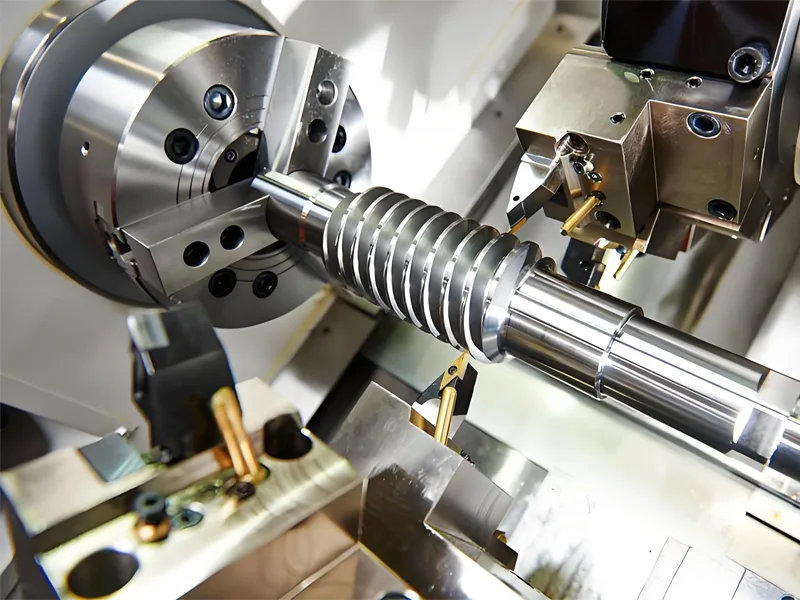
Mill-turn (turning–milling) consolidates multiple machining steps into one coordinated process. Instead of rough turning on a lathe, moving the part to a mill for cross holes or flats, then coming back for second-op work, a mill-turn machine combines these operations in one setup.
If you’re sourcing CNC turn mill services, the practical question is whether you can remove a whole setup (or two) without creating new quality risks.
For OEM engineers and supplier quality engineers (SQE), the big value isn’t novelty. It’s control. Fewer setups usually mean fewer opportunities to lose datum alignment, fewer queues between processes, and fewer places for yield to fall apart.
If you’re quoting a part that needs a live tooling y-axis sub-spindle lathe configuration, specify that early. Otherwise, suppliers may quote different routing assumptions, and the numbers won’t be comparable.
So, when should you choose CNC turning and milling services in a mill-turn configuration instead of splitting work across separate machines? Typically, when (1) you have turned geometry plus milled features that must stay in a tight relationship, (2) your delivery schedule can’t tolerate two or three separate setups, or (3) you’re trying to reduce the total cost of ownership by cutting handling, WIP, and inspection complexity.
What you’ll learn in this guide: how mill-turn machines are configured, what they’re good at (and not), which specs matter most in an RFQ, and how to evaluate a supplier using capability and quality signals that stand up to an audit.
Table of Contents
Mill-turn Basics (Mill-turn Machining Services)
Machine Configurations
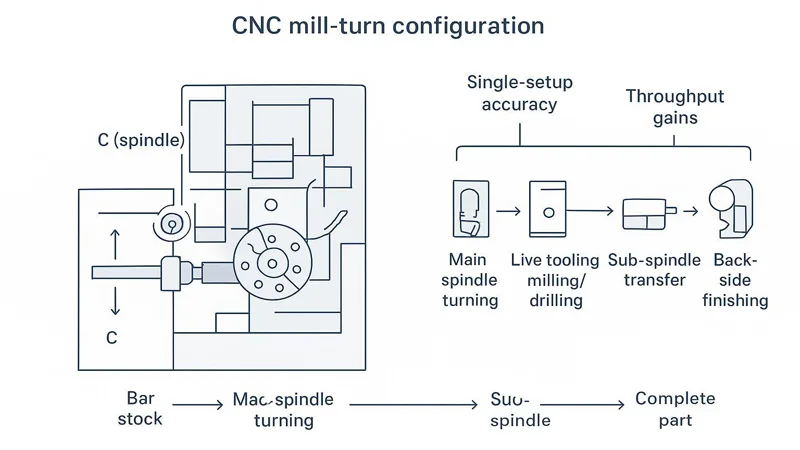
A mill-turn platform is still a turning center at its core: the main spindle rotates the part, and the machine controls tool motion along X and Z axes. What changes is the set of “add-ons” that let you do real milling and complete a part without moving it to a different machine.
Common configurations you’ll see quoted as “turn-mill” or “mill-turn” include:
- C-axis + live tooling: the spindle can index/position (C-axis), and the turret can drive rotating tools for drilling, milling, and tapping.
- Y-axis: allows off-center machining, so you can mill features that aren’t on the centerline without awkward workarounds.
- Sub-spindle (second spindle): enables part transfer for back-side machining without a second setup.
- B-axis (swivel head) (on higher-end machines): allows angled milling and more complex multi-face work, at the cost of programming complexity and higher machine rates.
The combination of live tooling, Y-axis, and a sub-spindle is what usually enables “one-and-done” work on shaft-style components.
Here’s a simple way to think about it: C-axis and live tooling cover a lot of “lathe + simple mill features.” The Y-axis and sub-spindle are what turn it into a true one-and-done cell for many shaft and rotational parts.
One-setup Benefits
If you only take one point from this section, make it this: every time you unchuck a part, you’re creating a new opportunity for stack-up error.
Mill-turn reduces that risk by keeping turning and milling features in the same coordinate system for most of the process. That shows up in practical ways:
- Better relationship control between turned diameters and milled flats/holes because datums don’t get “reinterpreted” on a second machine.
- Shorter lead time because you remove transport and queue time between operations.
- Less inspection rework because you can plan measurement around a single datum scheme instead of explaining two or three.
Key Takeaway: If your drawing relies on tight GD&T relationships between turned and milled features, single-setup machining is often the simplest path to repeatability.
Process Limitations
Mill-turn is not a magic bullet. It has trade-offs you should account for in both DFM (design for manufacturability) and supplier evaluation.
Typical limitations include:
- Part rigidity: long, slender shafts can deflect and chatter. You may need a tailstock/steady rest strategy, revised cutting parameters, or different sequencing.
- Milling rigidity vs. a VMC: deep pockets, wide face milling, or heavy material removal may be better on a dedicated machining center.
- Thermal stability on long cycles: long, heat-generating cycles can drift if the environment and process aren’t controlled.
- Programming and prove-out: complex synchronization (especially with a sub-spindle) can increase CAM effort and prove-out time.
Capabilities and Materials (CNC Turning and Milling Compound Machining Services)
Typical Parts and Features
Mill-turn makes the most sense for parts that are fundamentally rotational but need “non-lathe” features.
Typical examples include:
- Motor shafts, couplers, and stepped shafts with flats, keyways, cross holes, or threaded ports
- Valve components and housings that need turned sealing diameters, plus milled wrench flats or mounting faces
- Sensor bodies and connectors with precise bores plus milled pockets or slots
- Hydraulic and pneumatic components with turned OD/ID features plus drilled passages
Feature-wise, you’re usually combining:
- Turning: OD/ID, faces, grooves, tapers, undercuts
- Milling: flats, slots, pockets, cross drilling, radial holes, polygon features
- Threading: internal/external threads, thread milling where required
Supported Materials
Most mill-turn suppliers will support a broad range of metals. For OEM quoting and process planning, the useful question is not “can you machine it?” but “do you machine it often enough to quote it confidently and hold CTQs consistently?”
Commonly machined metals in CNC work include aluminum alloys, steels, stainless steels, brass/copper, and titanium, as summarized in overviews like Fictiv’s CNC materials series and ARRK’s manufacturing materials guidance (see Fictiv’s CNC materials overview and ARRK’s guide to common CNC machining materials).
In practical OEM programs, the “most common” materials you’ll see for turning, milling, and combined machining tend to cluster around:
- Aluminum: 6061-T6 for general-purpose; 7075 for higher strength-to-weight parts
- Stainless steel: 303/304 for general corrosion resistance; 316 for harsher environments; 17-4 PH for high strength with heat treat options
- Carbon/alloy steels: 1018 and 1045 for many industrial shafts and brackets; 4140 for higher strength applications
- Free-machining steel (where permitted): 12L14 for high throughput and good finish (check compliance requirements)
- Brass/copper: C360 brass for fittings and electrical components; copper when conductivity is the driver
- Titanium: Grade 5 (Ti-6Al-4V), where strength, corrosion resistance, and weight matter
Pro Tip: If you’re sourcing globally, specify the material standard (ASTM/AMS/EN/DIN) and include allowed substitutions. Many quote delays come from ambiguous material naming.
Tolerances and Finishes
Tolerances and surface finish are where “CNC turning and milling services” stop being generic and start being program-critical.
A widely cited benchmark is that standard CNC machining tolerance is ±0.005 in (0.13 mm) when nothing tighter is specified, with tighter tolerances available when you define the critical features and accept the added process control and cost. Protolabs states this benchmark explicitly in its design guidance (see Protolabs’ “Fine-tuning tolerances for CNC machined parts”).
For RFQ purposes, it’s useful to communicate tolerances in bands (and link them to function):
- Baseline (many non-CTQ features): around ±0.005 in / ±0.13 mm
- Common tightened quotes on specific features: around ±0.002 in / ±0.05 mm when the measurement plan and datum scheme are clear
- Tighter than that: often requires deeper process planning (tooling strategy, in-process probing where applicable, stabilized setups, and metrology that matches the callouts)
Surface finish is usually specified as Ra (roughness average). If you’re selecting a finish level, it helps to align the number to function (seal surface, bearing fit, cosmetic) rather than treating “smoother” as always better. For a practical overview of machining surface roughness ranges and what they mean, Xometry Pro’s surface roughness explainer is a decent reference point.
RFQ Specifications
Drawings and GD&T
If you want a predictable quote and predictable parts, treat your RFQ package like an engineering handoff, not a purchasing form.
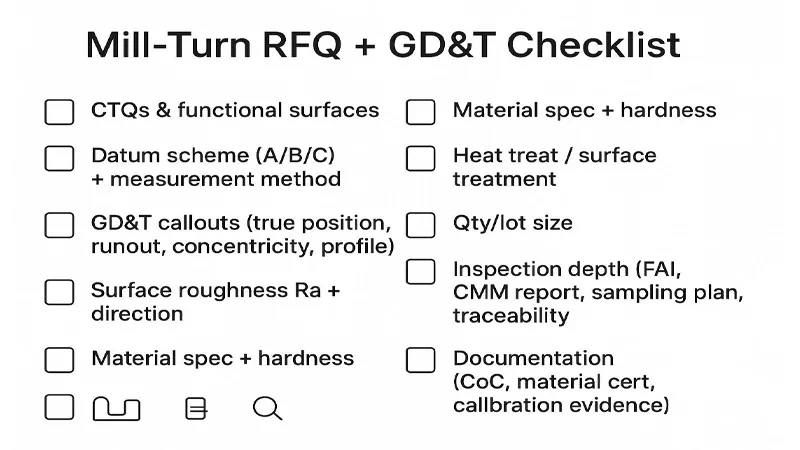
At a minimum, include:
- A controlled drawing (PDF) with revision level
- A 3D model (STEP preferred) when the geometry is complex
- Clear CTQs (critical-to-quality features) called out or noted
- A datum scheme that matches how you want the part measured
GD&T (geometric dimensioning and tolerancing) is where many mill-turn jobs win or fail. The same nominal dimensions can be easy or painful depending on how datums are defined and how relationship tolerances are applied across turned and milled surfaces.
For high-mix suppliers, your RFQ is also your “inspection contract.” If you want CMM reporting on true position and runout, say it up front.
Material and Treatments
Specify material in a way that can’t be misinterpreted:
- Standard and grade (e.g., ASTM/EN/AMS)
- Temper/condition (e.g., T6, annealed, H900)
- Any required hardness range
Treatments and secondary processes should be explicit, too, because they drive both cost and risk:
- Heat treat (and whether post-HT machining is allowed)
- Plating/coating/anodizing type and thickness, where applicable
- Passivation requirements for stainless
If a surface is a functional interface (seal, bearing, electrical contact), connect the treatment callout to the functional requirement and any masking rules.
Inspection and Documentation
For OEMs, documentation isn’t overhead. It’s how you keep suppliers aligned across programs and how you debug failures when they happen.
Common documentation elements to consider:
- Certificate of Conformance (CoC): confirms parts meet drawing and PO requirements
- Material certification: heat/lot traceability and test results where required
- First Article Inspection (FAI): a structured first-run inspection package
- Dimensional report: CMM report or manually recorded measurements, depending on CTQs
- Gage calibration evidence: especially when the part is CTQ-heavy
If you want a different inspection depth for prototype vs. production, specify that split. Otherwise, suppliers will assume one approach, and you may get quotes that aren’t comparable.
Cost and Lead Time
Key Cost Drivers
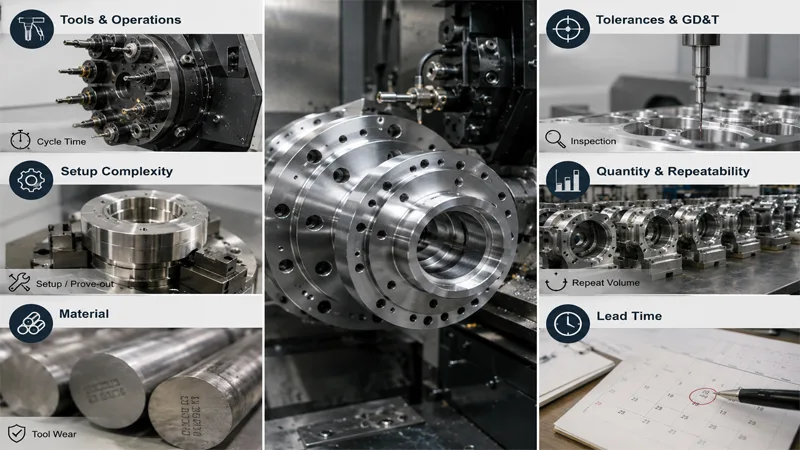
Mill-turn pricing is driven by a small set of practical factors:
- Number of tools and operations: more driven-tool work and synchronization increases cycle time.
- Setup complexity: soft jaws, custom workholding, balancing, and prove-out effort.
- Material machinability: titanium and some stainless grades drive tool wear and slower cutting parameters.
- Tolerance and GD&T density: a tight relationship, tolerances usually mean slower machining and more inspection.
- Quantity and repeatability: high repeat volumes can amortize setup and prove-out.
Two drivers that procurement teams often underestimate:
- Inspection depth: a quote that includes FAI (first article inspection) with a full CMM report, surface roughness checks, and traceability records is not comparable to a quote that assumes “spot-check only.” Specify inspection scope so you’re comparing like-for-like.
- Hidden routing steps: if any feature requires post-machining processes (heat treat, plating, passivation), or secondary operations (grinding, honing), it changes both lead time and the risk profile. It’s better to call those out in the RFQ than to discover them in first articles.
A common mistake is quoting the whole drawing to the tightest tolerance on the page. If only two diameters are CTQ and everything else is clearance, label it that way.
For AFI references on related capability, see AFI Parts CNC turning and AFI Parts CNC milling.
Lead-time Accelerators
If you need fast turnaround without creating hidden risk, focus on the levers that reduce uncertainty:
- Provide a complete RFQ package (drawing revision, model, material, treatments, quantity)
- Clarify which dimensions are CTQ and which can follow general tolerances
- Allow material equivalents when function permits
- Confirm inspection depth early (FAI vs. basic dimensional report)
Two practical accelerators that often get missed:
- Confirm stock form early (bar vs. billet/forging). If the supplier assumes bar stock and you later require a forged blank, lead time and cost can change materially.
- State your revision-control expectations. If you anticipate an engineering change order (ECO) during NPI, agree on how programs, inspection plans, and revision markings will be controlled so you don’t lose a week to re-approval loops.
DFM Levers
DFM is where you can usually reduce both cost and lead time without compromising performance.
High-impact levers for mill-turn parts:
- Datum simplification: choose datums that match how the part will be held and measured.
- Avoid unnecessary tight tolerances: defaulting to ±0.01 mm everywhere is expensive and often functionally pointless.
- Reduce tool reach: deep, narrow grooves and pockets drive deflection and cycle time.
- Standardize threads and radii: nonstandard forms increase tool lead time.
⚠️ Warning: If a tolerance is tighter than your measurement system capability (or the supplier’s), you’re buying arguments, not quality.
Supplier Evaluation
Equipment and Process Capability
Start by matching the supplier’s machine configuration to your part’s actual needs. Ask targeted questions:
- Do you need the Y-axis to machine off-center features, or is the C-axis live tooling enough?
- Do you need a sub-spindle to finish the back side without reclamping?
- Do they have a stable process for long, slender parts (steady rest, tailstock strategy)?
Then validate process discipline, not just “machine specs.” What you’re looking for is repeatable control:
- Set up sheets and controlled programs
- Tool life management for hard-to-machine materials
- Defined in-process checks for CTQs
AFI Industrial Co., Ltd. provides DFM support and ISO 9001 compliance.
Metrology and Quality
For mill-turn work, quality is mainly about two things: the measurement plan matches the datum scheme, and the measurement tools match the tolerances.
Signals to look for:
- In-house CMM capability or a reliable, accredited partner
- Documented calibration system and gauge control
- Capability to report GD&T (true position, runout, profile) when required
- Clear handling of nonconformance: segregation, root cause, corrective action
If your part has CTQ GD&T, ask for a sample report format before you place the order. It’s one of the fastest ways to see if the supplier is guessing.
NPI to Production Scaling
Scaling from prototype to production is where many suppliers look good on paper and fail in reality.
Evaluate how the supplier handles:
- Change control (drawing revisions, ECNs)
- Process capability ramp (how they stabilize a process after the first articles)
- Capacity planning (machine time, second shift, tooling redundancy)
- Consistent documentation across lots
If your program expects volume ramps or dual-sourcing, you want a supplier who can lock down process parameters and inspection plans in a transferable way.
Conclusion
Selecting CNC turning and milling compound machining services is mostly about reducing avoidable variation. Mill-turn helps by consolidating operations, holding datums through more of the process, and reducing lead time tied to multi-step routing.
Key takeaways:
- Choose mill-turn when turned and milled features must stay in a tight relationship, and you want to reduce setup-driven risk.
- Quote tolerances in bands: keep noncritical features at general tolerances, and be explicit about CTQs.
- Treat RFQs as technical packages: datum scheme, GD&T intent, inspection depth, and documentation requirements should be unambiguous.
- Evaluate suppliers on process control and metrology readiness, not just a machine list.
Immediate next steps to reduce risk and total cost of ownership:
- Package your RFQ with a CTQ list, datum scheme intent, and the inspection depth you expect.
- Ask the supplier how they will control your top 3 failure modes (runout, true position, thin-wall distortion, etc.).
- If you want, request a DFM-focused quote review on your CTQs and inspection plan.
FAQ
Mill-turn machining (also called turn-mill) combines CNC turning and CNC milling in one machine, so a part can be completed in fewer setups.
Use mill-turn when turned and milled features must stay in tight relationship, when you want to reduce setup error, or when a one-setup process can shorten lead time.
Live tooling means the lathe can drive rotating tools (drills/end mills) to machine features like cross holes, flats, and threads without moving the part to a separate mill.
Not always. The Y-axis is most useful for off-center features (keyways, slots, milled flats, bolt patterns) that are difficult to machine accurately with C-axis indexing alone.
It depends on geometry, material, and inspection method. A common baseline is around ±0.005 in (±0.13 mm) unless tighter tolerances are specified and supported by process control and metrology.