
Introduction
If you’re sourcing a small run of CNC machined parts from China (prototypes, pilot builds, bridge production, spares), you usually aren’t optimizing for the same thing as high-volume programs. Your constraint is often time, engineering iteration speed, and risk control as you move toward repeatability.
This guide explains how to evaluate a China CNC supplier for low volume production in a way that’s practical for procurement, mechanical engineering, and supplier quality. It focuses on what you can specify, what you can measure, and what you should ask for in writing.
You’ll learn:
- How to interpret common tolerance benchmarks, what “tight” actually means, and where GD&T adds value.
- What inspection “tiers” look like (from basic workmanship checks through FAI and CMM reports), and when each tier is worth paying for.
- How materials, finishes, logistics, and Incoterms change lead time, landed cost, and quality risk.
- How to structure an RFQ package so quotes are comparable and supplier feedback is actionable.
A note on reading benchmarks in this guide: treat them as planning ranges, not guarantees. Actual capability depends on geometry, datums, material behavior, fixturing strategy, and measurement method. When you see a tolerance range, the right follow-up is, “For which features, in which material, with which inspection method, at what sample size?”
Key Takeaway: In low volume production, you’re not just buying parts. You’re buying a controlled process that can survive iteration.
/tocv
Table of Contents
Tolerances and inspection
This is the section where most supplier comparisons are won or lost.
Tolerance discussions go off the rails when teams mix three different things:
- Baseline dimensional tolerance (the general size limits on linear/diameter dimensions)
- Geometric requirements (feature relationships: position, flatness, runout, profile)
- How measurement will be done and documented
Getting these aligned early makes China sourcing much more predictable.
Baseline vs precision ranges (low volume production CNC machining China factory)
A useful way to think about tolerances is in tiers.
- Baseline / general machining: Many CNC services cite a typical baseline around ±0.005 in (±0.13 mm) for common features, assuming reasonable geometry and stable workholding. Protolabs, for example, lists ±0.005 in (±0.13 mm) as a standard machining tolerance and ±0.002 in (±0.051 mm) as a more precise tier when required (with tighter features possible in specific cases, such as reamed holes).When you request “tight tolerance everywhere,” you may end up paying for time-consuming process controls on features that don’t affect fit or function. That’s a common cause of slow quotes and high scrap risk.
- Precision tiers: For features that drive assembly (bearing seats, sealing grooves, dowel pin locations, coaxial bores), you often want a smaller set of explicitly tight tolerances plus a measurement plan. This is where moving from “baseline” to “precision” is less about the number and more about the discipline: stable datums, consistent setups, and inspection methods that match the requirement.
- Ultra-tight features: If you truly need sub-±0.001 in (±0.025 mm) behavior on specific features, call that out explicitly and expect process changes (more controlled environment, slower cutting, secondary operations like grinding/EDM). In low volume, these requirements can dominate cost and schedule.
A practical tactic: mark critical-to-function (CTF) tolerances on the drawing (or in a separate tolerance map) and keep cosmetic/low-impact features on a general tolerance standard.
For a baseline tolerance reference and how tighter tolerances change routing, see Protolabs’ CNC tolerance guidance (±0.005 in standard).
Where to apply GD&T
When parts must assemble reliably, linear tolerances alone aren’t enough. GD&T is what lets you control feature relationships in a way that’s tied to function.
Use GD&T deliberately in these cases:
- Mating hole patterns: Bolt circles, dowel patterns, connectors, manifolds. Position tolerance is typically more meaningful than a pair of X/Y dimensions.
- Datums that matter: If a “primary surface” is what locates the part in the assembly, declare it as a datum and control perpendicularity/parallelism to it.
- Rotating features: Coaxial bores, bearing seats, and runout-sensitive features benefit from GD&T controls that reflect how the part will behave in motion.
- Seal surfaces and flatness: Flatness/profile can be more reliable than stacking multiple linear dimensions.
A rule that reduces friction with overseas suppliers: apply GD&T only to features that truly control function, then make sure your datums are unambiguous. Over-specified GD&T forces extra setups and metrology, and in low volume that often shows up as higher NRE and longer lead times.
If your org references ASME, you can point suppliers to the same standard language. ASME describes ASME Y14.5 (GD&T standard) as the authoritative guideline for GD&T symbols, rules, and practices.
Inspection documentation tiers
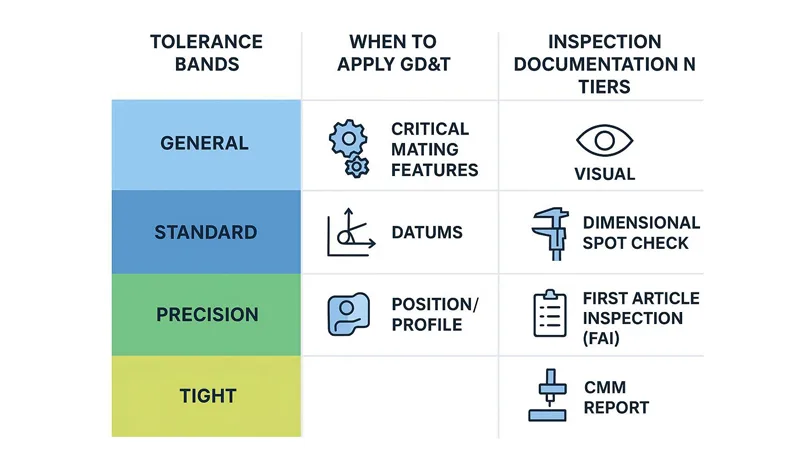
Inspection is not binary. Buyers get better outcomes when they choose the inspection tier that matches the risk.
A practical tier model:
- Workmanship + visual inspection (default)
- What it covers: burrs, nicks, finish defects, obvious damage, basic feature checks.
- When it fits: non-critical prototypes, cosmetic housings, early concept validation.
- Dimensional spot checks / in-process checks
- What it covers: key CTF dimensions on a sample basis, measured with calibrated hand tools (micrometers, pin gauges, height gauges).
- When it fits: pilot builds where a few dimensions drive assembly fit.
- FAI (First Article Inspection)
- What it covers: a documented measurement of the first part (or first-off sample) against drawing requirements.
- When it fits: you’re about to build multiple units; you want a formal baseline before a run continues.
- CMM report (for GD&T and feature relationships)
- What it covers: coordinate measurement of features and their relationships, often needed when position/profile and datum reference frames matter.
- When it fits: complex parts, multi-axis geometry, tight positional controls, or when your SQE team needs deeper traceability.
If your drawing uses a title-block general tolerance, call it out consistently. ISO 2768 is often used to set default tolerances for dimensions that aren’t individually toleranced. A concise explainer is in the ZEISS Quality Forum summary of ISO 2768-1/2 general tolerances.
For a supplier-side perspective on tolerance targets and inspection expectations, you can also reference AFI Parts’ CNC machining tolerances guide when aligning on what will be measured and how it will be reported.
Materials and finishes
Low volume production is where “material on the PO” and “material in the part” can silently diverge if you don’t specify what you need. The fix isn’t bureaucracy. It’s asking for the right documents and being clear about which properties matter.
Common stocked metals and plastics
Most CNC suppliers in China keep common grades in stock (or can source quickly): aluminum (e.g., 6061, 7075), carbon steels (1018/1045/4140), stainless steels (303/304/316), brass/copper alloys, titanium grades, and engineering plastics (ABS, acetal/Delrin, nylon, PEEK).
For low volume production, the buyer decisions that matter most are:
- Grade and temper (example: 6061 vs 7075, and T6 vs other tempers)
- Material standard equivalence (ASTM vs EN vs GB; be explicit if equivalence matters)
- Traceability expectations (heat/lot, mill certs, and whether you need certs per shipment)
If you need full traceability for regulated programs, define it in the RFQ. Don’t wait for “supplier standard.” A supplier can do the right thing and still deliver the wrong paperwork if your requirement isn’t stated.
Surface roughness and finishing options
Surface finish is not just cosmetic. It changes how parts seal, slide, wear, and (in some cases) how coatings adhere.
When you specify roughness, state it as a number (Ra) and tie it to function:
- Sliding/rotating interfaces
- Seal faces
- Mating surfaces that must sit flat
If you don’t specify roughness, many shops will quote an as-machined finish that’s workable for general use. Protolabs includes typical surface roughness ranges alongside its tolerance guidance in its CNC design tips.
Finishing options (anodize, plating, powder coat, bead blast, passivation) have two buyer-critical implications:
- Dimensional change: coatings add thickness; if you have tight fits, you must specify whether dimensions are before or after finish.
- Masking: decide which surfaces must remain uncoated or must be tightly controlled.
For a practical overview of finish types and how to request them cleanly, see surface treatment options for machined parts.
Certification and traceability notes
A simple documentation tier for material and process can keep low-volume projects controlled without turning into a paperwork project:
- Tier A (basic): material grade stated on quote + supplier COC (certificate of conformity).
- Tier B (traceable material): mill test report (MTR) tied to heat/lot; include heat number on packaging/label.
- Tier C (program-grade): MTR + process certs for finishing (e.g., anodize certification) + inspection report tier defined (FAI/CMM).
The point is repeatability. If you need Tier C, say so in the RFQ so the supplier prices and schedules the document generation.
Lead times and logistics
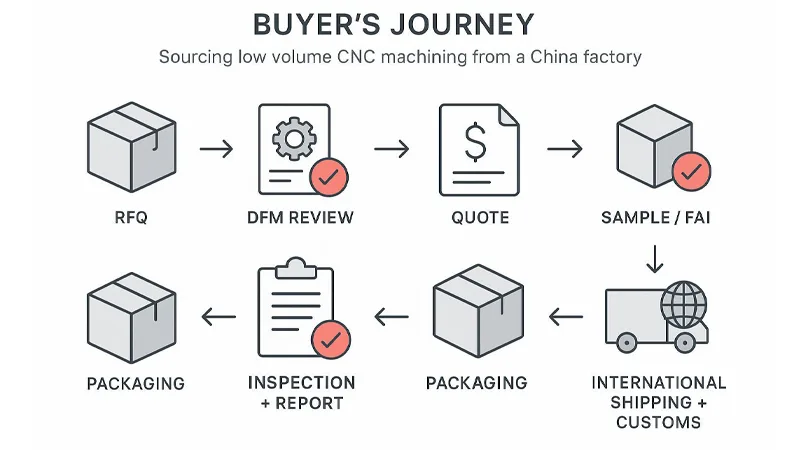
Low volume CNC from China lives or dies on total timeline, not just machine time. The timeline you care about is:
engineering review + machining + finishing + inspection documentation + pack-out + transit + customs + receiving.
Machining and finishing durations
Lead times depend heavily on complexity, setups, and queue. For planning, it’s reasonable to think in bands:
- Machining: quick-turn prototypes can be days; many low volume production orders will land in a 1–3 week band once programming, setups, and inspection requirements are included.
- Finishing: some finishes add little time; others add days (or more if the finishing supplier batches parts).
What reduces variability is clarity:
- Mark which dimensions are CTF.
- Specify inspection tier up front.
- Clarify finish and masking requirements.
Courier vs air/sea transit to the U.S.
For low-volume runs shipping to the U.S., mode choice is usually straightforward:
- Courier/express: fastest for small boxes and urgent builds, but cost per kg can be high.
- Air freight: a middle ground for heavier pilot lots.
- Sea freight: economical for heavier or less time-sensitive shipments, but the calendar time is longer and variance is higher.
For landed cost calculations, build a transit plan option set (courier vs air vs sea) before you accept the quote, because “expedite” on the manufacturing side can be erased by slow mode choice.
Packaging and Incoterms considerations
Machined parts are easy to damage in transit: scratches on cosmetic faces, dents on edges, corrosion on bare steel, and dimensional shifts if delicate features are bent. Packaging isn’t a nice-to-have.
A practical packaging request for low-volume CNC parts:
- Separate parts to prevent metal-on-metal contact.
- Use corrosion protection for steels (VCI paper/bags when appropriate).
- Add edge protection for sharp corners and cosmetic faces.
- Label boxes with part number, revision, quantity, and handling notes.
Incoterms are where many “hidden costs” come from. The short buyer framing:
- EXW: you control everything, but you also own everything (pickup, export, freight, import).
- FOB: supplier handles export and delivers to port; you control main freight and import.
- CIF: supplier includes freight/insurance to port; you handle import.
- DDP: supplier covers door-to-door, including duties and clearance (convenient for low-volume if you trust the paperwork).
The right choice depends on your internal capability and how much you want to control freight and paperwork. When you’re modeling total cost, start with a clear landed-cost input list like CargoFromChina’s landed cost definition and input list.
Cost transparency and quoting
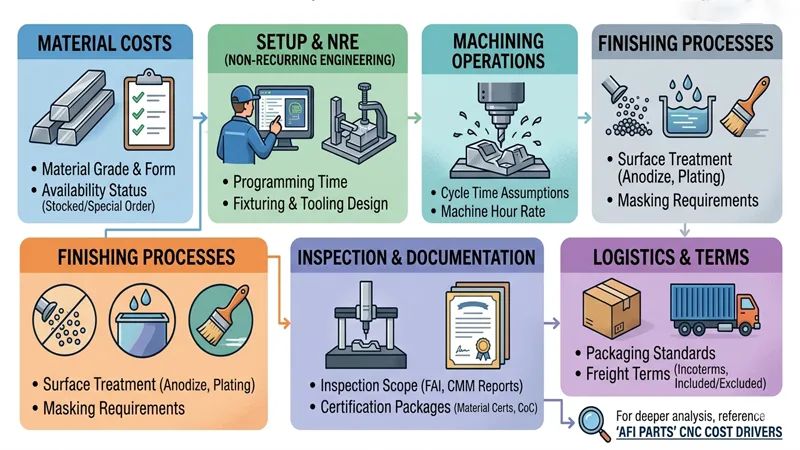
For low volume CNC machining from China, the biggest quote risk isn’t “too expensive.” It’s “not comparable.” Two suppliers can quote the same unit price while hiding different assumptions about setup time, inspection scope, and finishing.
Itemized quote structure
Request an itemized quote that separates at least:
- Material (grade + form + whether it’s stocked)
- Setup/NRE (programming, fixturing)
- Machining (cycle time assumptions)
- Finishing (process + masking)
- Inspection and documentation (FAI, CMM, cert packages)
- Packaging
- Freight terms (what’s included/excluded)
When suppliers can’t itemize, it’s harder to run a clean cost-down later. It’s also harder to interpret a price delta: is it faster machining, a different inspection assumption, or lower finishing cost?
For a supplier-side breakdown of cost drivers (tolerances, setups, geometry) that helps frame these conversations, see AFI Parts’ CNC machining cost drivers.
MOQ, setups, and scaling
“MOQ” in CNC is often less about an arbitrary quantity and more about whether the supplier can justify the setup and inspection overhead.
In low volume production, watch for these scaling behaviors:
- Programming/setup dominates at very low quantities (1–10 pcs). Unit price is high because fixed work is amortized over few parts.
- Fixture ROI changes around repeat orders. If you’ll reorder, a better fixture can reduce variation and cycle time.
- Inspection scope can scale: full FAI on first-off, then reduced sampling on the remainder, if you agree on a plan.
This is why quoting multiple quantity breaks (10/50/100, or 25/100/250) is useful. It makes setup amortization visible.
Landed cost modeling inputs
A landed-cost model keeps procurement aligned with engineering and logistics. At minimum, track:
- Part price (from itemized quote)
- Freight mode and cost (courier/air/sea)
- Insurance (if used)
- Duties/tariffs assumptions (based on HS code classification)
- Customs broker and clearance fees
- Packaging/crating surcharges (if required)
- Buffer for rework/remake risk on tight-tolerance parts
This matters because “cheap EXW” can be expensive after brokerage, duties, and expedite freight.
DFM collaboration and RFQ package
Low volume production is where DFM collaboration pays back fastest. When the supplier and your engineering team align early, you reduce rework loops and avoid late “can’t hold tolerance” surprises.
Critical features and wall thickness
Don’t send a drawing that treats every feature as equally important.
Instead:
- Identify the critical-to-function features: fits, seals, bearing seats, datum faces.
- Mark cosmetic “don’t care” regions, so suppliers don’t waste time polishing or holding tight location where it doesn’t matter.
- Specify minimum wall thickness and deep-pocket limits that match the material.
Thin walls, deep pockets, and long-reach toolpaths create deflection and chatter. That shows up as tolerance drift and surface finish variation.
A practical way to manage this is to request a DFM note that answers:
- Which features drive setups?
- Which features are risk for deflection?
- Which tolerances are likely to require secondary ops?
AFI Industrial Co., Ltd. typically treats DFM as a drawing review step (before cutting metal), which is where issues like thin-wall deflection, datum ambiguity, and finish masking are easiest to fix. If you want that to happen, make it explicit in the RFQ: “DFM feedback required before production.”
Files, drawings, and revision control
For low-volume sourcing, your RFQ package should be consistent and version-controlled. A clean package reduces wrong-rev scrap.
Minimum RFQ package:
- 3D model (STEP preferred unless your org mandates otherwise)
- 2D drawing (PDF) with tolerances and GD&T where needed
- Datum scheme and CTF feature list (can be in drawing notes)
- Surface finish requirements (Ra where functional)
- Material spec (grade + temper) and required cert tier
- Finish spec (type, color, masking notes, dimension-before/after-finish callout)
- Quantity breaks + target lead time
- Inspection tier requested (visual/spot/FAI/CMM)
- Packaging requirements (separation, corrosion protection)
Revision control practices that reduce errors:
- Put revision in the file name and the title block.
- Include an ECN-style change note for what changed (critical for suppliers).
- Send “one source of truth” zip, not a trail of email attachments.
Multi-axis necessity and fixturing
Multi-axis machining is not a flex. It’s a way to reduce setups.
A part is a candidate for 3+2 or 5-axis when:
- critical features need to be held relative to the same datum frame across multiple faces
- you have angled holes/features that would otherwise require extra fixtures
- you want to reduce tolerance stack-up from re-clamping
Fixturing questions worth asking in the quote stage:
- How many setups are assumed?
- What is the primary datum for each setup?
- Which features are measured in which setup?
- If you need positional accuracy, will they use probing to re-establish datums?
If you need a quick way to align on process capability, you can point stakeholders to AFI’s core pages on CNC milling capabilities and CNC turning capabilities to set expectations on part families and typical process flows.
Risk and supplier verification
Low volume production can feel “small,” but the risks are the same: IP exposure, quality escapes, and schedule disruption.
IP protection and NDAs/NNNs
If IP matters, don’t treat it as an afterthought. Use the right instrument for the jurisdiction and the risk.
- NDA: common and useful for confidentiality, but often limited if you need enforceability across borders.
- NNN agreement (non-disclosure, non-use, non-circumvention): frequently used for China sourcing to explicitly prohibit using your drawings for other customers or bypassing you.
Whatever you use, align it with your PO terms and your drawing distribution rules (who gets what files, and when).
Certifications and on-site/third-party audits
Certifications aren’t proof of capability, but they are useful filters.
For supplier verification, consider:
- Quality management certification relevance to your program (and whether the certificate is current)
- Calibration system and traceability of measurement tools
- Evidence of CMM capability if you need GD&T verification
- Past inspection report samples (redacted is fine) matching your inspection tier
For higher-risk parts, on-site or third-party audits add confidence. If you can’t audit, request a structured evidence pack: quality manual excerpt, calibration certificates, sample FAI, and a controlled-document process example.
Dual-sourcing and continuity planning
Low volume projects turn into larger programs more often than teams expect. Build continuity early:
- Maintain a second supplier quote as a benchmark (even if you don’t award it).
- Keep fixtures and programs ownership clear in writing.
- Standardize inspection outputs and revision control so you can migrate without re-learning.
This is also where packaging and documentation consistency matters. If each supplier ships and documents differently, dual-sourcing becomes an internal receiving and QA headache.
Conclusion
Sourcing low volume production CNC machining from a China factory can be predictable when you treat it as a controlled engineering workflow, not a price hunt.
Key takeaways:
- Use tolerance tiers: keep general features on a baseline tolerance, and put tight tolerances only on CTF features.
- Apply GD&T where it changes assembly outcomes, and align on the standard language (ASME Y14.5).
- Choose an inspection tier that matches risk (visual → FAI → CMM) and ask for the documentation up front.
- Quote transparency matters more than a low unit price. Request itemized quotes and model landed cost.
- Treat DFM collaboration and a clean RFQ package as part of quality control.
- Verify suppliers with evidence packs/audits, protect IP with the right agreements, and plan continuity.
Immediate next steps (internal checklist recap):
- Identify CTF features and mark them on the drawing (or in a tolerance map).
- Decide inspection tier (FAI? CMM?) and define what the report must include.
- Define material and finish cert requirements (basic vs traceable).
- Request an itemized quote and quantity breaks.
- Build a landed cost model with freight mode + duties + broker fees.
- Package the RFQ with clear revision control.
If you want a fast way to pressure-test manufacturability before you commit to a purchase order, request a short DFM review alongside your RFQ so you can resolve datums, thin walls, and setup assumptions early.
FAQ
Low volume production typically refers to manufacturing runs ranging from as few as 10 parts to several thousand units. It bridges the gap between one-off prototyping and full-scale mass production, allowing businesses to bring products to market without a massive upfront investment.
The main advantages include reduced lead times, lower tooling costs, and increased design flexibility. It allows for faster design iterations and minimizes financial risk by avoiding the high costs associated with large-batch production molds and setups.
One of the strengths of CNC machining is its material versatility. It supports a wide range of metals (such as Aluminum, Stainless Steel, Brass, and Titanium) and engineering-grade plastics (like PEEK, ABS, Nylon, and Polycarbonate), ensuring the final parts have the required mechanical properties.
While the cost per part in low volume production is generally higher than in mass production (due to less economy of scale), the overall project cost is much lower. This is because it eliminates the need for expensive permanent tooling and allows for adjustments without scrapping large quantities of inventory.
Yes. Low volume CNC machining uses the same high-precision equipment and professional-grade materials as high-volume production. In many cases, quality control is even more stringent because the smaller batch size allows for closer inspection of individual components.
A company should transition once the design is functional and verified but not yet ready for the hundreds of thousands of units required for mass production. It is an ideal strategy for market testing, pilot runs, or for niche products with limited total demand.