
Introduction
A ±0.00 in tolerance looks small on a drawing. In an assembly, it often decides whether a part slides into a bore without galling, whether an O-ring seals without extrusion, and whether components remain interchangeable across suppliers, lots, and time.
If you’re buying machined parts for an OEM program, “tight tolerance” isn’t a single number. It’s a promise that the supplier can repeat a result while tools wear, machines warm up, operators change shifts, material lots vary, and measurement uncertainty stacks up.
In practice, tight tolerance means the supplier has a controlled process: stable fixturing and datums, predictable tool deflection, managed heat, clear GD&T (geometric dimensioning and tolerancing) intent, and a metrology system that can prove conformance at the temperature the drawing assumes.
This guide breaks down what has to be true for tight tolerance CNC machining services to hold ±0.001 in.
Reliably, what makes it risky, how results are verified at scale, and what evidence to request when you qualify a supplier.
Table of Contents
Capability Benchmarks
Typical tolerance bands by process
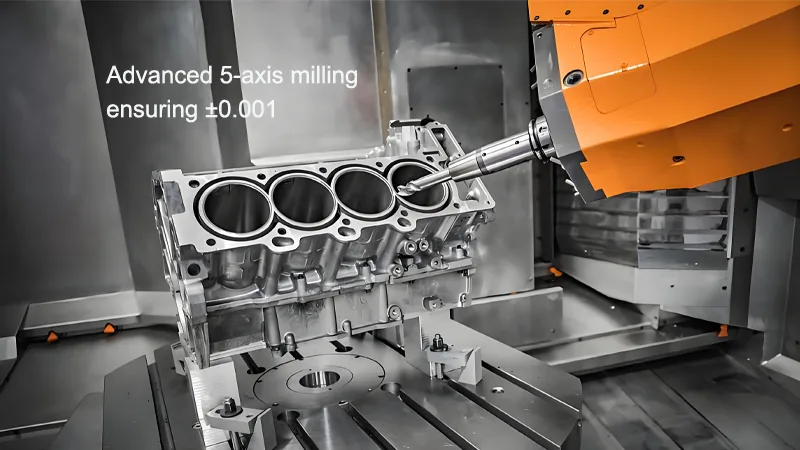
Most suppliers can hit “standard” tolerances on many features without extraordinary controls. Tight tolerance work starts when the tolerance band approaches the combined effect of machine positioning error, tool deflection, thermal drift, and measurement uncertainty.
A practical way to think about benchmarks is by what the process normally holds versus what it can hold with special handling.
- General CNC machining (milling/turning): many suppliers default around ±0.005 in for unspecified dimensions.
- Precision CNC machining: ±0.002 in is commonly achievable on stable features with appropriate tooling and inspection.
- Tight tolerance CNC machining: CNC machining tolerances ±0.001 in are achievable on many metals and geometries, but they should trigger a conversation about risk drivers and inspection strategy.
Turning often has a natural advantage for concentric features (shafts, journals, coaxial diameters) because the datum is the spindle axis. Milling often wins on complex prismatic geometry, but tight size and position tolerances can become sensitive to setup changes and thermal growth.
When ±0.001 in is realistic vs. risky
±0.001 in is realistic when most of these conditions are true:
- The critical features can be completed in a single setup (or at least referenced to a stable datum structure across setups).
- The part is thermally stable during machining and inspection (material, wall thickness, and heat input cooperate).
- Tools are short enough and stiff enough that deflection is predictable and can be compensated.
- The drawing uses GD&T to express function, so the supplier can control what matters instead of chasing every edge.
- The measurement plan is appropriate (for example, a CMM program plus a dedicated functional gauge for the CTQ).
It becomes risky when you see one or more of these patterns:
- Thin walls or large aspect ratio features that move as soon as you release the clamps.
- Deep pockets, long-reach tools, or small cutters where deflection dominates.
- Tight tolerances on features that require multiple re-clamps and have weak datum alignment.
- Materials that create instability: gummy alloys that build heat, hard/abrasive alloys that accelerate wear, or plastics that creep and warp.
- Tight tolerances are specified everywhere, even on non-functional surfaces, forcing slow machining and heavy inspection across the entire part.
A strong supplier won’t just say “yes, we can hold ±0.001.” They’ll identify which dimensions are truly critical, propose datums and process steps that protect those features, and flag where secondary processes (grinding, honing, lapping) may be the safer path.
Material and feature factors that shift the capability
Tolerance capability is not only about the machine. Material behavior and feature design can move the goalposts.
Material effects that matter at ±0.001 in:
- Thermal expansion: When temperature changes, dimensions change. Aluminum moves more per degree than steel; plastics move much more and can absorb moisture. If the part is measured before it stabilizes at the inspection temperature, you can reject a good part or accept a bad one.
- Residual stress: Some materials distort after roughing when internal stress is released. If the process doesn’t include a stabilization step (rest, stress relief, or a rough/semi-finish/finish sequence), size can drift after machining.
- Tool wear behavior: Abrasive materials and hard alloys can shift size slowly over a run. Without tool-life rules and offset control, Cpk will collapse even if the first parts look perfect.
Feature effects that matter at ±0.001 in:
- Long, slender features amplify deflection and vibration.
- Bores and bearing seats often need both size and form control (roundness, cylindricity). Size alone doesn’t guarantee fit.
- Patterns of holes often fail in position, not diameter. Hole position is a datum strategy and probing strategy problem as much as it is a machining problem.
Process Controls That Hold Tolerance
Thermal stability, fixturing, and tool control
At ±0.001 in, temperature is a process variable, not an environmental detail.
A control-minded supplier will typically do some mix of:
- Machine warm-up routines so the spindle and axes reach a stable condition.
- Controlled cutting conditions to reduce heat spikes on finish passes.
- Fixturing that repeats without distorting the part. Over-clamping can “machine in” stress that springs back out after unclamping.
- Tool-length and tool-diameter control with defined inspection intervals, tool-life limits, and offset update rules.
If a quote claims ±0.001 in but the supplier cannot explain how they manage spindle warm-up, tool wear, and clamp distortion, treat that as a risk indicator.
Single-setup, multi-axis, and in-process probing
The fastest way to lose tolerance is to re-datum the part.
For tight-tolerance work, suppliers often try to:
- Complete critical relationships in one setup so the machine’s coordinate system is the datum.
- Use 4-axis/5-axis positioning to reach multiple faces without unclamping.
- Use in-process probing to measure features during machining, update work offsets, and catch drift before producing scrap.
In-process probing is not the same as final inspection. It’s a control tool. The value is that it closes the loop: measure, correct, verify.
SPC, Cp/Cpk, and corrective action loops
Holding ±0.001 in is rarely a “hero machinist” achievement. It is a CNC machining process capability Cp Cpk problem: reduce variation, keep the process centered, and react fast to drift.
Two metrics come up in supplier discussions:
- Cp describes how much natural process variation fits inside the tolerance band if the process is perfectly centered.
- Cpk accounts for centering (drift matters). It is usually the more honest number for production.
Many manufacturing programs treat Cpk ≥ 1.33 as a baseline for “capable” on important characteristics, with higher targets for safety-critical or high-cost failure modes. The point is not the exact threshold. The point is that capability is measured, and the supplier knows how to improve it.
A typical SPC loop for tight-tolerance machining looks like this:
- Define CTQs (critical-to-quality features) and a sampling plan.
- Use control charts to detect tool wear and thermal shifts early.
- Apply a documented reaction plan: adjust offsets, change tools, re-qualify, and quarantine suspect parts.
- Confirm the measurement system can see the variation (MSA), or the charts become decoration.

Standards, GD&T, and Metrology
ASME Y14.5, ISO 2768, and datum strategy alignment
Tight tolerance work breaks down when the design intent isn’t explicit.
- ASME Y14.5 is the dominant GD&T standard used to communicate design intent through datums, feature control frames, and modifiers.
- ISO 2768 is commonly used for general tolerances when individual dimensions are not specified.
For supplier alignment, what matters is not the name of the standard, but the shared interpretation:
- What is the primary datum, and how is it established in machining and inspection?
- Are you controlling function through position, profile, and runout, or trying to force it through tight ± size on everything?
- Do datum targets and inspection setups reflect how the part actually assembles?
If you expect interchangeability across lots and suppliers, the datum strategy must be stable enough that two different shops will inspect the same part and get the same pass/fail decision. In practice, that comes down to a clear GD&T datum strategy and an inspection setup that matches it.
Verification with CMM, air gages, and CMM inspection ISO 10360
CMMs (coordinate measuring machines) are often the backbone of tight-tolerance verification because they can measure complex geometry and GD&T relationships.
A buyer evaluating a supplier should ask:
- What metrology equipment is used for CTQs (CMM, air gage, bore gage, optical, surface roughness tester)?
- Is the CMM performance verified using recognized methods, such as the ISO 10360 series (acceptance and reverification tests)?
- Are there dedicated gauges for high-volume features where a CMM would be too slow or too variable?
Air gages and functional gages can be more effective than a CMM for certain bores and fits because they provide fast, repeatable measurements with low operator influence.
Measurement at 20 °C and MSA/Gage R&R
At ±0.001 in, you can lose the tolerance band to temperature alone.
Most engineering drawings assume dimensions apply at 20 °C (68 °F) unless otherwise specified. That doesn’t mean your factory must be a standards lab. It does mean the supplier must control and document the inspection environment, and ensure the part has reached thermal equilibrium before measurement.
MSA (measurement system analysis) is how you avoid false confidence. A Gage R&R (repeatability and reproducibility) study answers a simple question: can this measurement system reliably distinguish good parts from bad parts at this tolerance?
For critical characteristics, you want a measurement system where variation is a small fraction of the tolerance. If the gauge consumes a large share of the tolerance band, every “capability” number becomes suspect.
Cost, Lead Time, and DFM Trade-offs
Tolerance tightening vs. cycle time and yield
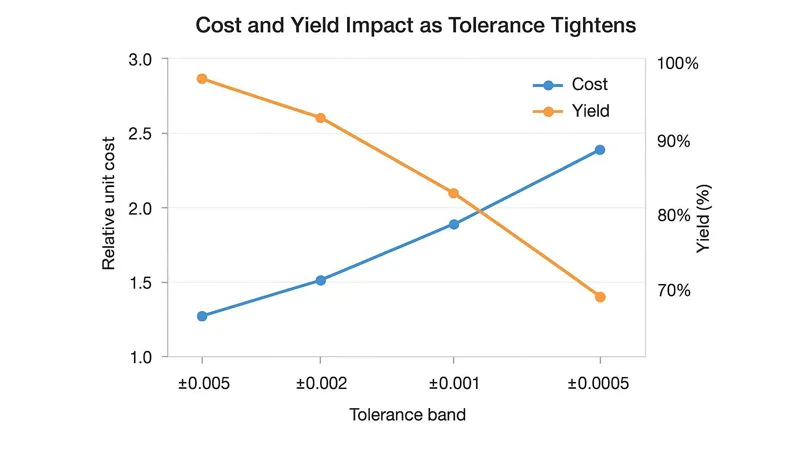
Tightening tolerance rarely adds cost in a straight line. It changes the process plan.
As you move from ±0.005 in to ±0.002 in to ±0.001 in, suppliers often need more of the following:
- Additional semi-finish and finish passes
- Slower feeds and lighter cuts to control deflection and heat
- More frequent tool changes and offset adjustments
- More inspection time (and sometimes 100% inspection on CTQs)
- Higher scrap risk during ramp and during long runs if drift isn’t controlled
The result is longer cycle time and a higher probability that at least one feature falls out of spec, especially on complex parts with many CTQs.
Design tactics to localize tight features
Many drawings fail not because ±0.001 in is impossible, but because it is applied where it adds no functional value.
Design tactics that reduce cost and risk without changing function:
- Localize tight tolerances to mating and sealing features (bearing seats, gasket lands, alignment datums).
- Use GD&T to control function (position/profile) instead of over-tightening size everywhere.
- Create inspectable datums: generous, stable datum surfaces beat tiny datum edges.
- Avoid long cantilevers and thin webs on CTQs unless you also plan the process (support ribs, machining sequence).
- For hole patterns, define a datum structure that reflects the assembly, then control true position rather than forcing diameter and edge distances to do the job.
A good DFM (design for manufacturability) review should end with a map: which features are CTQ, which are “standard,” and which can float within a wider band.
When to add grinding, honing, or lapping
There’s a point where “CNC machining harder” is not the best answer.
Consider secondary finishing processes when:
- You need a tighter size or form than milling/turning can hold consistently on that feature.
- Surface finish and geometry are both critical (bearing bores, hydraulic sealing surfaces).
- The CTQ is sensitive to tool wear or thermal change and would benefit from a dedicated finishing step.
Common choices:
- Grinding for flatness, parallelism, and tight size on hardened materials.
- Honing for bore geometry (size, roundness, crosshatch) when fit and leakage matter.
- Lapping for extremely flat, smooth surfaces and final fit control when removal amounts are very small.
Proving It: Documentation and Qualification
FAI/AS9102, PPAP, and traceability packages
If ±0.001 in is truly important, qualify the supplier the way an aerospace or automotive program would: with artifacts, not promises.
For first builds or new suppliers, ask for:
- FAI (first article inspection) packaged in an AS9102-style format: ballooned drawing plus characteristic-by-characteristic results.
- Traceability: material certs (heat/lot), special process certs (heat treat, plating/anodize), and linkages to part serial/lot.
- Calibration evidence for gauges used on CTQs.
For production or safety-critical parts, add PPAP-style elements where appropriate:
- Control plan for CTQs
- PFMEA (process failure mode and effects analysis)
- MSA results (including Gage R&R for CTQ measurements)
- Initial capability study results (Cp/Cpk) once the process is stable
Sample inspection reports and capability studies
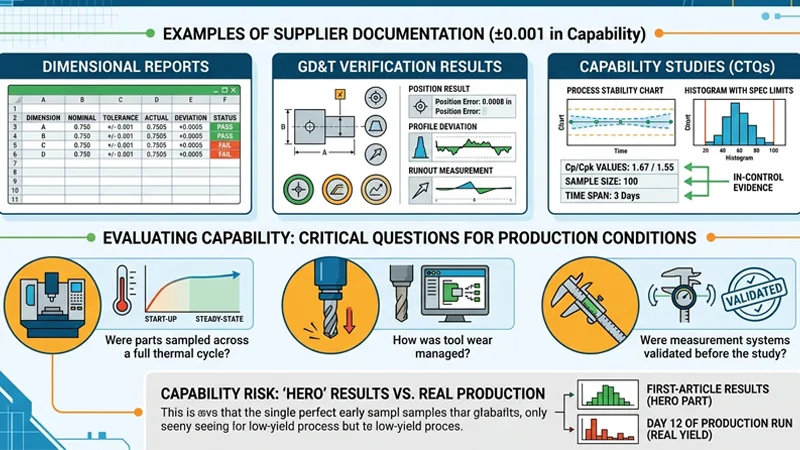
A supplier that can hold ±0.001 in should be able to show examples of:
- Dimensional reports with nominal, tolerance, actual, and deviation
- GD&T verification results (position/profile/runout, not only size)
- Capability studies on CTQs, including sample size, time span, and evidence that the process was in control
When you review capability, ask what happened during real production conditions:
- Were parts sampled across a full thermal cycle (start-up to steady-state)?
- How was tool wear managed?
- Were the measurement systems validated before the study?
If the supplier can only show “hero” first-article results, you still don’t know what yield looks like on day 12 of a long run.
Change control, run-at-rate, and ramp stability
Tight-tolerance parts often fail during change.
Ask for a documented approach to:
- Change control: what triggers re-FAI, how revisions are released, how offsets and programs are versioned.
- Run-at-rate: evidence that the supplier can produce at the required pace while holding CTQs.
- Ramp stability: what happens when volume increases, shifts change, or material lots change.
The goal is to prevent quiet drift from becoming a field failure, warranty event, or line stop.
Selecting Tight Tolerance CNC Machining Services Partners
Certifications and assets to verify
For a supplier claiming ±0.001 in capability, certifications matter less as a badge and more as a signal that the organization can run controlled processes.
What to verify:
- Quality management certifications relevant to your program (commonly ISO 9001; for regulated work, sector-specific certifications like IATF 16949, ISO 13485, or AS9100 may apply).
- Metrology assets appropriate for your GD&T: CMM capacity, probing systems, surface finish measurement, and the ability to keep inspection controlled near 20 °C.
- Document control and traceability practices that match your audit expectations.
Evidence on like parts and metrology depth
Ask to see evidence on parts that are similar in the ways that drive risk:
- Similar material and heat treatment conditions
- Similar feature sizes (thin walls, deep bores, long reach)
- Similar CTQ type (position/profile vs size)
- Similar volume and lead time constraints
Also evaluate metrology depth:
- Can the supplier explain how CMM verification is maintained (for example, acceptance/reverification practices aligned with ISO 10360 concepts)?
- Do they run MSA and Gage R&R studies on critical measurements?
- Can they correlate in-process probing results with final CMM results so shop-floor adjustments don’t fight the inspection room?
Commercial transparency and delivery performance
Tight-tolerance programs fail as often on communication as they do on machining.
Look for a supplier that is willing to be explicit about:
- Which tolerances are low risk vs high risk (and why)
- What is the inspection plan for CTQs
- What drives price: setups, cycle time, gaging, secondary processes
- How they handle expedited builds, engineering changes, and ramp events
In partner evaluations, it is reasonable to prefer suppliers that can show both engineering support and quality documentation depth. For example, AFI Industrial Co., Ltd. (AFI Parts) publishes process capability guidance, supports CNC milling and CNC turning, and describes inspection planning and GD&T-focused engineering review as part of its workflow. When you evaluate any supplier making similar claims, use the same yardstick: ask for the artifacts (FAI, traceability, capability data), confirm the metrology path, and confirm how they keep results stable from prototype through production.
Relevant references if you want to compare how a supplier documents these topics:
Conclusion
Holding ±0.001 in reliably is not a single equipment capability. It’s a controlled system: stable datums and fixturing, managed thermal behavior, predictable tooling, in-process verification, and metrology that proves conformance at the temperature the drawing assumes.
Key takeaways:
- Treat ±0.001 in as a risk-managed requirement: identify CTQs and localize tight features.
- Ask how the supplier closes the loop (probing, SPC, corrective action), not just what machine they run.
- Align GD&T, datums, and inspection plans so machining and measurement agree.
- Qualify with evidence: FAI/AS9102-style reporting, MSA/Gage R&R, capability studies, and traceability.
Next steps to de-risk sourcing and accelerate NPI: run a short pilot build on the true CTQs, require a defined inspection plan up front, and review capability after the process has seen real thermal and tool-wear conditions.
FAQ
In most CNC shops, “standard” is often around ±0.005 in. “Precision” commonly targets about ±0.002 in, and “tight tolerance” work typically starts around ±0.001 in, where thermal drift, tool deflection, and measurement uncertainty become major factors.
Yes—when the process is controlled. It usually requires stable fixturing and datums, thermal management, predictable tooling and offset control, in-process probing, and a verification plan (often CMM plus functional gaging) to keep the process centered over long runs.
They combine appropriate metrology (e.g., CMMs, air gages, bore gages, surface roughness tools) with a defined inspection plan, a controlled inspection temperature (often 20 °C/68 °F), and measurement system checks such as MSA/Gage R&R to ensure the gage can actually detect small variations.