
Table of Contents
Thread Depth and Its Impact on Threading Cost
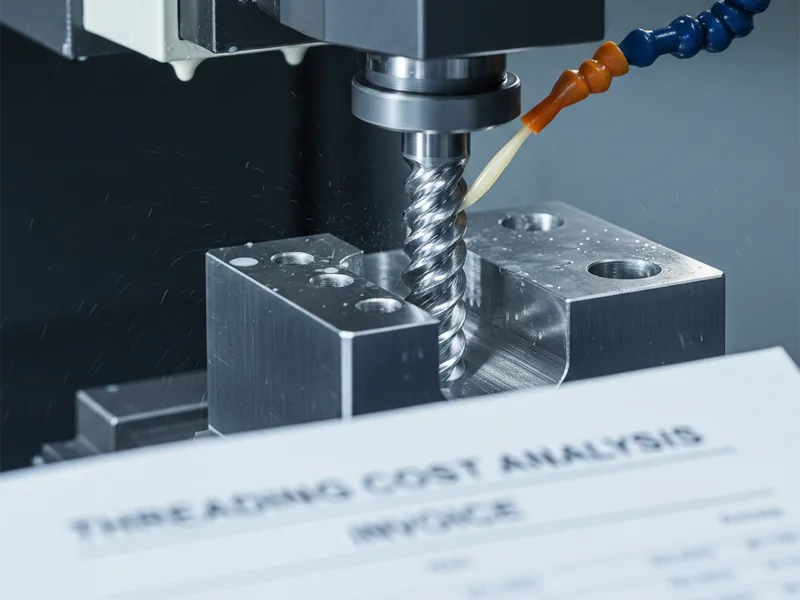
In the realm of custom metal parts manufacturing, few design features are as deceptive as the threaded hole. To the uninitiated, specifying a deeper thread appears to be a low-cost method of ensuring joint integrity and safety. However, as senior engineers at AFI Industrial Co., Ltd, we frequently observe a direct correlation between excessive thread depth specifications and inflated manufacturing costs.
The cost of threading is not linear; it is exponential relative to depth. When a design engineer specifies a thread depth that exceeds the necessary mechanical requirements, they are inadvertently triggering a cascade of manufacturing complexities. These include increased cycle times, accelerated tool degradation, and a statistically higher probability of part rejection due to tolerance deviation.
For a custom machining supplier, the “threading cost” is an aggregate of machine amortization, operator intervention, perishable tooling consumption, and non-conformance risk. Our data indicates that increasing thread depth from 2 x D (diameter) to 3 x D can increase the threading operation cost by upwards of 40%. This is primarily driven by the physics of chip evacuation and heat generation in confined spaces. Deep threads act as heat sinks that trap thermal energy, leading to work hardening in materials like 304 Stainless Steel or Titanium Grade 5, which in turn compromises the structural integrity of the thread itself.
Machining Time and Tool Wear
The relationship between thread depth and machining time is governed by the limitations of cutting mechanics. Unlike simple drilling, threading requires precise synchronization between the spindle rotation and the linear feed of the tool.
Increased Passes Required
In CNC machining, we rarely cut a thread to full depth in a single pass, particularly in hard metals. We utilize canned cycles (such as G76 on a lathe) that break the cut into manageable “passes” to reduce tool load.
- The Physics of the Cut: As the thread tool penetrates deeper, the contact area between the cutting insert and the workpiece increases. To maintain cutting stability and prevent chatter, the “Depth of Cut” (DOC) for each subsequent pass must decrease.
- Cycle Time Multiplication: A shallow thread might be completed in 5 passes. A deep thread, requiring chip breaking and heat dissipation, might require 12 to 15 passes. Furthermore, deep threads often require “spring passes” (cutting with zero depth) to eliminate deflection and ensure dimensional accuracy.
- Retraction Latency: In deep tapping operations, the machine must stop the spindle, reverse rotation, and retract the tool. The deeper the hole, the longer this non-cutting time (dead time) becomes. When multiplied across thousands of units in a production run, these seconds accumulate into hours of lost capacity.
At AFI Parts, we utilize advanced simulation software to calculate these cycle times during the quoting phase. We consistently find that designs adhering to standard depth ratios allow for higher feed rates and fewer passes, directly translating to lower part costs.
Tool Life Considerations
Tool life management is a critical component of cost control in a metal parts manufacturing plant. Deep threads are notorious for reducing tool life expectancy significantly.
- Cantilever Effect and Deflection: Deep threading tools, by necessity, have a high length-to-diameter (L/D) ratio. This makes them susceptible to deflection. As the tool deflects, it rubs rather than cuts, generating friction and heat that accelerate flank wear.
- Chip Packing and Breakage: In deep holes, evacuating chips is difficult. Chips can pack into the flutes of a tap or the teeth of a thread mill. If chips are recut (are cut again by the tool), it causes catastrophic cutting edge failure. A broken tap in a deep hole often results in the entire part being scrapped, as extraction is difficult and risky.
- Coolant Starvation: Reaching the cutting zone with coolant becomes exponentially harder as depth increases. Without adequate lubrication and cooling, the cutting edge experiences thermal shock, leading to micro-cracking and premature failure.
We employ real-time spindle load monitoring at AFI Parts to detect tool wear. Our data confirms that tools used for threads exceeding 2.5 x D require replacement 30-50% more frequently than those used for standard depths.
Material Removal and Waste
Efficiency in CNC machining is often measured by Material Removal Rate (MRR). However, in threading, the focus shifts from bulk removal to precision evacuation.
Volume of Material Cut
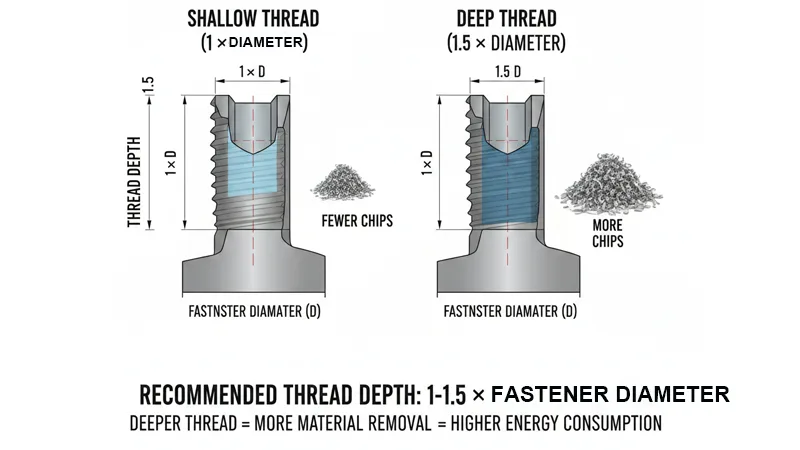
The volume of material removed in a thread is dictated by the thread profile (e.g., UNC, ISO Metric, NPT). While the volume difference between a shallow and deep thread seems negligible mathematically, the difficulty of removing that volume changes drastically with depth.
- Energy Consumption: Removing material deep within a bore requires higher torque and consumes more energy due to friction losses.
- The 1.5x Rule: Mechanics of materials dictates that the first three threads bear approximately 34%, 23%, and 16% of the load, respectively. By the sixth thread, the load bearing capacity is negligible. Therefore, a thread depth of 1 to 1.5 times the fastener diameter is mechanically sufficient for 95% of standard fastening applications. Extending beyond this removes material that contributes nothing to the joint’s strength but adds significantly to the manufacturing burden.
At AFI Parts, we advocate for the “Minimum Material Condition” philosophy. By limiting thread depth to what is structurally necessary, we reduce the volume of chips generated and the energy consumed per part, aligning with sustainable manufacturing practices.
Waste Management
Effective waste management—specifically chip control—is the unsung hero of precision threading.
- Chip Morphology: Deep threads in ductile materials (like Aluminum 6061 or Copper) tend to produce long, stringy chips. These “bird’s nests” can wrap around the tool holder, damaging surface finishes and requiring operator intervention to clear.
- Coolant Contamination: Deep hole threading generates fine metal particulate (swarf) that is difficult to filter. This increases the frequency of coolant tank maintenance.
- Process Reliability: When chips are not effectively evacuated from a deep blind hole, they can prevent the fastener from seating correctly during assembly, leading to “false torque” readings and potential joint failure in the field.
To mitigate this, AFI Parts utilizes High-Pressure Coolant (HPC) systems (up to 1000 PSI) to force chips out of deep bores. While effective, this technology adds to the operational cost, further validating the argument for optimized thread depths.
Machining Technology in AFI Industrial Co., Ltd
As a leader in the manufacturing sector, AFI Parts leverages state-of-the-art technology to mitigate the challenges of threading. Our investment in advanced infrastructure allows us to handle complex threading requirements, though we advocate for design optimization to save our clients money.
Precision and Efficiency in Machining
Our facility is equipped with multi-axis CNC turning and milling centers capable of rigid tapping and helical interpolation with micron-level accuracy.
- Rigid Tapping: Our machines synchronize spindle rotation and Z-axis feed so precisely that we can retract the tap at thousands of RPM without damaging the thread profile. This is essential for maintaining pitch tolerances in deep holes.
- In-Process Probing: We utilize Renishaw tactile probes to verify hole position and diameter before the threading cycle begins. This prevents “air cutting” or breaking tools in undersized holes, ensuring that every cycle yields a compliant component.
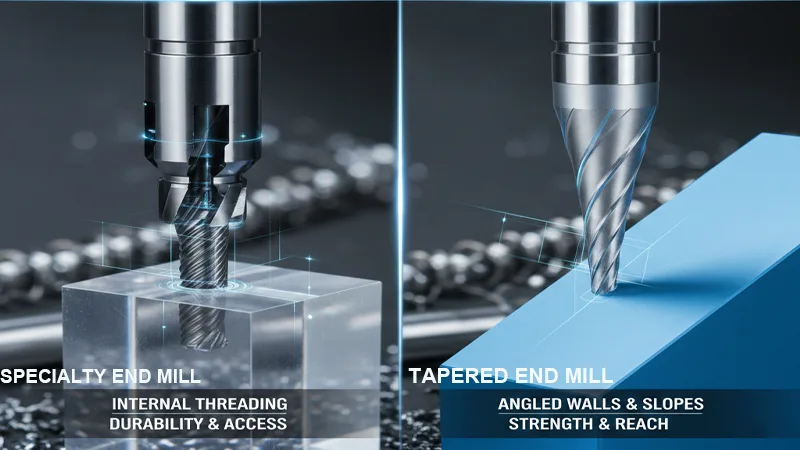
- Scientific Tool Selection: We do not rely on generic tooling. For deep threads, we utilize application-specific taps with spiral flutes designed to lift chips vertically, or thread mills with through-tool coolant capability.
Material Compatibility and Customization
Different materials behave differently under the stress of threading. A “one-size-fits-all” approach is a recipe for failure in high-precision manufacturing.
- Hardened Steels (>45 HRC): For these materials, tapping is often impossible. We utilize solid carbide thread mills with AlTiN coatings. This allows us to machine threads into parts that have already been heat-treated, eliminating the risk of thread distortion during quenching.
- Exotic Alloys (Inconel/Hastelloy): These work-hardening alloys require specific cutting geometries. We use thread mills with variable helix angles to reduce harmonic vibration and prevent the tool from seizing in deep holes.
- Plastics (Delrin/PEEK): Deep threads in plastic risk melting due to friction. We utilize sharp, polished flutes and air-blast cooling to maintain thread geometry.
Our engineering team matches the tool substrate, coating, and geometry to your specific material and thread depth, ensuring optimal cost-efficiency.
Quality Control and Scrap Rate Impact
The hidden danger of deep threading lies in quality assurance. Verifying a deep thread is significantly more time-consuming and prone to error than verifying a shallow one.
Tolerance and Inspection Challenges
Deep Threads and Out-of-Spec Risks
The deeper the thread, the harder it is to maintain geometric tolerances such as cylindricity and perpendicularity.
- Tool Deflection & Taper: As a long tool pushes into the material, it naturally bends away from the cut. This results in a thread that is tighter at the bottom than at the top (tapered). A tapered thread may accept a gauge for the first few turns but bind deep in the hole, rendering the part useless.
- Gauging Difficulty: Standard Go/No-Go plug gauges have a finite length. Verifying the bottom threads of a deep hole requires custom, extended-shank gauges, which are expensive and have long lead times.
- Non-Destructive Testing (NDT): For critical aerospace or automotive applications, we employ Eddy Current Testing and vision systems to ensure no micro-cracks have formed at the root of the thread deep within the bore.
Inspection Time and Equipment Needs

Quality control is a billable activity. The time required to inspect a deep thread is non-trivial.
Documentation: Per ISO 9001 and AS9100 standards, we maintain rigorous documentation. Deep threads often require 100% inspection rather than statistical sampling due to the higher process risk, further increasing the cost of quality.
Manual Gauging: Screwing a thread gauge into a deep hole, verifying the fit, and unscrewing it is a manual process that can take 30-60 seconds per hole. For a part with 20 holes, this adds massive overhead to the labor cost.
Automated Verification: We utilize coordinate measuring machines (CMM) with scanning heads to profile threads. However, scanning deep, small-diameter threads requires specialized styli and slower scan speeds to prevent probe damage.
Scrap and Rework Costs
Causes of Scrap in Deep Threading
Scrap at the threading stage is particularly painful because it usually occurs near the end of the manufacturing process. A part that has been turned, milled, drilled, and faced carries significant accumulated value. Scrapping it due to a broken tap or oversized thread is a maximum-loss scenario.
- Thread Stripping: In an attempt to clear chips from deep holes, operators may re-tap holes manually, risking “cross-threading” or stripping the delicate thread crests.
- Oversized PD (Pitch Diameter): Tool wear in deep cuts often leads to the machine operator applying offsets. If over-compensated, the Pitch Diameter becomes too large, and the “No-Go” gauge enters, failing the part.
Prevention Strategies in Machining
AFI Parts employs a “Zero-Defect” methodology.
- Root Cause Analysis: We analyze every scrap event. If deep threads are the cause, we immediately review the DFM (Design for Manufacturing) feedback loop with the client.
- Predictive Maintenance: We track the “life” of every tap and thread mill. We retire tools before they show signs of failure, trading a small tooling cost for the elimination of catastrophic part scrap.
- Standardized Work: Our operators follow strict Standard Operating Procedures (SOPs) for clearing chips and applying coolant, ensuring consistency across shifts.
Optimizing Thread Depth for Cost-Effective Machining
The most effective way to reduce machining costs is not faster machines, but a smarter design. We partner with our clients to optimize their blueprints for manufacturability.
Engineering Design Tips
Specifying Necessary Thread Depth Only
As a rule of thumb derived from mechanical engineering standards (including ASME B1.1), the strength of a threaded connection reaches a plateau.+1
- Steel: A thread engagement of 1.0x Diameter typically provides tensile strength exceeding that of the bolt itself.
- Aluminum/Brass: A thread engagement of 1.5 x Diameter is sufficient to prevent thread stripping under load.
- The 3xD Limit: We strongly advise against thread depths exceeding 3 x Diameter. Beyond this depth, there is zero mechanical advantage, yet manufacturing risk skyrockets.
- Blind Hole Design: Designers must account for the “tap lead” (the tapered tip of the tool that does not cut full threads). Always provide a clearance at the bottom of a blind hole equal to at least $0.5 \times Diameter$. This allows chips to accumulate without packing and prevents the tap from bottoming out and breaking.
Early Collaboration with Machining Experts
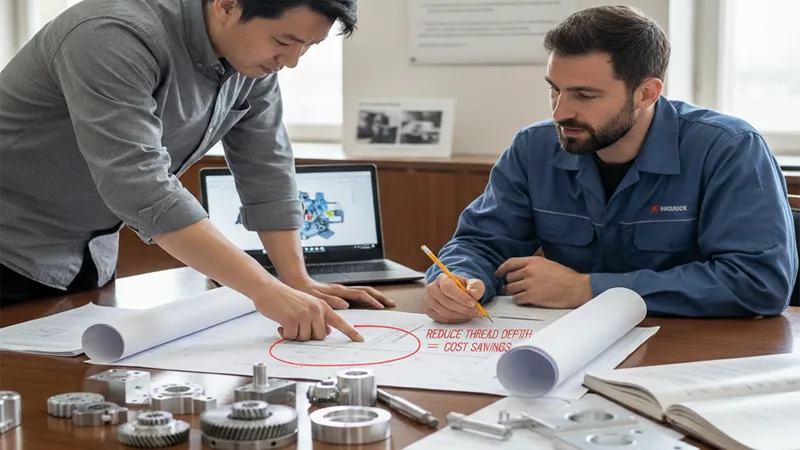
The optimal time to address threading costs is during the prototyping phase. AFI Parts offers Early Supplier Involvement (ESI).
By engaging with our engineering team before finalizing your drawings, we can:
- Identify non-standard thread pitches that require custom tooling.
- Suggest changes to thread depth based on the specific alloy selected.
- Propose alternative fastening methods (e.g., inserts or press-fit studs) for difficult materials.
- This collaborative approach shifts the focus from “fixing problems” to “preventing costs”.
Machining Process Selection
Choosing the right method—Thread Milling vs. Tapping—is a strategic decision made by our CAM engineers based on volume, material, and tolerance.
Thread Milling vs. Tapping
| Feature | Tapping | Thread Milling |
| Speed | Faster for holes < 2 x D and softer materials. | Slower cycle time, but combines roughing and finishing. |
| Tool Cost | Lower initial cost ($15-$50). | Higher initial cost ($60-$200+). |
| Risk | High risk of part scrap if tap breaks inside. | Low risk; if the tool breaks, it is smaller than the hole and falls out. |
| Quality | Dependent on tap geometry, the fixed pitch diameter. | Highly adjustable; pitch diameter can be tuned by microns. |
| Versatility | One tap size = one thread size. | One mill can cut multiple diameters of the same pitch. |
| Deep Holes | Difficult chip evacuation; high torque. | Excellent chip evacuation; low cutting forces. |
At AFI Parts, we typically employ tapping for high-volume production in aluminum and mild steel, where speed is paramount. We utilize thread milling for high-value components (titanium, stainless steel), large diameters, and deep threads where process security and thread quality are non-negotiable.
Supplier Communication
Transparent communication between the OEM and the custom machining supplier is the bedrock of a successful partnership.
Requesting Cost Breakdowns
We encourage our clients to understand the “Why” behind the price. A transparent cost breakdown reveals the impact of design choices.+1
- Setup vs. Run Time: Deep threads increase run time. If a quote seems high, ask if thread depth is driving the cycle time.
- Tooling Amortization: Non-standard threads require us to buy special taps. These costs are often passed on to the project.
- NRE (Non-Recurring Engineering): Complex deep threads require specialized programming and fixture design to ensure rigidity.
Standardizing Thread Specifications
Standardization is a powerful lever for cost reduction.
- Inventory Reduction: If a machine is set up with a 1/4-20 tap, designing all relevant holes on the part to 1/4-20 avoids tool changes. Mixing 1/4-20 and 1/4-28 on the same part requires two tool stations and two setups.
- Economies of Scale: Buying standard taps in bulk lowers the per-unit tooling cost.
- Risk Mitigation: Operators are less likely to load the wrong tool if the shop floor standardizes on common coarse threads (UNC/Metric Coarse) rather than fine threads, which are more delicate and prone to cross-threading.
Our Recommendation: Unless vibration resistance specifically demands a fine thread, always default to standard coarse threads for lower cost and easier machining.
Case Studies and Practical Applications
Real-world examples from the AFI Parts floor demonstrate the financial impact of thread engineering.
Aerospace and Automotive Threading
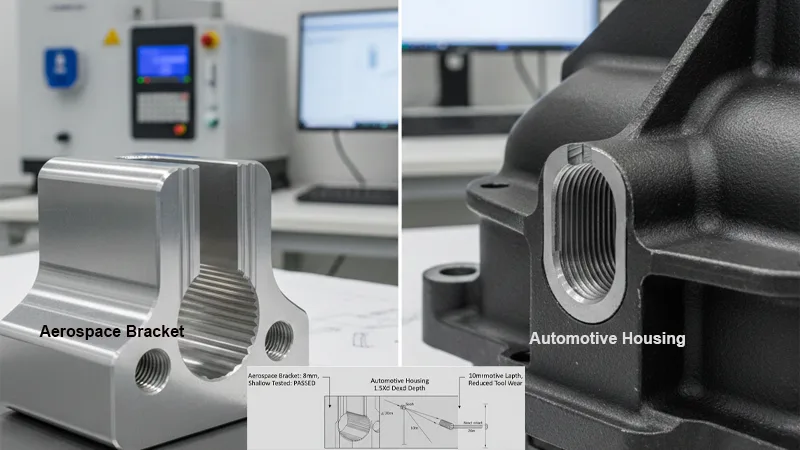
Case A: Aerospace Titanium Bracket
- Challenge: A client requested a 1/4-28 thread with a depth of 4 x D in Titanium 6Al-4V.
- Issue: Taps were breaking every 50 parts due to heat buildup and titanium’s tendency to “grab” the tool.
- Solution: Our engineers consulted with the client to analyze the stress load. We determined that a 1.5 x D depth provided 120% of the required pull-out strength. We also switched to thread milling.
- Result: Cycle time reduced by 20%. Tool life extended by 300%. Scrap rate dropped to near zero.
Case B: Automotive Aluminum Housing
- Challenge: High-volume production of a cast aluminum housing with varied thread sizes (M6, M8, M10).
- Issue: Frequent tool changeovers were causing bottlenecks.
- Solution: We worked with the design team to standardize all mounting points to M8 x 1.25. We implemented roll form tapping (forming threads without cutting), which is faster and stronger in aluminum.
- Result: Setup time reduced by 30%. Throughput increased by 15%. The thread strength improved due to the cold working of the material
Small Batch vs. Mass Production
The strategy for threading changes with volume.
- Small Batch (Prototyping): We prioritize process security. We will use thread milling or conservative tapping cycles to ensure the first part is correct. The goal is to avoid setup scrap.
- Mass Production: We prioritize cycle time. We optimize the drill-to-tap ratio, use custom coated taps, and push speeds to the limit. Here, reducing thread depth by even 2mm can save thousands of dollars annually across a 50,000-unit run.
Checklist for Engineers and Buyers
To assist our partners in designing cost-effective, high-quality components, the engineering team at AFI Parts has compiled this essential DFM checklist. Use this before finalizing your technical data packages.
- Thread Depth Validation:
- [ ] Is the thread depth limited to 1.5 x D (Steel/Hard Metals) or 2.0 x D (Aluminum/Soft Metals)?
- [ ] Is there a valid structural reason for any thread exceeding 2.5 x D?
- Hole Type Verification:
- [ ] For blind holes, is there at least 0.5 x D of clearance at the bottom for chips and tap lead?
- [ ] Can through-holes be used instead of blind holes to assist with chip evacuation?
- Standardization:
- [ ] Are thread sizes standardized across the assembly to reduce tool changes?
- [ ] Are standard coarse threads used instead of fine threads where possible?
- Material & Process alignment:
- [ ] Is the material machinability considered? (e.g., Deep tapping in Inconel is high-risk; specify thread milling).
- [ ] Have you consulted AFI Parts for a DFM review on critical threaded features?
FAQ
While we can machine virtually any depth, we strongly recommend a maximum of 3 x D. Beyond this, special long-reach tooling is required, rigidity is compromised, and costs increase disproportionately to any mechanical gain.
We recommend thread milling for three main reasons:
- Risk Management: In expensive materials/parts, breaking a tap is catastrophic. Thread mills do not jeopardize the part.
- Thread Quality: Thread milling produces superior surface finishes and allows for precise tolerance adjustments (e.g., H limits).
- Hard Materials: Tapping hardened steel is risky; thread milling cuts it efficiently.
Pull-out strength is not linear. The first thread takes ~34% of the load. The first six threads take nearly the entire load. Adding depth beyond 1.5 x D generally provides no additional tensile strength, as the bolt will fracture before the threads strip.
Absolutely. This is our specialty. By engaging with AFI Industrial Co., Ltd early in the design phase, we can simulate machining processes and suggest geometric changes (like thread depth reduction) that lower costs without compromising performance.
Providing clear drawings, thread size, depth, material, and any special requirements. This helps to choose the right process and keep costs low for your project.
Conclusion
At AFI Industrial Co., Ltd, we see ourselves not just as a machine shop, but as your strategic manufacturing partner. The correlation between thread depth and manufacturing cost is undeniable. By understanding the mechanics of CNC machining, tool wear, and material removal, engineers can design parts that are not only superior in performance but also optimized for economic production.
We invite you to contact our engineering department for a comprehensive review of your next project. Let us help you navigate the complexities of precision machining to deliver value, quality, and reliability.
Contact AFI Parts Today for a DFM Review.