
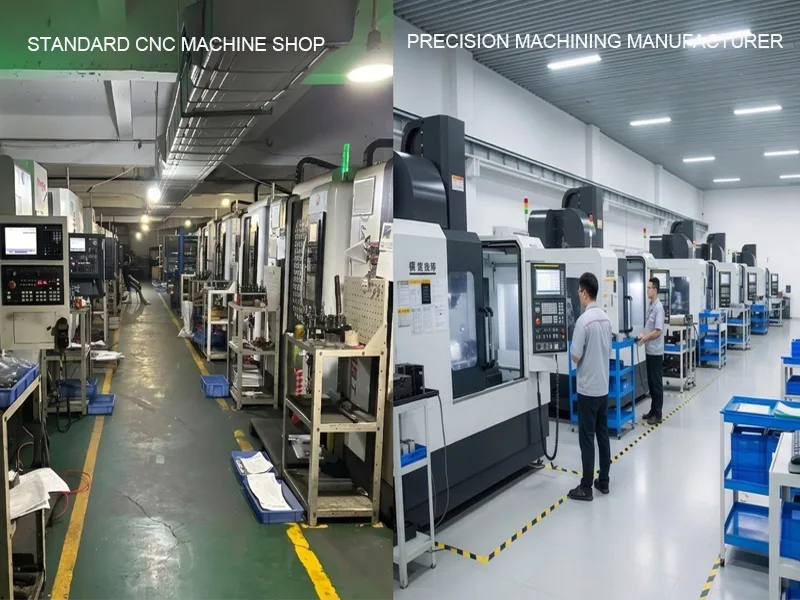
In the highly competitive landscape of modern manufacturing, selecting the appropriate supply chain partner can dictate the success or failure of a product line. A precision machining manufacturer is fundamentally different from a standard shop. While both entities manipulate raw materials into finished goods, the operational philosophies, technological investments, and fundamental capabilities diverge sharply.
A standard shop typically focuses on high-volume, low-complexity general manufacturing, whereas a precision machining manufacturer can make parts with very exact measurements and uses advanced engineering. Picking the right company changes the quality, how well things work, and whether rules are followed. In sectors where catastrophic failure is not an option, relying on standard machining practices introduces unacceptable risk. Some industries inherently need precision machining to function. These include aerospace, defense, and medical devices, which must follow strict rules and avoid mistakes. Advanced technology helps give steady results, tight tolerances are needed for important uses, and engineering skill helps meet industry rules.
At AFI Parts, we recognize that true precision is not merely a marketing term; it is a rigorous, quantifiable discipline rooted in metrology, material science, and advanced multi-axis kinematics.
Key Takeaways
- Precision machining manufacturers make parts with exact sizes, utilizing advanced technology to do this.
- Tight tolerances are very important for some industries. Aerospace and medical devices need these to be safe and work well.
- Advanced CNC machines help make high-quality parts fast, and skilled workers also help with this, while standard shops do many different jobs.
- Standard shops do not have the same precision or quality checks, whereas precision machining has strong quality control.
- Precision facilities often follow ISO standards, which ensure every part meets strict rules.
- You should pick the pipeline based on your project, thinking about how hard it is, your budget, and what quality you need.
- Investing in precision machining can save time and money later, as it does this by making fewer mistakes and making sure parts fit.
- Precision manufacturers can also give advice and engineering help, which can make your designs and material choices better.
Table of Contents
What Is a Precision Machining Manufacturer?
A precision machining manufacturer is a specialized production enterprise that utilizes various high-precision manufacturing equipment to process metallic or non-metallic materials, producing components with complex structures and tolerances reaching the micron level.
What Is a Standard Shop?
A standard shop does many kinds of manufacturing work. It can handle everything from design to packing. Standard shops use different tools and ways to make things, like robots and assembly lines. Workers may help with running machines, moving products, or managing jobs. These shops often make things for stores or do simple jobs. Some can make custom items, but they do not focus on tight sizes or special machines. Workers in standard shops learn about running jobs and basic engineering.
Key Differences Overview
You can see the differences by looking at what each shop does, what tools they use, and how they check quality.
Tolerances and Precision
Precision machining manufacturers can make parts with much tighter sizes than standard shops. For example, CNC machining can make parts as close as ±0.0025 mm (±0.0001″). Standard shops usually work with sizes around ±0.127 mm (±0.005″). This high level of precision is needed for jobs where parts must always work the same way.
Technology and Equipment
Advanced technology is what makes precision machining manufacturers different. They use CNC machines, 3D analysis, and special programming tools. These tools help move from design to making parts without mistakes. For example, Siemens’ Optimize MyProgramming/3D Scanner helps by using 3D analysis with CNC control. Standard shops use both hand tools and some machines, but they do not use advanced software or multi-axis machines.
Quality and Reliability
Precision machining manufacturers use strong quality control systems. They check parts while making them, and after they are done. Many follow ISO 9001 rules to make sure every part is right. They also use simulation and path planning to save time and work better. Standard shops may do simple checks, but they do not have as many steps or as much formal paperwork.
Target Industries
Because of these stringent controls, precision machining manufacturers work for industries that need very accurate and reliable parts. These include aerospace, medical devices, automotive, and defense, where they often help with sample preparation, provide engineering support, and perform additional steps such as plating or assembling parts. Standard shops usually work with general manufacturing, fixing things, or making simple samples.
Comparison Table: Operational Scope and Capabilities
| Aspect | Precision Machining Manufacturer | Standard Shop |
|---|---|---|
| Scope | Shapes parts through material removal, tight tolerances, and micro-machining . | Handles full production, broader focus, standard tolerances |
| Tools and Techniques | CNC machines, advanced software, 5-Axis CNC machines, advanced CAM software, multi-axis lathes, and EDM. | Manual tools, tools, 3-axis basic mills, basic automation. |
| Quality Control | Rigorous CMM inspections, GD&T adherence, ISO standards。 | Basic caliper/micrometer checks, less documentation。 |
| Target Industries | Aerospace, medical, defense, and high-performance automotive。 | General manufacturing, commercial repair, and fixtures. |
Precision machining manufacturers are special because they use advanced technology, make parts with tight sizes, and work for industries with strict needs. Standard shops do more types of jobs, but do not reach the same level of precision or quality checks.
Capabilities and Services
Tolerances and Accuracy
Precision Levels
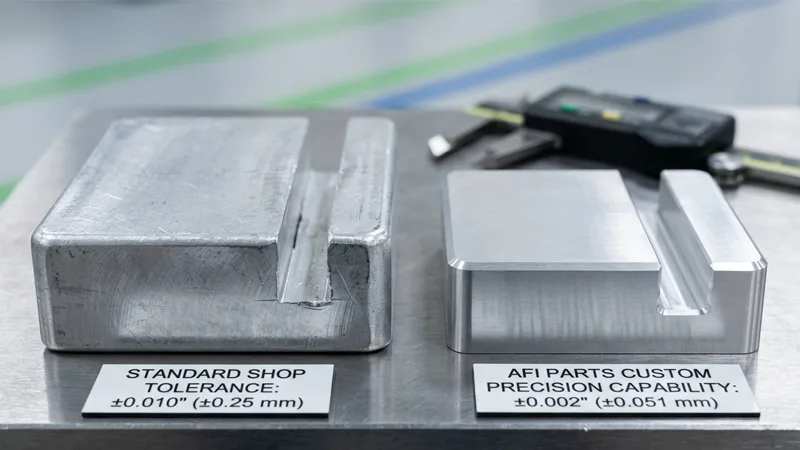
Precision machining manufacturers can make parts with much tighter sizes than standard shops. They use advanced CNC machines to get very small measurements right. This is important for jobs where every part must fit and work the same way.
The table below shows how close the sizes can be for different materials under strictly controlled thermal conditions (standardized at 20°C / 68°F):
| Material Grade | Standard Shop Tolerance Limit | AFI Parts Custom Precision Capability |
|---|---|---|
| Aluminum 6061 | ±0.010″ (±0.25 mm) | ±0.002″ (±0.051 mm) |
| Stainless Steel 316 | ±0.010″ (±0.25 mm) | ±0.001″ (±0.025 mm) |
| Copper Alloys (C110) | ±0.010″ (±0.25 mm) | ±0.003″ (±0.076 mm) |
| Titanium (Ti-6Al-4V) | ±0.010″ (±0.25 mm) | ±0.002″ (±0.051 mm) |
| Tool Steel (D2, H13) | ±0.010″ (±0.25 mm) | ±0.0005″ (±0.013 mm) |
Standard shops usually work with bigger sizes, meaning their parts may not fit as well or work as well in tough jobs.
Impact on Product Performance
Tight sizes help parts last longer and work better. When a part fits just right, it does not wear out fast. This means fewer problems and less time fixing things. In places like airplanes or hospitals, even a small mistake can be a big deal. Precision machining manufacturers help stop these problems by making sure every part is made right.
Equipment and Technology
CNC Machines and Automation
Precision machining manufacturers use advanced CNC machines with 3-axis, 4-axis, and 5-axis simultaneous cutting features. These machines can make hard, complex geometries in fewer setups. By reducing the number of times a part is clamped and re-clamped, they also make fewer mistakes and work faster. Automation, such as robotic arm machine tending, helps finish jobs on time and keeps the quality consistently high.
- 3-axis, 4-axis, and 5-axis CNC machines make hard parts with less manual work.
- Automation helps stop mistakes and makes parts the same every time.
- CNC machines make things faster and can save money, whereas standard shops may use hand tools or simple machines that cannot work as fast or as well.
Software and Process Control
Advanced CAD/CAM software seamlessly connects the digital design phase to the production of physical parts. This lets precision machining manufacturers generate complex toolpaths (like trochoidal milling) to make parts that were simply too hard to machine before. The software also helps plan each granular step, so machines cut the right way every time, controlling chip load and tool engagement angles. In-machine touch probes and process control systems watch each job and find mistakes early. Using good software means less wasted raw material and lower overall manufacturing costs.
Materials and Part Complexity
Range of Materials
Precision machining manufacturers can work with many challenging kinds of materials. They use aerospace-grade aluminum, high-carbon steel, stainless steel, medical-grade titanium, and superalloys like Inconel. Each material possesses a unique machinability rating and thermal conductivity. For example, austenitic stainless steel can get harder when cut (work hardening), and titanium requires high-pressure coolant and special carbide tools because it dissipates heat poorly.
| Material Type | Machining Characteristics | Complexity & Precision Impact |
|---|---|---|
| Aluminum Alloys | Stays steady, easy to cut, high thermal conductivity | Tight sizes are possible with minimal tool wear |
| Steel Alloys | Strong, but can wear out cutting tools fast | Needs careful tool path planning and rigid fixturing for good results |
| Stainless Steel | Does not rust, gets harder when cut (work hardens) | Can change size due to thermal expansion if not done right |
| Titanium Alloys | Light and strong, gummy, hard to cut | Needs experts and specialized tooling for tight sizes |
| Inconel/Superalloys | Handles high heat, extremely tough to cut | Needs special rigid setups and low cutting speeds for good results |
Standard shops often lack the rigidity in their machines to handle superalloys, so they use easier materials like simple aluminum or plastics.
Intricate and Custom Parts
Precision machining manufacturers can make very detailed and custom parts featuring undercuts, deep holes, and non-standard threads. Multi-axis CNC machines and skilled workers help make organic, complex shapes that standard shops cannot do. This directly helps industries that need special, highly engineered parts, like airplanes and medical devices.
These advanced CNC machines help make hard designs and small custom jobs, resulting in fewer dimensional mistakes and far superior surface finishes (Ra values). Standard shops may have trouble with hard parts or special requests, usually defaulting to making simple geometric shapes and bigger batches.
Quality Standards and Certifications
Quality Control Methods
Inspection and Testing
Precision machining manufacturers use very strict, data-driven ways to check parts. They look at parts during every step of the routing process. Workers use highly calibrated tools like coordinate measuring machines (CMMs), optical comparators, digital calipers, and micrometers. These tools help accurately measure physical parts to make sure they match the digital CAD model and are the right size.
Furthermore, manufacturers often use advanced CNC machines equipped with spindle probes to help check parts directly in the machine enclosure. Some high-end systems can laser scan parts and find volumetric mistakes fast. Standard shops, lacking this capital investment, use simple tools to check parts by hand or use easy go/no-go gauges. This works for simple jobs but can easily miss small, critical tolerance deviations. Checking parts often helps stop compounding mistakes and keeps the production work moving efficiently.
Documentation Practices
Writing things down and maintaining strict lot traceability is incredibly important in precision machining. Manufacturers keep meticulous notes and logs on every step they take, writing down exact sizes, machine spindle load settings, and the specific heat numbers of the materials they use. This traceability helps quickly find root-cause problems and mathematically proves parts meet the required rules.
Dedicated quality engineering teams look at these notes to make sure everything is right before issuing a Certificate of Conformance (CoC). Standard shops may only write down simple things, noting basic sizes or general job info. This is okay for easy jobs, but totally unacceptable for industries with strict regulatory rules
AFI Parts’ Comparative Quality Matrix
| Quality Control Method | Precision Machining (AFI Parts Standard) | Standard Shops |
|---|---|---|
| ISO Certifications | Often strictly needed for high standards | Not always needed or maintained |
| Advanced CNC Machining | Uses high-precision, rigidly built CNC machines | Uses regular, lighter-duty CNC machines |
| Quality Assurance (QA) Practices | Has strict, multi-stage QA steps (FAI, SPC) | Has basic, often final-only QA steps |
| Industry-Specific Standards | AS9100 for aerospace, ISO 13485 biocompatibility | General commercial rules, less specific |
Industry Certifications
ISO Standards
ISO standards are internationally recognized rules for good quality management. ISO 9001 is a foundational and common certification for precision machining manufacturers. It provides a framework that helps companies do things in the same reliable way and continually get better over time through corrective actions. ISO 9001 says you must keep detailed records, calibrate measuring instruments, and have regular internal checks. Customers explicitly trust companies with ISO because an external auditor verifies that they genuinely care about quality.
AS9100 and Others
Beyond basic ISO, some highly regulated jobs need special certifications.
- AS9100: This is critical for making airplane parts, featuring extra rules for supply chain risk, safety, and trust.
- IATF 16949: This is for car parts, utilizing core tools like PPAP to make sure car parts are made well.
- ISO 13485: This is for medical devices, creating an audit trail that helps keep medical parts safe, traceable, and reliable.
These certifications help customers trust the company, showing that a manufacturer follows strict, unyielding rules and makes good, safe parts. Precision machining manufacturers often invest heavily to maintain many of these certifications. Standard shops may not have the infrastructure for these, so they default to doing easier commercial jobs. These certifications fundamentally help companies secure vendor contracts in industries that need high standards.
Applications and Industries
Precision Machining Manufacturer Use Cases
Aerospace
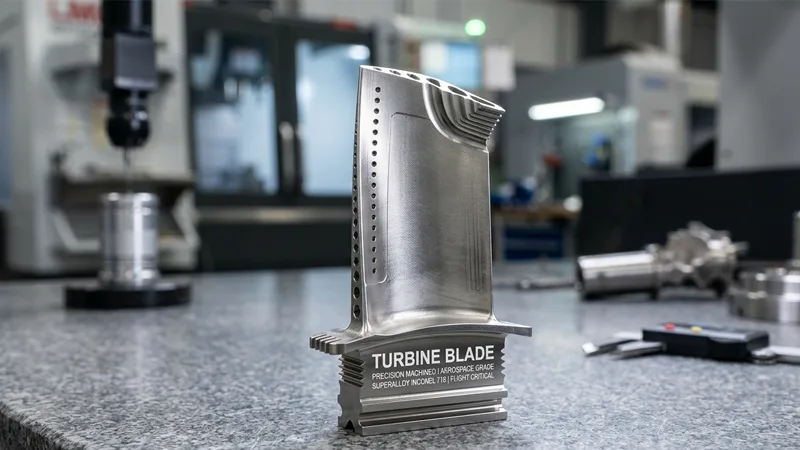
Aerospace companies need parts that follow the strictest metallurgical and dimensional rules. A precision machining manufacturer makes flight-critical engine parts and heavy-duty landing gear. These components must fit perfectly into complex assemblies and handle a lot of cyclic stress and extreme temperatures. Intricate turbine blades and structural engine mounts are made this way too. The aerospace field cares absolutely about safety and trust, so every single part must meet special, non-negotiable needs.
Medical Devices
Medical device makers use advanced precision machining for life-saving surgical implants and surgical tools. These titanium and stainless steel parts must perfectly fit the human body and work without any geometric mistakes. Complex diagnostic machines and delicate dental tools also need exact shapes, burr-free edges, and smooth, sterile sides. This rigorous machining process makes sure each part is biocompatible, safe, and meets stringent FDA health rules.
Automotive and Defense
High-performance car companies use precision machining for vital engine blocks, custom pistons, and heavy-duty axles. They also rely on it for tight-tolerance transmission systems and high-pressure fuel injectors. Similarly, defense companies need robust metal parts for advanced weapons systems and reliable engines used in armored military vehicles. The multi-axis machining process also makes heavy-duty brackets and other structural parts for these vehicles. Each defense and automotive part must work perfectly in hard, unforgiving environments and last a very long time without failing.
Target Industries Matrix
| Industry | Typical Precision Machined Applications |
|---|---|
| Automotive | Engine blocks, transmission systems, axles, fuel injectors |
| Aerospace and Defense | Turbine blades, landing gear, engine mounts, weapon brackets |
| Medical and Healthcare | Orthopedic implants, surgical tools, diagnostic machines, and dental tools |
| Oil & Gas | High-pressure valve parts, seals, drilling tools, and pump housings |
| Electronics | Semiconductor chip housings, heat sinks, connectors, circuit board fixtures |
| Robotics and Automation | Robotic arms, actuator components, precision gears, sensor mounts |
| Renewable Energy | Wind turbine hubs, solar tracking system parts, and generator components |
| Marine Industry | Corrosion-resistant parts for boats, commercial shipping, and military ships |
Standard Shop Use Cases
General Manufacturing
Standard shops help many commercial industries with basic, non-critical manufacturing. They mostly make simple parts for consumer machines and hand tools, focusing on jobs that do not need tight sizes or advanced metallurgy. They can quickly make sheet metal brackets, plastic covers, and simple electronic housings.
Maintenance and Repair
Maintenance and repair of existing industrial infrastructure is a big part of standard shop work. Progressive shops use digital checklists to carefully track safety inspection jobs and plan their repair work. Implementing preventive maintenance helps keep factory machines working smoothly and stops costly, unexpected breakdowns. Furthermore, structured troubleshooting frameworks help maintenance workers systematically find and fix mechanical problems fast.
Prototyping
Standard shops often help engineers with making initial proof-of-concept test parts. They make early, low-fidelity versions of parts specifically for form-and-fit testing. This early prototyping helps hardware companies see if a new design basically works before spending capital on making a lot of them. Prototyping basic geometries in a standard shop is quick and saves money for easy shapes. Overall, standard shops give flexible, cost-effective help for simple manufacturing, facility repairs, and early product ideas.
Cost, Lead Time, and Flexibility
Pricing Comparison
Cost Drivers
Precision machining manufacturers and standard shops have fundamentally different financial structures and ways to set prices. The final quoted price heavily depends on many technical things. First, the raw material type drastically changes the cost; common aluminum costs much less to procure than aerospace-grade titanium or Inconel. Furthermore, softer materials are significantly easier to cut, which means expensive cutting tools last longer, cycle times are shorter, and overall costs go down.
Conversely, the massive capital investment in advanced 5-axis CNC machines and the high salaries of specialized, skilled workers naturally make precision machining more expensive on an hourly basis. Standard shops, dealing with simpler machinery, have overhead costs that generally sit at about 15% of their lower hourly rates. Additionally, geographic location and supply chain logistics can change overall production prices by up to 22%. High-level precision engineering lets manufacturers ultimately make things more accurate and efficient, reducing long-term waste.
Note: In certain highly specific, outsourced or broker-based standard shop models, anomalous cost structures can appear. For instance, some pipeline models might see sales commissions taking 40% of revenue and shipping/logistics taking 25% of revenue, leading to a total variable rate of 65%. However, in direct manufacturer-to-client precision machining like at AFI Parts, these bloated middle-man costs are eliminated).
Generally, standard shops usually charge between $65–$85 per hour for basic spindle time. In contrast, precision machining contractors utilizing advanced technology may charge $110–$150 per hour. CNC shop rates fluctuate depending on the market because each shop has different machine capabilities, spindle speeds, and worker skills.
Value vs. Price
When evaluating quotes, procurement managers must look beyond the initial invoice. Precision machining manufacturers actually give more long-term value for complex jobs needing tight tolerances and highly reliable parts. Their higher upfront prices directly come from investments in advanced measuring machines, highly skilled workers, and strict, documented quality checks.
Standard shops offer lower initial prices, perfectly suited for simple jobs and general commercial manufacturing where a failure won’t cause catastrophic damage. The true economic value always depends on properly matching the shop’s technical skills to the specific risk profile and tolerances of the project.
Lead Times
Project Complexity
Manufacturing lead times heavily depend on exactly how hard the specific part is to make; naturally, simple parts take less time from CAD to completion. Hard, intricate designs need custom workholding fixtures, more machine setups, and careful CAM programming work. As mentioned, the raw material also wildly affects cutting speed. Soft aluminum is substantially faster to machine at high feed rates than work-hardening stainless steel. Furthermore, different operations like 3D contour milling, single-point turning, and deep-hole drilling all have vastly different completion speeds.
In summary: Simple parts are made faster, complex parts need more physical setups and take longer, and softer materials are quicker to efficiently machine. Conversely, harder super-metals inevitably slow down the overall production timeline.
Volume and Scheduling
Beyond the part itself, the requested batch size and shop scheduling determine how fast a manufacturer can finish work. Capable precision machining manufacturers successfully handle both rapid small prototypes and big, multi-year production orders. They frequently use pallet pools and robotic automation to keep continuous production moving overnight (lights-out manufacturing). Standard shops, lacking this automation, may focus solely on small batches or single repair jobs. This manual approach can be faster for an urgent, easy part, but is severely slower for hard, high-volume projects.
Production Volume Profiles
| Feature | Prototype Machining | Job Shop Machining | High-Volume Production Machining |
|---|---|---|---|
| Typical Quantity | 1–10 parts | Few to dozens | Thousands or millions |
Customization and Flexibility
Design Changes
A major advantage is that precision machining manufacturers actively help engineers with complex design changes. They offer invaluable DFM (Design for Manufacturability) consultations and robust engineering support before cutting chips. They help engineers pick optimal materials and do rapid prototyping and physical testing. This collaborative phase makes sure custom parts completely meet mechanical needs before committing to expensive full production. Furthermore, custom machine tending robotic solutions solve special, unique floor problems like handling severe part complexity and tight factory space limits.
In short: Deep engineering consultations help fully explain project needs, direct engineering support vastly improves part designs, and early prototyping and testing rigorously check custom parts.
Batch Sizes
Thanks to advanced fixture tracking, precision machining manufacturers can efficiently make rapid prototypes, small bridge-tooling runs, and massive orders. Standard shops often only do small batches or single replacement parts. This high scalability and flexibility help precision machining manufacturers continuously serve demanding industries with rapidly changing product lifecycle needs. Picking the right shop ultimately depends heavily on how hard the project geometry is, how many total parts you need over the year, and if you want specialized custom work.
Choosing the Right Shop
Key Factors to Consider
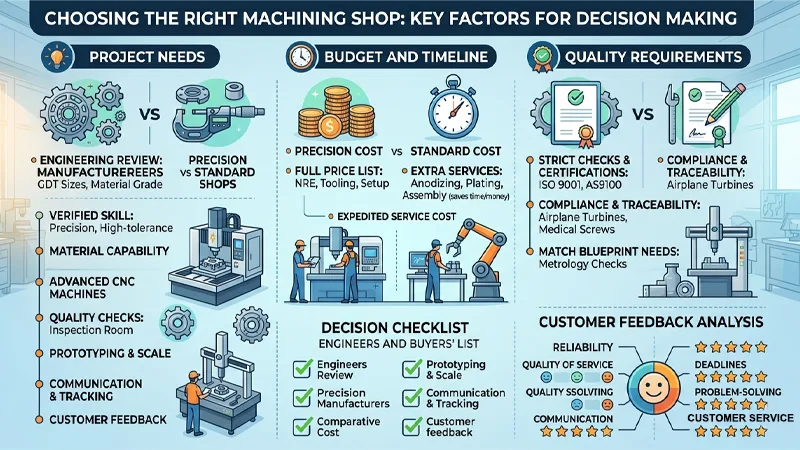
Project Needs
Every single metal machining project is structurally different. First, engineering teams must look honestly at how hard their part is to actually make. Think deeply about how exact the GD&T sizes must be and what specific material grade you need. Precision machining manufacturers are exceptionally good at making complex parts with tight sizes and tricky, multi-axis shapes. Standard shops predictably do better with simple, loose-tolerance parts and basic big orders.
When you plan your critical project, you must think about these specific things:
- The shop’s verified skill in precision, high-tolerance machining.
- If they can reliably work with many difficult materials.
- The specific types of advanced CNC machines they have on their floor.
- How stringent their checks for quality are in the inspection room.
- If they can rapidly adapt to changing designs and make test parts.
- How predictably fast they finish, and if they can safely scale to do more volume later.
- How well and transparently they talk with your engineering team.
- Whether you can track your critical order status online.
- What other verified customers say about their track record.
Budget and Timeline
Available money and required time are always important metrics when picking a manufacturing shop. Precision machining manufacturers inevitably cost more per hour because they utilize special, expensive machines and highly skilled workers. Standard shops charge less for fast, easy jobs. It is vital to always ask for a full, transparent price list so you know all the hidden costs (like NRE – Non-Recurring Engineering fees).
Additionally, some advanced shops can fully finish (anodize, plate) or put sub-assemblies together, which dramatically saves supply chain time and money. If you need your parts incredibly fast, a high-end shop may use robots or work extra weekend hours, but you must expect that this expedited service can cost more.
Quality Requirements
Different shops have vastly different ways to check part quality. Precision machining manufacturers utilize incredibly strict checks and almost always have audited ISO 9001 or AS9100 certificates. Standard shops use quick, simple manual checks. You must make sure the shop’s internal metrology checks match what your compliance department needs. For critical things like airplane turbines or medical bone screws, you absolutely need strong regulatory rules and lots of traceable notes. For easy, non-load-bearing jobs, simple manual checks might be perfectly fine.
Decision Checklist
Engineers and buyers should use this strategic checklist to help pick the exact right shop:
- Does the shop physically have the right rigid CNC machines for your specific job?
- Can they properly cut your chosen material and handle any thermal or tooling problems?
- Do the floor workers have the proven skills and training for your complex part?
- Are there any obvious slow steps in their process, like manually changing tools or restrictive small batch limits?
- Do their internal CMM checks and QA rules match what your blueprints need?
- Did you clearly talk about tight sizes, specific surface finish (Ra), and exactly how many you need?
- Did you get a full, itemized price list with all tooling and setup costs included?
- Do they offer valuable extra help like surface finishing or putting parts together?
- Can you strategically work with them as a partner for a long time?
A critical tip for buyers: Price is definitely not the only thing that matters in manufacturing. Picking the absolute cheapest standard shop can actually cost you massively more money later if they miss critical launch deadlines or make costly dimensional mistakes.
Customer Feedback Analysis
| Key Aspect | Precision Machining Manufacturer | Standard Shop |
|---|---|---|
| Reliability | Exceptionally High | Changes a lot based on the operator |
| Quality of Service | Always consistently high | Not always the exact same |
| Communication | Clear, engineering-focused, and quick | Usually answers only after you ask |
| Adherence to Deadlines | Strictly follows production deadlines | Frequently misses strict deadlines |
| Problem-Solving | Shows deep capability in real engineering stories | Not always technically clear |
| Customer Service | Helps actively throughout the DFM and the project | Not always the same |
Picking the absolute right shop means accurately matching what you legally and mechanically need with what the shop does best. Look closely at your blueprint needs, compare what competing shops can realistically do, and use the strategic checklist to actively help you choose.
Precision machining manufacturers are special partners because they rigidly check quality all the time, completely preventing bad parts from leaving the dock. They exclusively use advanced CAD/CAM systems to program complex paths and strictly follow industry rules. Conversely, standard shops do bigger, looser jobs and use simple manual checks. Looking forward, AI-powered predictive systems and hybrid additive-subtractive machining will be vastly important in the manufacturing future. These technological leaps will make precision work even more popular and capable.
To pick the best right provider, you must actively look at their technical skills and audit how they check quality. You should also always look at physical sample parts and ask for direct industry references. Be sure to check their historical defect rates (PPM) if you desperately need high-precision parts. Talk openly about any past machining problems they’ve faced and precisely how they engineer fixes for them. Make sure you know what your digital project needs before you sign a contract and choose a shop; this due diligence helps you seamlessly find the best long-term fit.
FAQ
Precision machining manufacturers make parts with very exact sizes. They use advanced CNC machines and skilled workers. This means the parts are always of the same quality. Industries like aerospace and medical devices need this kind of accuracy.
Standard shops can make custom parts. They usually make simple shapes and bigger groups of parts. If a part is hard to make or needs tight sizes, you need a precision machining manufacturer.
CNC machines help by cutting and shaping parts automatically. They make fewer mistakes and finish jobs faster. CNC machines can also make hard designs. Precision machining manufacturers use multi-axis CNC machines for tough parts.
ISO 9001 and AS9100 are important certifications. These show that a manufacturer follows strict quality rules. Medical device projects may need ISO 13485.
Precision machining services cost more money. This is because they use advanced machines, skilled workers, and strong quality checks. The higher price means you get better parts and fewer mistakes.