
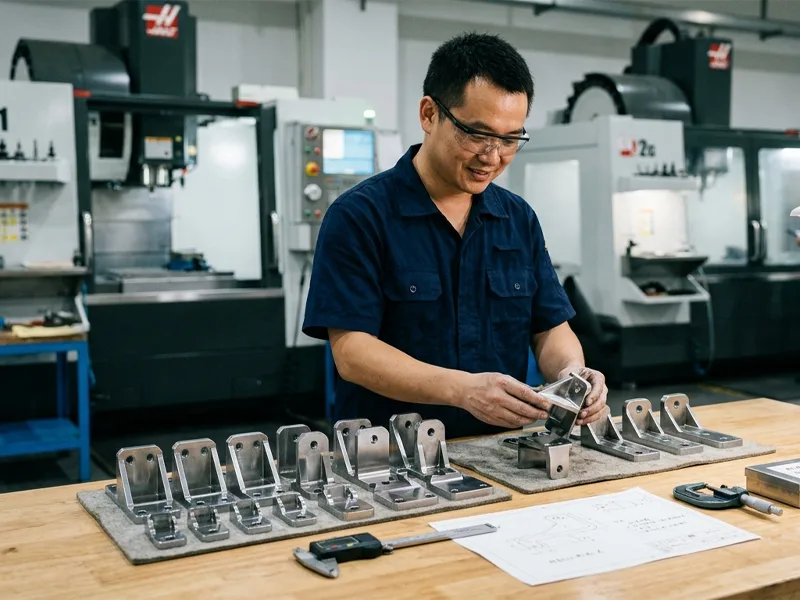
Introduction
If you’re sourcing heavy-duty brackets, you’re usually balancing three constraints that do not negotiate: load path integrity, dimensional fit, and delivery risk. That tension shows up most clearly when procurement and engineering are trying to qualify a new machine shop or add a second source.
This guide is for procurement managers, mechanical engineers, and supplier quality engineers (SQE) who need to evaluate a heavy duty bracket custom machining supplier with enough evidence to sign off on an RFQ award.
You’ll get a practical, audit-ready framework: what technical requirements to define, what Design for Manufacturability (DFM) feedback to expect, what supplier-quality evidence to request (PPAP/FAI, capability, traceability), and how to compare quotes on total cost of ownership (TCO), not piece price.
Why it matters: Brackets are simple-looking parts that fail expensively. A bracket that “meets print” but has unstable datums, distortion after finishing, or inconsistent inspection practices drives rework, line stops, and late engineering changes. The cheapest quote often becomes the highest TCO.
Key Takeaway: The best supplier choice is the one that can prove capability (process + measurement), not the one that promises tight tolerances.
Table of Contents
Technical requirements
Before you compare suppliers, lock down the technical definition of the bracket as if you were writing the inspection plan. If the drawing package is under-specified, different shops will quote different assumptions, and you’ll only discover the gap after parts arrive.
A simple way to avoid ambiguity is to include a one-page “assumption sheet” in the RFQ. It lists the few decisions that change price and risk the most: datum scheme, inspection reporting level, post-finish measurement requirement, and any special handling (corrosion protection, thread inserts, marking). When these assumptions are explicit, quotes become comparable and first-article expectations are clearer.
Materials & finishes
Start with material as a functional decision, not a catalog pick. For heavy-duty brackets, the common split is between aluminum alloys (weight and corrosion), carbon steels (strength and stiffness), and stainless steels (corrosion and temperature).
What to specify in the RFQ:
- Material standard and condition (example: 6061-T6, 7075-T6, 4140 Q&T, 304/316L). Require mill test reports or certificates of conformance for each lot.
- Heat treatment and stress relief expectations when distortion risk is high (thick-to-thin transitions, deep pockets).
- Finish type and performance requirement (corrosion, wear, appearance). If anodizing or plating is required, call out whether critical dimensions are measured before or after finishing.
- Surface finish requirement (Ra) on functional faces, and what instrument will be used to verify it. If you reference surface finish terminology, use a common definition source, such as GD&T Basics on surface finish terminology.
Practical supplier questions:
- Which surfaces are “functional” in your fixture and datum plan?
- How do you control dimensional change from finishing (masking, stock allowance, post-finish inspection)?
- Can you provide final certifications from approved sub-tier suppliers when required?
Processes & envelopes
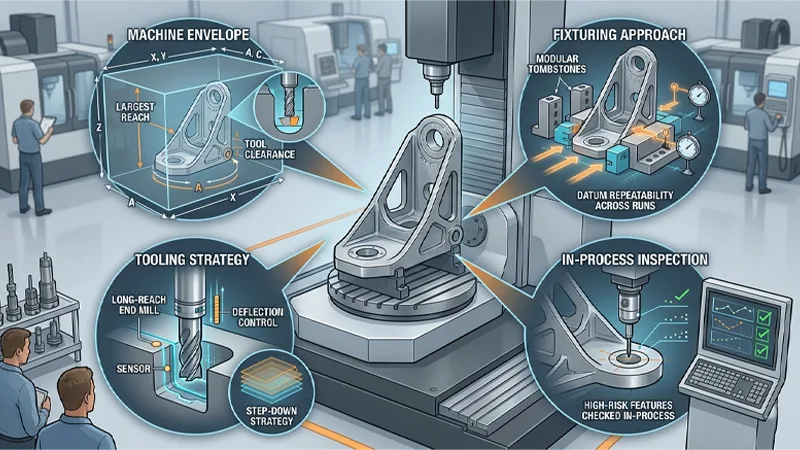
For brackets, the manufacturing route is usually CNC milling (3-axis through 5-axis) plus secondary operations (deburr, finishing, inserts, marking). Your evaluation should focus on whether the supplier’s equipment and fixturing approach match the bracket’s size, access constraints, and inspection method.
What to ask for:
- Machine envelope and axis capability relative to your largest bracket and feature reach.
- Fixturing approach (soft jaws, modular tombstones, dedicated fixtures) and how they maintain datum repeatability across runs.
- Tooling strategy for deep pockets or long-reach features (deflection control, step-down strategy).
- In-process inspection approach and checkpoints for high-risk features.
If a supplier says they can hold “tight tolerance,” ask what that means in their normal production controls. Many machining capability descriptions cite typical precision ranges around ±0.001 inch for critical features when the process and measurement system support it; see a practical overview, such as Modus Advanced, on tight-tolerance CNC machining and quality standards.
Tolerances & GD&T
CNC machining tolerances are not just a number on a quote. They are the combined result of machine capability, tool deflection, fixture stability, thermal control, and the measurement method used to verify the feature.
A bracket’s fit is usually driven by relationships (hole-to-hole position, hole-to-datum position, flatness of a mounting face) more than single dimensions. That’s where geometric dimensioning and tolerancing (GD&T) is valuable, but only if the datums reflect how the bracket is located in assembly.
If you use GD&T, align three things:
- Functional datums: the surfaces/axes that represent how the bracket seats and locates.
- Inspection method: coordinate measuring machine (CMM) strategy, probing access, and measurement uncertainty.
- Manufacturing plan: which operations establish datums first, and how re-clamping affects location.
If you need a refresher on GD&T intent and terminology, use a reference like Fictiv’s GD&T 101 guide so that engineering and suppliers are speaking the same terminology.
Practical acceptance criteria to include in your RFQ package:
- Identify critical characteristics (CC) and key product characteristics (KPC) explicitly.
- State whether tolerances apply as-machined or after finishing.
- Define the inspection reporting format you want for first articles (full dimensional layout vs. ballooned drawing + partial layout).
DFM for brackets
Bracket DFM is where most cost-down wins come from, because it changes the process plan before you are paying for scrap and rework. If two suppliers quote the same part, the one who gives you better bracket DFM feedback is usually the one you can ramp with less drama.
The best supplier qualification process includes a DFM loop before quote finalization. A supplier that cannot explain why a feature is expensive or unstable is likely to discover problems late, after you’ve committed.
Geometry & tool access
Bracket cost often comes down to tool access and cutting stiffness. When geometry forces long-reach tools, thin walls, or repeated re-clamping, you pay for slower feeds, higher scrap risk, and more inspection.
DFM questions that separate strong suppliers from quote-factories:
- Inside corners: Are the internal radii compatible with standard end mills, or are you forcing tiny tools and incurring long cycle times?
- Wall thickness: Are tall, thin walls required, or can ribs/fillets provide stiffness with better machinability?
- Pocket depth vs. tool reach: Can you reduce depth, add access windows, or split features across setups?
- Datum surfaces: Are you giving the supplier flat, accessible faces to clamp and probe consistently?
Hole patterns & datum strategy
Hole patterns are where “looks fine on CAD” turns into real assembly pain. The best RFQs define how holes relate to the bracket’s mounting scheme.
What to validate:
- Datum scheme matches assembly: If datum A is the mounting face, the supplier should machine and verify it early.
- Position tolerances are inspectable: A tight true position callout is meaningless if the supplier can’t probe the datum and holes with adequate access.
- Stack-up awareness: If multiple hole patterns interface with different components, consider functional gaging or an assembly check fixture.
Ask the supplier to describe their first-article measurement plan: what datums they will establish, how they will re-locate between ops, and whether a CMM program is used.
Distortion control
Distortion is common in brackets that mix thick and thin sections or require heavy stock removal. It shows up as warped mounting faces, shifted hole location after stress relief, or geometry drift after anodizing/plating.
Controls to look for:
- Roughing + rest + finishing strategy to let stresses relax before final passes
- Symmetric material removal where possible
- Stress-relief steps when the material and geometry justify it
- In-process checks on datums before committing to downstream ops (finishing, inserts)
⚠️ Warning: If a supplier agrees to tight flatness/position but cannot describe how they will control distortion, treat the quote as high risk.
Supplier qualification & quality
A capable shop is not just a machine list. It’s a controlled process plus a measurement system you can trust. The decision-stage question is simple: what evidence do you get before you approve production?
Certifications
Certifications don’t make parts good, but they reduce uncertainty. At minimum, verify ISO 9001 and confirm what the certificate scope covers (sites, processes).
For higher-risk programs, also confirm whether the supplier holds industry-specific certifications (example: IATF 16949 for automotive supply chains, AS9100 for aerospace, ISO 13485 for medical). The practical point is whether their quality system can support document control, traceability, calibration, and nonconformance handling.
PPAP/FAI evidence

Define acronyms up front in your sourcing process, even if your internal team knows them:
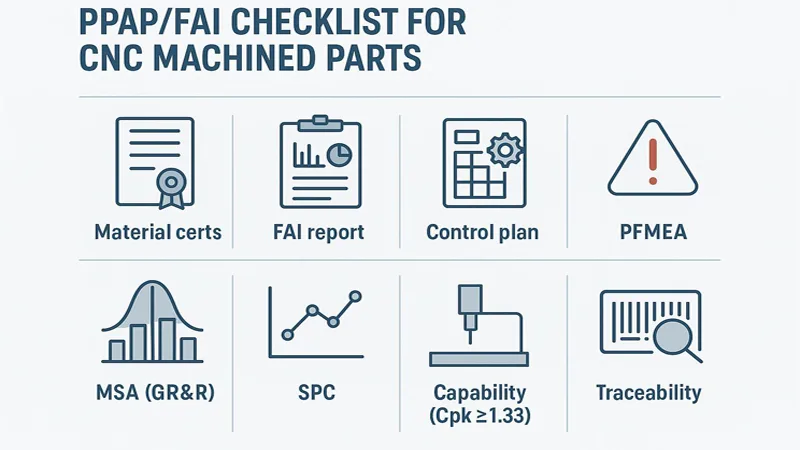
- FAI (First Article Inspection): a complete dimensional verification of a first-article part against the drawing, often with a ballooned print and results table.
- PPAP (Production Part Approval Process): a package of documents used to prove the production process can consistently make conforming parts before full production release.
For a plain-language overview of what a PPAP package typically contains, use 1factory’s PPAP guide. Even if you don’t require full automotive PPAP, the elements are still a strong checklist for evidence-based approval.
What to request in an RFQ (tailored by risk level):
- FAI report format (full dimensional layout, GD&T results, and any functional checks)
- Control plan (inspection points, method, frequency, reaction plan)
- MSA (Measurement System Analysis) summary for critical gages, including GR&R (Gage Repeatability and Reproducibility) where applicable
- Capability evidence for critical dimensions (often Cpk (Process Capability Index) targets such as 1.33 for stable processes, when required by your program)
- Material certifications and lot traceability model
- Change control rules (what triggers re-FAI, re-approval, or customer notification)
Inspection & traceability
Inspection is where supplier promises meet reality. Evaluate it like a system:
- Equipment: CMM availability, calibrated hand tools, surface finish instruments if needed
- Method: how GD&T is measured (CMM program, fixtures, probing strategy)
- Records: how inspection results are stored, revised, and retrievable
- Traceability: how a shipped bracket is tied back to the material lot, process route, and inspection records
If you’re building an approved supplier list (ASL) process, a structured approach is described in SimplerQMS supplier qualification guidelines.
Lead time, logistics & TCO
Piece price is only one line item. For brackets, TCO is driven by lead-time variability, inspection scope, rework risk, and logistics friction.
NPI to production timelines & MOQs
NPI (new product introduction) is where brackets cause the most churn. You want a supplier that can support quick iterations without losing process discipline.
Also, ask for a clear definition of “lead time.” Some suppliers mean machining days only, excluding finishing, outside processing, and outbound shipping. For decision-stage sourcing, request a dated timeline that shows: drawing review/DFM, programming + fixture prep, machining, deburr, finishing, final inspection, packaging, and ship date. If they cannot break it down, you are buying schedule risk.
What to confirm:
- Prototype lead time vs. production lead time, and what changes when volume ramps
- Minimum order quantities (MOQs) and whether they change after process stabilization
- Surge capacity plan: overtime policy, second-shift capability, alternate machines/fixtures
- Engineering change process during NPI: revision control, scrap containment, and re-FAI triggers
If you want a supplier to provide early DFM feedback during NPI, require a written drawing review summary and an itemized quote that calls out inspection scope, finishing assumptions, and change-control triggers. If you’re evaluating AFI Parts as one option, start with their CNC milling capability page and validate the same evidence you request from every supplier.
Logistics & Incoterms
Incoterms decide who owns risk at each step. For heavy brackets, packaging damage and customs delays are common hidden costs.
In your RFQ, request:
- Incoterms offered (EXW, FCA, DAP, DDP) and what’s included
- Packaging spec (corrosion protection, edge protection, crate/pallet requirements)
- Insurance and claims process for damage in transit
- Export documentation handling (commercial invoice, packing list, COO if required)
If you source internationally, insist on clarity. A “cheap” quote that excludes export packing, customs brokerage, or inspection reporting will show up as schedule slip later.
TCO checklist & hidden costs
Use this checklist to compare suppliers apples-to-apples. It’s short on purpose.
Two cost drivers are routinely missed in bracket RFQs:
- Inspection time: A full CMM layout on a complex bracket can take longer than machining the part. Decide up front whether you need 100% feature reporting, a reduced layout focused on critical characteristics, or a hybrid approach.
- Finishing variability: Anodizing, plating, and powder coating can shift dimensions. If a feature is function-critical after finishing, require either post-finish measurement or a defined stock allowance and verification method.
These are not “nice-to-haves.” They change the process plan, the quote, and how you prevent escapes.
- Quality cost: inspection scope included? FAI included? What is charged as extra (CMM reporting, capability studies, gage costs)?
- Yield risk: how is scrap handled in early builds? Who pays for rework from DFM gaps?
- Change cost: What is the policy for drawing revisions, ECO lead time, and re-approval?
- Logistics cost: packing, freight class, duties/tariffs exposure, and expedited options
- Supplier management cost: communication cadence, time zone overlap, and escalation path
If you want a conservative TCO view, assign a dollar value to schedule risk. A bracket that arrives late can stop a build. That cost is rarely in the quote.
Red flags & shortlisting
Once you’ve gathered quotes and evidence, you should be able to eliminate weak suppliers quickly.
Common pitfalls
- “We can hold any tolerance” with no discussion of measurement method, fixturing, or capability evidence.
- Quotes that omit inspection scope (FAI, CMM reports) or treat them as unspecified add-ons.
- No clear datum strategy discussion for hole patterns and mounting faces.
- Unclear traceability model (material lot, revision control, inspection record retention).
- No plan for NPI changes or ramp capacity.
Supplier scorecard
A scorecard keeps procurement and engineering aligned. Use weighted criteria tied to risk.
Suggested categories (example weights you can tune):
- Technical capability (materials, envelope, 5-axis/fixturing): 25%
- Quality evidence (FAI, control plan, MSA/GR&R, capability): 30%
- Inspection & traceability system: 20%
- Lead time + ramp capacity: 15%
- Commercial clarity (Incoterms, itemized quote, change policy): 10%
Keep the scoring evidence-based. If a supplier can’t provide an artifact, they don’t get points for it.
RFQ data package essentials
To reduce quote variance and rework, include:
- 2D drawing with GD&T and clearly marked critical characteristics
- 3D model (STEP) if available
- Material spec + finish spec, including post-finish inspection expectations
- Annual volume forecast and build schedule (prototype, pilot, production)
- Inspection requirements: FAI format, sampling plan, CMM report expectations
- Packaging and labeling requirements
- Incoterms and delivery address details
Conclusion
Shortlisting a heavy-duty bracket supplier is easiest when you force the discussion into evidence: quantified capability, PPAP/FAI artifacts, and TCO transparency.
Request itemized quotes that spell out Incoterms, inspection scope, finishing assumptions, and surge-capacity proof. If the quote is not specific, it is not comparable.
Before the award, align on the NPI-to-production plan, documentation package, and change control triggers so engineering and procurement aren’t renegotiating requirements mid-build.
Next step: request an itemized quote and a DFM review tied to your bracket’s functional datums and inspection plan. If AFI Parts is on your shortlist, ask for the same documentation package and measurement evidence you require from every supplier.
FAQ
Most shops quote a general tolerance for non-critical features, then tighten only the features that affect fit (hole position, mounting-face flatness). To compare suppliers fairly, define critical characteristics on the drawing and ask how they will measure and prove capability (FAI/CMM results), not just what they will “hold.”Accordion content
If the finished surface affects fit or function, require post-finish measurement (or a defined stock allowance and verification plan). Finishing can change dimensions and sometimes distort thin sections, so your RFQ should state whether acceptance is based on as-machined or after-finish results.
At minimum: a ballooned drawing + FAI report, material certificates, finish certs (if applicable), and a clear inspection plan. For higher-risk parts, also request a control plan, gage calibration records, GR&R (where applicable), and capability evidence (e.g., Cpk targets) for critical features.
Ask for a dated timeline that includes drawing review/DFM, programming/fixturing, machining, finishing, final inspection, packaging, and shipping—then confirm Incoterms and packaging specs in writing. This prevents “machining-only” lead times from hiding finishing and logistics delays.