
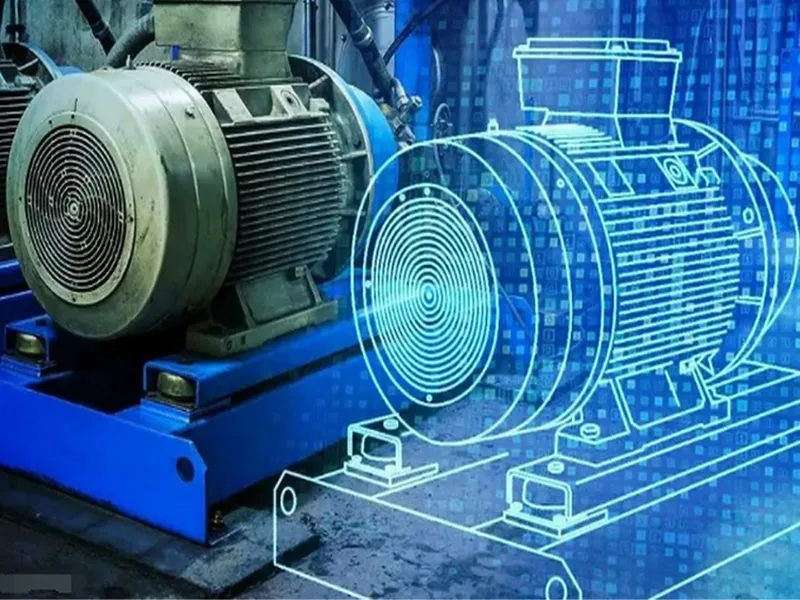
In the field of precision manufacturing, Digital Twin technology is no longer just a conceptual industry buzzword; it has evolved into a core engineering capability driven by Physics-based Models and real-time data. Traditional manufacturing processes often rely on “Trial-and-Error” and offline inspection, approaches that fall short when facing high alloy material costs and rigorous tolerance requirements.
Modern digital twin systems integrate IoT sensor data, Finite Element Analysis (FEA), and historical records from Manufacturing Execution Systems (MES) to build a virtual mirror completely synchronized with the physical shop floor. For CNC machining manufacturers pursuing micron-level precision, that means the ability to verify tool paths, predict thermal deformation, and optimize process parameters through virtual simulation before any cutting occurs, thereby fundamentally eliminating scrap risk and ensuring delivery quality.
Table of Contents
Digital Twins in Precision Manufacturing
Waste Prevention Strategies
In Subtractive Manufacturing, material waste typically stems from ineffective tool path planning, incorrect stock allowance estimation, and unexpected chatter during processing. Digital Twin technology completely transforms waste management strategies by introducing a “Virtual Machining” environment to simulate operations fully before G-code is sent to the machine.
- Dynamic Nesting & Material Utilization Optimization: For expensive metal sheets or bars, AI-driven digital twin algorithms perform Dynamic Nesting based on order demand. This not only considers geometric compactness but also incorporates material grain direction and stress release characteristics to maximize raw material utilization.
- Abnormal Cutting Prediction: By analyzing real-time data streams from spindle load and vibration sensors, the system identifies abnormal fluctuations in cutting forces. Before tool breakage or workpiece scrapping occurs, the digital twin model triggers Adaptive Control to adjust feed rates, preventing material waste caused by broken tools.
- Lifecycle Waste Tracking: Integrated with Enterprise Resource Planning (ERP) systems, digital twins precisely track the generation and classification of chips and offcuts. particularly for high-value alloys like nickel or copper, the system provides precise recycling classification guidance, enhancing scrap recovery value.
Resource Optimization
In precision manufacturing, resource optimization points not just to energy saving, but to the maximization of Overall Equipment Effectiveness (OEE). Digital twins achieve granular scheduling of manufacturing resources by constructing equipment-level thermal-mechanical coupling models.
- Energy Management: Traditional machine energy management is often reactive. Digital twins optimize spindle start/stop and coolant injection strategies by analyzing energy consumption curves under different machining parameters. For instance, automatically reducing auxiliary system power during non-cutting (Rapid Traverse) movements significantly lowers Specific Energy Consumption.
- Tool Life Prediction & Management: Utilizing deep learning algorithms to analyze cutting sound spectra and current signals, digital twins establish precise tool wear models. This shifts the tool replacement strategy from conservative “Scheduled Replacement” to Condition-Based Maintenance (CBM), avoiding quality incidents caused by overuse while reducing waste from prematurely replaced tools.
- Production Takt Time Balancing: In multi-axis machining centers or automated production lines, digital twins use Discrete Event Simulation (DES) to identify bottleneck processes, optimizing AGV logistics paths and robotic arm timing to ensure the line operates at optimal load.
Enhancing Quality
For precision parts, quality is not just the result of final inspection, but the manifestation of process stability. Digital twins implement a “Shift-Left” strategy for quality control, transitioning from “post-event inspection” to “online process control.”
- Process Variable & Quality Correlation Analysis: The digital twin system correlates cutting parameters (cutting speed, feed rate, depth of cut) with machining results (surface roughness, dimensional deviation) in real-time. Through regression analysis of historical data, the system recommends optimal parameter combinations capable of stably achieving a CPK (Process Capability Index) > 1.67.
- Thermal Error Compensation: During long-duration continuous machining, machine thermal deformation is a primary factor affecting precision. Digital twins build real-time thermal error models using temperature sensors placed at critical machine points, sending compensation commands directly to the CNC system to dynamically correct the tool tip position, ensuring dimensional consistency across different temperature environments.
- Closed-Loop Quality Feedback: Combining data from On-Machine Verification (OMV) probes, the digital twin instantly compares actual machined dimensions against the CAD theoretical model and automatically generates compensation tool paths for finishing cuts, ensuring the first part is correct.
Cutting R&D Costs with Digital Twins
Virtual Prototyping
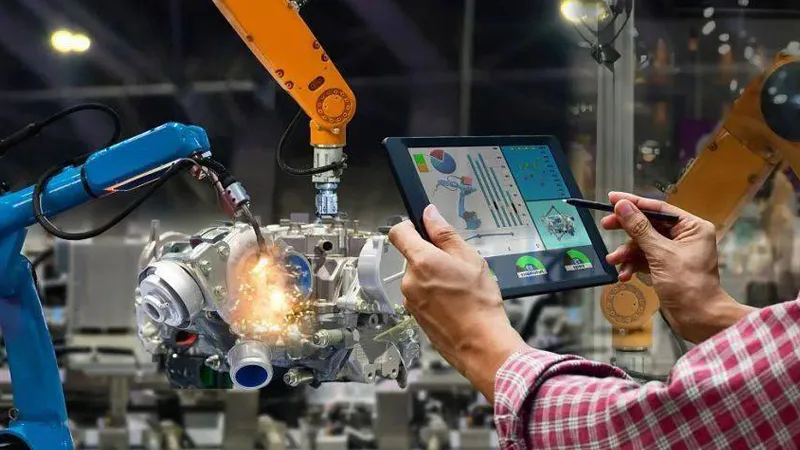
Virtual Prototyping is a core method for reducing hard R&D costs. Before physical prototyping, engineers use Multiphysics Simulation within the digital twin to test product performance under extreme limits.
This involves not only geometric validation but also deep dives into material science. For example, when developing new alloy parts, engineers can simulate grain structure evolution and residual stress distribution under different heat treatment processes. This physics-based simulation can replace the majority of early Physical Testing. Industry best practices show that through high-fidelity virtual prototyping, the number of physical samples in the New Product Introduction (NPI) phase is typically reduced by over 60%, drastically cutting expensive raw material consumption and machining costs.
Fewer Redesigns
The disconnect between design and manufacturing is the main cause of iterative Redesigns. Digital twin technology exposes potential manufacturing defects during the design phase by introducing Design for Manufacturability (DFM) analysis modules.
- Manufacturability Verification: During the CAD design stage, the digital twin simulates Tool Accessibility, detects chip evacuation risks in deep hole drilling, and analyzes deformation of thin-walled parts under clamping forces.
- Tolerance Stack-up Analysis: Traditional tolerance allocation often relies on experience, leading to assembly difficulties. Digital twin technology utilizes Monte Carlo Simulation for 3D tolerance analysis, predicting the probability of assembly interference in mass production. This optimizes GD&T (Geometric Dimensioning and Tolerancing) annotations at the design end, avoiding expensive design changes after molds or fixtures have been made.
- Early Failure Mode Identification: By simulating lifecycle operating loads in a virtual environment, engineers discover stress concentration points and fatigue fracture risks early, enabling structural optimization before drawings are frozen.
Faster Product Development
In fierce market competition, Time-to-Market is crucial. Digital twins break the traditional sequential development model through Concurrent Engineering.
Manufacturing engineers do not need to wait for detailed designs to be finalized; they can begin fixture design and CAM programming based on the digital twin model. When design changes occur, the data associativity of the digital twin system ensures the synchronous update of process documents, inspection standards, and NC codes. This collaborative mode significantly shortens the product validation cycle. Furthermore, cloud-based digital twins allow cross-border teams (e.g., a manufacturing center in China and a client engineering department in Germany) to share the same virtual model in real-time, quickly confirming technical details and eliminating delays caused by cross-timezone communication.
Reducing Risk in R&D
Simulation and Testing
The biggest risk in R&D is the unknown. Digital twins provide a zero-risk “sandbox” environment, allowing engineers to conduct destructive testing and extreme condition simulations without risking physical equipment damage.
- Multiphysics Coupling Simulation: For complex machined parts, such as aero-engine blades or medical implants, a single mechanical analysis is insufficient. Digital twins integrate Computational Fluid Dynamics (CFD), thermodynamics, and structural mechanics to simulate real performance in high-temperature, high-pressure fluid environments. For instance, simulating whether coolant channel designs effectively remove cutting heat to prevent part burn or micro-cracking.
- Virtual Vibration Testing: Simulating the vibration spectrum of parts during transport and usage in a digital environment verifies the structure’s natural frequency, preventing early failure due to resonance.
- Regulatory Compliance Rehearsal: Addressing environmental regulations like the EU PFAS ban, digital twin systems simulate material composition and surface treatment processes (such as nickel plating) to pre-assess compliance risks, preventing non-compliant products from entering downstream development.
Predictive Analytics
AI-based predictive analytics transforms R&D from “Reactive” to “Proactive.” By analyzing massive amounts of historical design and manufacturing data, digital twins identify potential design pitfalls.
- Parameter Sensitivity Analysis: The system automatically runs thousands of simulations to analyze the sensitivity of final performance (e.g., fatigue life, weight) to different design parameters (e.g., wall thickness, fillet radius). This helps engineers quickly lock in the optimal Design Space rather than blindly testing.
- Manufacturing Risk Prediction: Based on machining data from similar past parts, algorithms predict yield bottlenecks for new designs. For example, predicting that a specific deep cavity structure might lead to shortened tool life or substandard surface finish, thereby prompting engineers to modify design features.
- Market Performance Simulation: Before product launch, utilizing digital twins combined with market data simulates product performance degradation curves, providing a scientific basis for establishing warranty policies and spare parts inventory plans.
Minimizing Failure Rates
Reducing failure rates is not just about cost saving; it is about building brand reputation. Digital twins construct a quality firewall through Virtual Validation.
In high-risk fields like drug R&D or chemical equipment manufacturing, digital twins simulate chemical reaction processes and pharmacokinetics, vastly reducing clinical trial failure rates. In mechanical manufacturing, simulating the assembly process in a digital twin discovers “hard interferences” and “soft interferences” (such as insufficient installation space) in advance, ensuring BOM (Bill of Materials) accuracy. For critical safety parts, the digital twin records data from every simulation step, forming a complete Digital Thread. Once a failure occurs, the design source can be quickly traced, fundamentally preventing the recurrence of similar faults.
Part Verification with Digital Twins
Automated Quality Checks
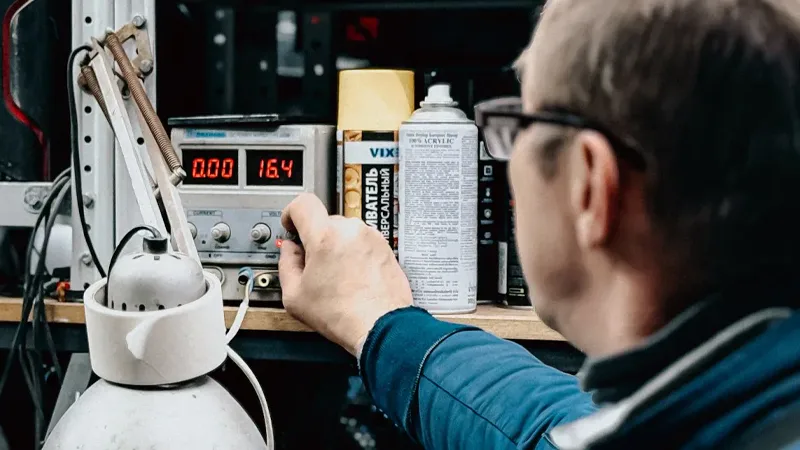
Traditional part verification relies on manual calipers or projectors, which are inefficient and prone to human error. Digital twin-driven Automated Quality Inspection Systems elevate inspection efficiency to a new magnitude.
- CMM Path Automatic Planning: For complex curved parts, digital twins automatically plan probe paths for Coordinate Measuring Machines (CMM) based on 3D CAD models and perform collision detection simulation, ensuring safe and efficient inspection.
- Machine Vision Integration: Utilizing high-resolution industrial cameras and deep learning algorithms, the system compares captured part images with the digital twin’s standard texture, identifying cosmetic defects (scratches, pits, uneven plating) in milliseconds.
- Online Size Compensation: Inspection data is fed back to the machining center in real-time, forming a closed-loop control. If dimensions are detected trending toward tolerance limits, the system automatically calculates compensation values to correct the next part, achieving “Zero Scrap” manufacturing.
Virtual Inspection
Virtual inspection technology uses non-contact scanning devices (Laser Scanners, Structured Light Scanners) to capture dense Point Cloud Data of the part and compare it globally against the nominal CAD model in a digital environment.
- Full-Color Deviation Mapping: Traditional inspection reports only contain a few key dimensions, whereas virtual inspection generates a deviation color map covering the entire part surface, visually displaying machining error distribution (e.g., warping, twisting). This is particularly effective for analyzing clamping deformation in thin-walled parts.
- GD&T Deep Analysis: Software automatically calculates complex geometric tolerances like flatness, cylindricity, and concentricity based on scan data. With millions of data points, the evaluation is far more representative and credible than traditional CMM sampling.
- Remote Acceptance: In global supply chains, clients do not need to visit the factory physically. The factory uploads scan data to the cloud digital twin platform, and clients perform immersive part acceptance remotely, viewing dimensional details of any cross-section, significantly shortening the delivery acceptance cycle.
Accelerated Validation
First Article Inspection (FAI) is often the most time-consuming link in New Product Introduction. Digital twins accelerate this process through Model-Based Definition (MBD).
- Paperless Verification: Digital twins directly read 3D models containing PMI (Product Manufacturing Information), eliminating the tedious process of converting 2D drawings to inspection programs and reducing data conversion errors.
- Virtual Assembly Verification: After a single part is manufactured, scan data is imported directly into the virtual assembly environment to virtually fit-check against other parts (even digital models of parts not yet manufactured). This allows parallel verification without waiting for all physical parts to be available.
- Compliance Documentation Auto-Generation: The system automatically aggregates inspection data, material certificates, and heat treatment reports to one-click generate quality data packages compliant with AS9100 (Aerospace) or ISO 13485 (Medical Devices) standards, drastically reducing documentation preparation time.
Industry Applications
Automotive
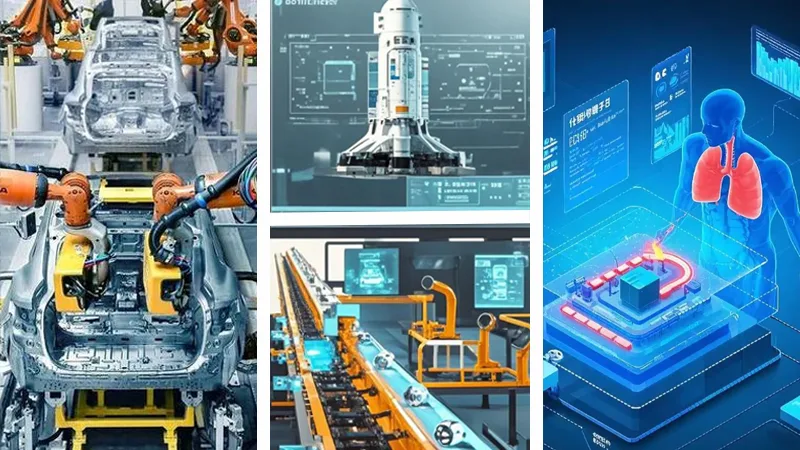
The automotive industry is in a critical period of electrification transition, and digital twins play a core role. In chassis development, engineers use Multi-body Dynamics simulation to optimize suspension kinematics for handling and comfort. For EV battery packs, digital twins simulate thermal management system efficiency, predicting temperature distribution under extreme charge/discharge cycles to optimize liquid cooling channel designs and prevent thermal runaway. On the production side, OEMs use “Virtual Commissioning” technology to debug PLC code and robot logic before the physical line is installed, reducing line startup time by over 30%.
Electronics
Electronics manufacturing emphasizes miniaturization and thermal management. Digital twin technology is widely used for Thermal Analysis of PCBs, predicting chip temperature rise under high loads to optimize heatsink design and airflow layout. In SMT processes, digital twin models simulate solder paste printing and reflow soldering, predicting voiding and Tombstoning defects. Additionally, for consumer electronics drop testing, Explicit Dynamics simulation accurately models housing rupture and internal component detachment risks, guiding structural rib layout optimization.
Aerospace
Aerospace demands near-absolute reliability. Digital twin technology is used not only for CFD optimization of aerodynamic shapes but also deeply in the casting simulation of single-crystal turbine blades, predicting grain growth direction and shrinkage porosity. In aircraft MRO (Maintenance, Repair, and Operations), digital twins based on fuselage sensor data monitor fatigue crack propagation in real-time, enabling Structural Health Monitoring (SHM). This allows airlines to plan maintenance based on actual fleet health rather than rigid flight hours, significantly reducing Lifecycle Costs (LCC).
Medical Devices
Medical device manufacturing faces strict FDA/CE regulatory oversight. Digital twins provide a personalized design verification platform for orthopedic implants (like artificial joints), simulating micromotion and wear in the human bone mechanical environment using patient CT data to ensure long-term stability. In surgical robot development, digital twins build high-fidelity human tissue models for training surgical path planning and force feedback algorithms. Furthermore, full-process digital recording provides a tamper-proof data chain for every medical product, meeting UDI (Unique Device Identification) compliance requirements.
Implementation for Manufacturers
Assessing Readiness
Implementing digital twins is not an overnight task; companies need to conduct a systematic Readiness Assessment.
- Data Infrastructure: Check if shop floor equipment has data acquisition capabilities (e.g., OPC UA support), if network bandwidth meets real-time big data transmission needs, and if “Data Silos” exist.
- IT/OT Convergence: Evaluate the integration level between Information Technology (IT) systems (ERP, PLM) and Operational Technology (OT) systems (SCADA, PLC). The core of digital twins lies in bridging these two architectures.
- Talent Reserve: Does the team possess cross-disciplinary capabilities, including data science, simulation modeling, and process engineering backgrounds?
- Business Pain Point Focus: Clarify whether the primary goal is solving bottleneck processes, improving yield, or shortening delivery times, avoiding the pursuit of an overly broad system.
Building a Strategy
Building a digital twin strategy should follow the principle of “Plan Big, Start Small.”
- Start Small: Choose a high-pain, high-value Pilot Project, such as tool life prediction for a specific critical CNC line.
- Establish a Digital Thread: Ensure unified data standards from design and process to manufacturing and QC, achieving smooth data flow across the entire lifecycle.
- Security by Design: Given the sensitivity of core process data, a defense-in-depth system including firewalls, encryption, and access control must be built, especially regarding export-controlled military or aerospace component drawings.
- Partner Ecosystem: Choose open-architecture platforms to facilitate the integration of third-party algorithms and hardware, avoiding vendor lock-in.
| Strategic Consideration | Description |
|---|---|
| High Initial Costs | You need to spend a lot at first on sensors, software, and upgrades. |
| Data Security Concerns | There are risks from hackers, so strong security is needed. |
| Integration Complexity | Mixing digital twins with old systems is hard and needs experts. |
| Workforce Skill Gaps | Workers may need training or new hires to use new technology. |
Measuring ROI
Measuring the Return on Investment (ROI) of digital twins requires a multi-dimensional KPI system.
Strategic Value Metrics: Assess increased customer satisfaction from improved quality stability, market share gained from faster NPI, and the value of accumulated data assets for future AI transformation. Typically, a successful digital twin project shows significant ROI 6-12 months after implementation and continues to release dividends in subsequent years.
Direct Financial Metrics: Calculate material cost savings from reduced scrap rates, capacity premiums from reduced downtime, and R&D savings from fewer physical prototypes.
Operational Efficiency Metrics: Focus on OEE improvement rates, First Time Quality (FTQ), and Lead Time reduction percentages.
FAQ
A high-fidelity digital twin is not just a 3D model of geometric appearance; it is a dynamic system containing physical properties (materials, kinematics, thermodynamics) and logic behaviors. It updates its state in real-time by receiving industrial data streams from shop floor sensors, reflecting the real operation of the physical entity with millisecond latency for simulation prediction and closed-loop control.
Digital twins eliminate first-piece setup scrap by verifying NC programs via “Virtual Machining”; prevent workpiece scrapping caused by broken tools through spindle load monitoring and adaptive control; and maximize raw material utilization via smart nesting algorithms. It shifts quality control from “post-event screening” to “pre-event prevention” and “in-process intervention,” significantly reducing the comprehensive scrap rate.
Finite Element Analysis (FEA) is the mathematical engine for multiphysics simulation in digital twins. It discretizes complex parts into millions of small elements to calculate physical responses under forces, heat, and vibration. In digital twins, FEA combined with real-time sensor data can dynamically assess part fatigue life and structural safety, serving as the core technology for predictive maintenance and virtual verification.
Enterprise-grade digital twin platforms employ End-to-End Encryption, Multi-Factor Authentication (MFA), and Role-Based Access Control (RBAC). For sensitive CAD models and process parameters, private cloud or hybrid cloud deployment is typically used to ensure core data does not leave the intranet. Simultaneously, the system logs all data access and operations for auditing to meet strict intellectual property protection requirements.
AI is not a prerequisite for digital twins, but it is a multiplier for advanced applications. SMEs can initially establish basic digital twins based on physical rules and statistical analysis for visualization and simple alarming. As data accumulates, AI algorithms can be gradually introduced for complex predictive maintenance and process parameter self-optimization. Phased implementation helps control costs and reduce technical risks.
CAD simulation is typically static and offline, verified based on idealized assumptions; a Digital Twin is dynamic and real-time, connected to real data from the physical world. Digital twins can reflect equipment aging, environmental temperature changes, and raw material batch differences, making their analysis results closer to the real physical world than traditional static simulation, with full lifecycle evolutionary capabilities.