

By the Senior Engineering Team at AFI Parts
In the realm of precision CNC machining and custom metal fabrication, stability is often a luxury. As engineers and manufacturers, we operate in an environment where material inputs—from Aluminum 6061-T6 billets to Stainless Steel 316 bar stock—are subject to global market forces that can erode margins overnight. Material price volatility is not merely a procurement inconvenience; it is a fundamental engineering and operational challenge that impacts Cost of Goods Sold (COGS), production lead times, and the strict adherence to ISO 9001:2015 quality standards.
While sudden price spikes in steel or non-ferrous metals can disrupt workflows and compress profitability, a sophisticated approach to risk management allows us to insulate our operations and, by extension, our customers’ supply chains. In the last five years, the industry has weathered significant storms, including a notable 25% global tariff on steel in early 2025, which fundamentally recalibrated the cost basis for structural and machined components. Coupled with persistent economic uncertainty in the United States, project cost estimation has moved from a static exercise to a dynamic variable.
Effective risk mitigation is the firewall that protects the integrity of the manufacturing process from these external fluctuations. This comprehensive guide goes beyond basic advice to provide a technical, data-driven framework—utilizing Total Cost of Ownership (TCO) models, Finite Element Analysis (FEA) for material substitution, and Just-in-Time (JIT) logistics—to empower our partners in navigating this volatility.
Key Takeaways
- Real-Time Data Integration: Move beyond periodic checks; utilize API-driven price indexing to monitor LME (London Metal Exchange) and local surcharge updates.
- Strategic Supplier redundancy: Implement a “China + 1” or multi-regional sourcing strategy to mitigate geopolitical risks.
- Contractual Engineering: Utilize Economic Price Adjustment (EPA) clauses and fixed-price hedging for short-term stability.
- Lean Inventory Dynamics: Balance JIT protocols with calculated “Safety Stock” buffers based on lead-time variability.
- Material Agility: Leverage DFM (Design for Manufacturability) to validate alternative alloys without compromising mechanical properties like yield strength or tensile modulus.
Table of Contents
Material Cost Fluctuations Overview
To manage risk, one must first quantify the vectors of volatility. In custom metal manufacturing, price instability is rarely mono-causal; it is the aggregate result of energy markets, geopolitical friction, and raw ore availability.
Causes of Price Volatility
Economic Factors
The correlation between energy costs and finished metal prices is high, particularly for energy-intensive processes like Electric Arc Furnace (EAF) steel production or aluminum electrolysis. The metals market reacts violently to shifts in crude oil and natural gas prices, which drive the cost of mining, refining, and logistics. When energy indexes rise, the “energy surcharge” on raw material invoices expands immediately. Furthermore, competition from adjacent heavy industries—automotive, aerospace, and defense—creates a crowding-out effect. As the automotive sector pivots toward EVs, the demand for specific inputs like nickel, copper, and cobalt tightens, making steel alloying elements harder to predict.
Geopolitical Concentration and Supply Chain Fragility
The geographic concentration of mineral deposits creates single points of failure. For instance, the reliance on the Democratic Republic of Congo for cobalt or specific regions for rare earth elements introduces severe volatility. Civil unrest, trade embargos, or changes in export policy can sever supply lines instantly.
Table 1: Matrix of Volatility Drivers in Precision Machining Materials
| Cause Category | Driver Description | Impact on Machining Costs |
| Geopolitical Concentration | Strategic reliance on single-origin sources (e.g., Cobalt/DRC, Magnesium/China). | Supply shocks lead to Force Majeure declarations and instant spot-price spikes. |
| Energy Markets | EAF and Smelting energy consumption. | Direct correlation: A 10% rise in industrial electricity can yield a 3-5% rise in aluminum billet costs. |
| Market Demand Cycles | Competition from EV battery production and Aerospace output. | Scarcity of alloying elements (Nickel, Molybdenum) drives up stainless steel (304/316) surcharges. |
Monitoring these signals is not passive observation; it is active intelligence gathering required to protect EBITDA margins.
Supply Chain Issues
The modern supply chain is a complex network where a delay in one node propagates exponentially—the “Bullwhip Effect.” Problems often manifest as raw material stock-outs due to export bans or shipping lane disruptions. For a machine shop, a conflict in a mining region doesn’t just mean expensive steel; it means the specific H9 tolerance bar stock required for a Swiss Lathe job is unavailable.
Speed is the only antidote. If a shipment is delayed, the production schedule must be re-optimized immediately. A single delay in raw material delivery can cascade into missed “lines-down” deadlines for OEM customers. This impacts not just cost, but the Cost of Poor Quality (COPQ) if rushed expediting leads to errors.
Furthermore, trade wars between major economies introduce artificial volatility. Tariffs serve as political levers but manifest as immediate 25% cost additives for manufacturers. Government interventions, such as Indonesia’s ban on nickel ore exports or Chile’s mining royalty changes, fundamentally alter global availability.
Tariffs and Duties
The regulatory landscape is as volatile as the commodity market. The 2025 tariff implementation demonstrated how a 25% surcharge could invalidate valid quotes overnight. For a machining business, this necessitates a deep understanding of HTS (Harmonized Tariff Schedule) codes and free trade agreements to forecast landed costs accurately. Navigating these duties often requires sourcing materials from treaty-partner nations to maintain budget viability.
Impact on Custom Metal Manufacturing
Budgeting Challenges
The primary casualty of volatility is the static budget. When material costs fluctuate, the BOM (Bill of Materials) cost moves from a constant to a variable. For long-term projects, such as a 2-year production run of automotive shafts, a rise in steel prices necessitates a complete revision of the project’s financial model. This unpredictability forces engineers and procurement teams to constantly audit supply availability and verify material certifications to prevent profit leakage.
Quoting and Contracts
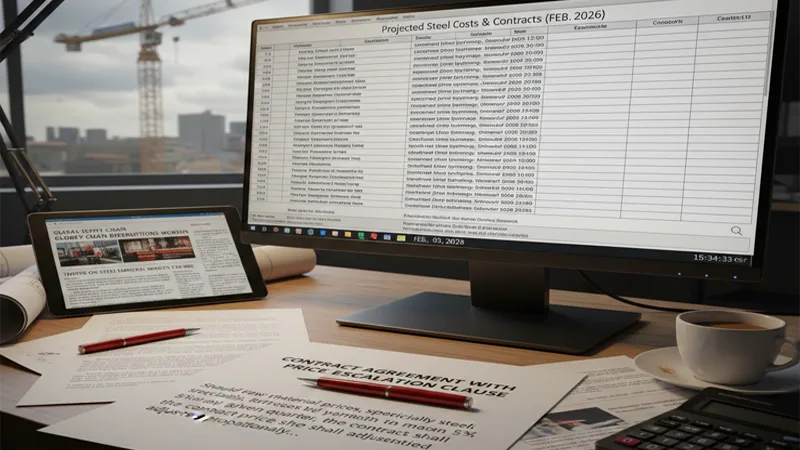
In the world of precision machining, quoting is a binding commitment. However, extreme volatility makes fixed-price quoting dangerous. Establishing a firm price for a 12-month delivery schedule is statistically risky without hedging mechanisms. Tariffs and supply constraints exacerbate this, making it difficult to guarantee “dock dates” or final costs. As a Senior Engineer, I recommend structuring contracts with valid-for dates not exceeding 7-14 days during volatile periods, or utilizing “Material Index Riders” that allow the final price to float based on a recognized index (e.g., CRU).
Customer Relationships
Transparency is the currency of trust. Customers demand On-Time Delivery (OTD) and zero defects. However, when material unavailability threatens a deadline, proactive communication is vital. Hiding the reality of supply chain constraints destroys relationships; conversely, sharing market intelligence and explaining the “why” behind a price increase or delay builds a partnership.
Assessing Risk Exposure
To manage risk, we must quantify it. At AFI Parts, we utilize a rigorous assessment framework.
Material Usage Mapping
Key Materials
Key Materials Analysis We begin by applying the Pareto Principle (80/20 Rule) to our material consumption. Usually, 20% of the alloys (e.g., SS304, Al6061, Mild Steel 1018) account for 80% of the spend. We map these high-volume materials against their volatility indices.
Life Cycle Costing (LCC) We move beyond purchase price to Life Cycle Costing. This model integrates acquisition cost, machining time, tool wear (machinability rating), and scrap recovery value.
LCC = Cmat + Cmach + Ctool+ Coverhead – Vscrap
Where Vscrap is significant for materials like brass or high-nickel alloys. Life Cycle Assessment (LCA) further evaluates the environmental footprint, which is increasingly relevant for ESG compliance.
Additive Manufacturing (AM) Integration. Where applicable, we evaluate if Metal 3D Printing (DMLS) can replace subtractive machining for complex geometries to reduce the “Buy-to-Fly” ratio (the ratio of raw material weight to finished part weight). AM can significantly reduce raw material exposure by minimizing waste.
Supplier Dependencies
Concentration Risk Calculation: Reliance on a single source is a critical vulnerability. We utilize the Herfindahl-Hirschman Index (HHI) concept adapted for supply chains to measure concentration. If one mill provides 100% of our aerospace-grade aluminum, a strike or furnace failure at that mill is a catastrophic event for us. Single-sourcing also erodes negotiation leverage.
Actionable Strategy:
- Audit: Review the Approved Vendor List (AVL) quarterly.
- Identify SPOF: Highlight any Single Points of Failure.
- Diversify: Qualify secondary suppliers even if their piece price is slightly higher, viewing the delta as an insurance premium.
Financial Impact Analysis
Cost Structure
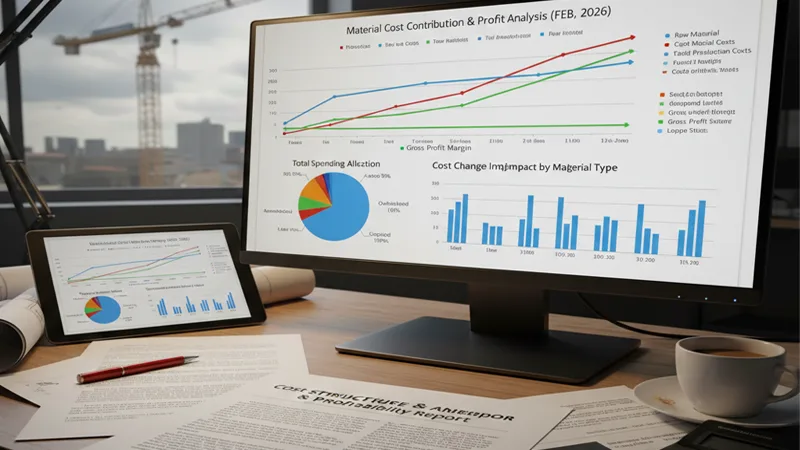
Understanding the granular breakdown of the “Shop Rate” is essential. When raw material prices shift, they impact the total manufacturing cost proportionally to the material’s weight in the final part.
CostTotal = WeightRaw x PriceMaterial + HoursRun x RateMachine + Overhead
Tracking the specific contribution of material costs to the overall P&L allows us to identify which product lines are most sensitive to market swings.
Project Budgets
Dynamic budgeting is required. We utilize ERP systems to re-forecast project margins whenever a material receipt shows a variance >5% from standard cost. Utilizing long-term blanket orders (BPOs) effectively locks in costs, acting as a physical hedge. Regular budget audits ensure that the “estimated” margin matches the “actual” margin.
Market Monitoring
Price Indexes & Technical Analysis We do not guess; we track. Utilizing indices like the PPI (Producer Price Index) for metals and custom feeds from the LME gives us predictive power. Monitoring industry trends allows us to distinguish between a temporary spike (noise) and a structural shift (trend).
Table 2: Strategic Application of Market Monitoring
| Application | Description | Engineering/Business Value |
| Lead Negotiations | Use index data to counter supplier price hike claims. | Empirically grounded bargaining power. |
| Inform Strategy | Forecast surcharges for quoting future quarters. | Protects margin on long-tail contracts. |
| Gauge Sentiment | Analyze “Available Stocks” in LME warehouses. | Timing bulk buys for inventory dips. |
| Spot Purchasing | Decide between Spot Buy vs. Contract Buy. | Optimizes cash flow and working capital. |
Setting automated alerts for these indices ensures we react to breaches in support/resistance price levels immediately.
Supplier & Sourcing Strategies
In custom metal manufacturing, the supply chain is the lifeline. Volatility in steel pricing and availability requires a robust, multi-tiered sourcing strategy. A strong network mitigates risk while maintaining the strict quality standards (ISO/AS9100) required for precision parts.
Supplier Diversification
Multi-Sourcing
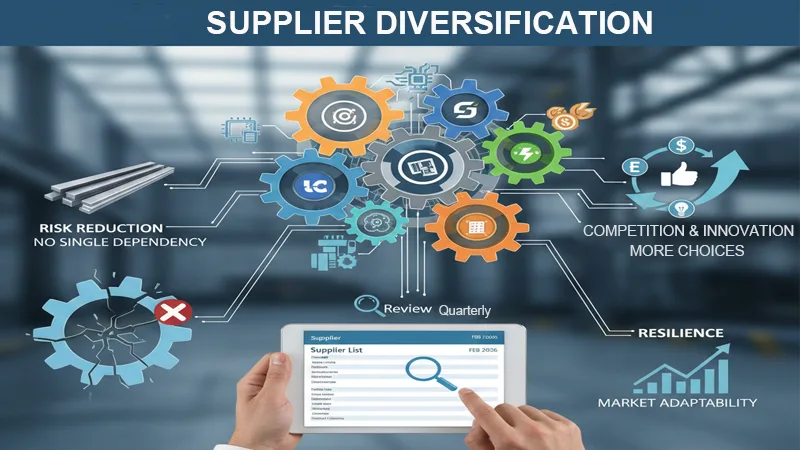
We advocate for a “Champion and Challenger” model. The “Champion” supplier gets 70% of the volume, while the “Challenger” gets 30%. This keeps the Champion honest on pricing and ensures the Challenger is warm and ready to ramp up if the Champion fails. This diversification lowers risk significantly. It fosters competition, driving better pricing and service levels.
- Outcome: No reliance on a single entity.
- Resilience: Operations continue despite localized disruptions.
- Protocol: Review the AVL every three months to assess financial health and capacity
Local vs. Global Sourcing
This is a calculation of Total Landed Cost (TLC) vs. Speed.
- Local Suppliers: Offer speed, easier communication, and lower logistics risk. Ideal for “Hot” jobs and JIT deliveries.
- Global Suppliers: Offer lower unit costs and access to specific exotic alloys not milled domestically. Ideal for high-volume, stocked production runs.
- Hybrid Approach: Use global sources for stock replenishment and local sources for volatility buffers.
Real-World Example of Successful Supplier Diversification
The following case studies from the manufacturing sector illustrate the power of diversification:
- Flywheel Fabrication: Utilizing Vietnamese sourcing to bypass specific tariff barriers while maintaining balanced specs.
- Large Sphere Metal Stamping: Shifting heavy tonnage work to regions with lower steel input costs.
- Railguard Systems: mitigating zinc plating bottlenecks by utilizing multi-regional finishing vendors.
- Hydraulic Press Frames: Managing massive structural steel logistics through diversified freight partners.
These examples demonstrate that multi-sourcing is not just about price; it’s about continuity of supply for complex assemblies.
Relationship Management
Strategic Partnerships
We view suppliers as an extension of our factory floor. Treating them as partners rather than adversaries builds “Customer of Choice” status. In times of shortage, suppliers prioritize “Customers of Choice.” This relationship allows for open-book cost breakdowns and negotiated payment terms (e.g., Net 60).
Table 3: Impact of Strategic Partnering
| Benefit | Description | Operational Impact |
| Cost Savings | Volume aggregation discounts. | Direct EBITDA improvement. |
| Negotiation Power | Preferential treatment during allocation. | Supply security during shortages. |
| Streamlined Inventory | Vendor Managed Inventory (VMI) agreements. | Improved cash conversion cycle. |
| Improved Efficiency | Integrated ERP forecasting. | Reduction in administrative overhead. |
Performance Reviews (Supplier Scorecards)
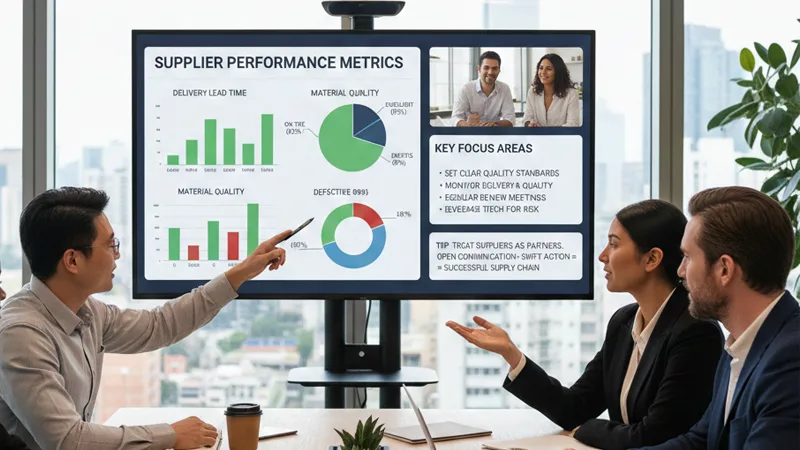
We quantify trust. Suppliers are graded on On-Time Delivery (OTD), Parts Per Million (PPM) defect rates, and responsiveness. Regular Quarterly Business Reviews (QBRs) allow us to address trends before they become failures. Rewarding top performers with more volume reinforces the partnership.
Contract & Price Management
Managing the commercial terms is as critical as managing the CNC toolpaths. In a volatile market, the contract is the first line of defense.
Locking in Prices
Fixed-Price Contracts
For short-duration projects (<3 months), we strive for fixed-price contracts with suppliers to lock in the BOM cost. This provides budget certainty for the customer. However, this is only viable when the market backwardation or contango is minimal. If volatility is high, suppliers will buffer the price, potentially costing us more.
- Recommendation: Use for short runs or when stock is physically secured.
Price Adjustment Clauses
Economic Price Adjustment (EPA) For long-term contracts (e.g., 1-year OEM agreements), we utilize EPA clauses. These mechanisms allow the part price to float based on a public index (e.g., “Price shall adjust quarterly based on the average closing price of Nickel on LME”). This ensures fairness; neither party profits from the volatility itself.
- Pass-through Clauses: The end customer absorbs the raw material delta (up or down).
- Trigger Thresholds: Adjustments only occur if the index moves >5%.
Negotiating Terms
Volume Commitments (Blanket Orders)
We leverage Economies of Scale. By issuing a Blanket Purchase Order (BPO) for 10,000 units but taking delivery in batches of 1,000, we lock in the raw material price for the whole lot.
Scale: Amortizes setup (NRE) and administrative costs.
Negotiation: Larger commitments yield “Mill Direct” pricing rather than “Service Center” pricing.
Flexible Schedules
Flexibility is a negotiation chip. Allowing a supplier to deliver “early” or giving them a wider delivery window can often secure a lower price, as it allows them to optimize their own machine utilization.
Legal Protections
Force Majeure
Ensure clauses cover “supply chain impossibility,” not just “Acts of God,” though be aware this rarely covers simple price increases.
Dispute Resolution
Pre-agree to arbitration to resolve pricing disputes quickly without litigation.
Inventory & Design Optimization
Inventory Management
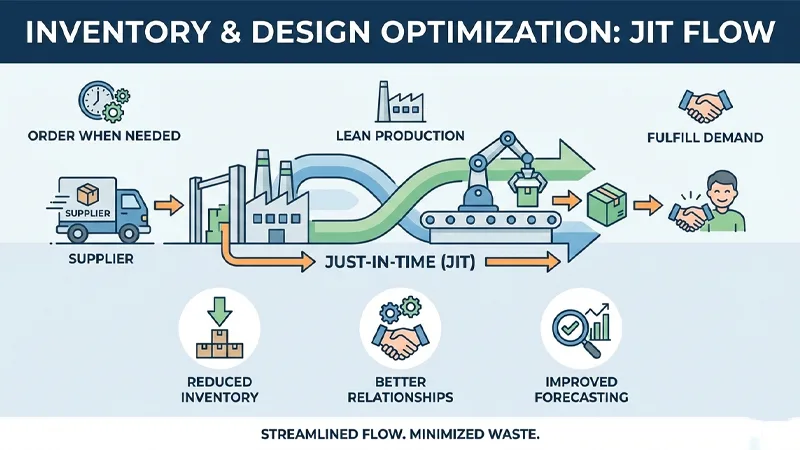
Just-in-Time (JIT) vs. Just-in-Case (JIC)
While JIT minimizes carrying costs, it is fragile in a volatile market. We employ a hybrid model. For standard materials (Al 6061, SS 304), we operate JIT. For volatile or exotic materials (Inconel, Titanium), we move to Strategic Buffering.
JIT Benefit: Reduces working capital tied up in racks.
Risk: Stock-outs during supply shocks.
Safety Stock
We calculate safety stock based on demand deviation and lead time variability.
Where Z is the service level factor (e.g., 1.65 for 95%). This math ensures we hold exactly enough stock to weather statistical disruptions.
Design Efficiency
Design for Manufacturability (DFM)
The most effective cost control is engineering. By optimizing the design, we reduce material usage.
- Nesting: Optimizing laser/waterjet cutting paths to maximize sheet yield.
- Standardization: Using standard bar sizes (e.g., designing a shaft to 24.8mm to fit 25mm stock, rather than 25.1mm, which requires 30mm stock).
- Waste Reduction: Companies implementing rigorous DFM can reduce material spend by 15-20%.
Alternative Materials
Material Substitution
When a specific alloy spikes in price, we evaluate alternatives using Ashby Plots (Strength vs. Density/Cost).
- Example: Replacing 316 Stainless with 304 Stainless if the environment is not highly corrosive (saving the Molybdenum surcharge).
- Example: Replacing Machined Aluminum with A380 Die Casting for high volumes.
- Example: Using Zinc alloys for intricate small parts to reduce machining time and material cost.
Table 4: Material Substitution Strategy
| Strategy | Technical Execution | Benefit |
| Design Simplification | Remove non-functional aesthetic features to reduce machining time. | Lower machine hours. |
| Material Substitution | Validating Grade 303 SS instead of 304 for non-welded parts. | Better machinability (lower cycle time) + lower cost. |
| Lifecycle Costing | Choosing a more expensive material that lasts 2x longer. | Lower TCO for the customer. |
Note: Any substitution is validated against the engineering print specifications (Yield Strength, Hardness, Thermal Conductivity) to ensure performance integrity.
Financial & Estimating Tools
Financial Hedging
For large-scale contracts, we employ financial instruments to hedge exposure.
- Futures Contracts: We can lock in the price of copper or aluminum for a future date. This is a binding obligation, but guarantees the cost basis.
- Options: Buying a “Call Option” gives us the right, but not the obligation, to buy metal at a certain price. This protects against upside spikes while allowing us to benefit if prices fall (unlike futures).
- Price Insurance: paying a premium to insure against volatility exceeding a certain percentage.
Senior Engineer Tip: Use futures for confirmed POs with fixed prices. Use options for quoted but unconfirmed projects to limit risk exposure.
Metal Estimating Services
Parametric Estimating We use advanced estimating software that utilizes parametric models (volume removal rates, tool wear factors) to generate precise cost models.
- Early ID: Identifying that a design requires a 5-axis setup vs. a 3-axis setup early in the quoting phase allows for cost engineering.
- Planning: These tools allow us to simulate “What-If” scenarios regarding batch sizes and material types.
Technology & Analytics
Modern manufacturing is data-driven. We leverage Industry 4.0 tools to manage volatility.
Real-Time Price Monitoring
Automated Alerts & ERP Integration
Our ERP system is connected via API to metal pricing indices. When the price of nickel breaches a set threshold, our purchasing managers receive an automated alert. This integration ensures that the inventory valuation in our books is always current, and quoting data is never stale.
Predictive Analytics
Machine Learning (ML)
We are moving toward ML algorithms that analyze historical seasonality, weather patterns (affecting mining logistics), and geopolitical sentiment to forecast price trends.
Scenario Planning: We run Monte Carlo simulations to assess risk. “What is the probability that steel prices rise >10% in Q3?”
Outcome: This allows us to adjust our inventory position proactively—buying heavily before a predicted spike.
Digital Supplier Collaboration
We utilize supplier portals where forecast data is shared bi-directionally. Suppliers see our anticipated demand, and we see their capacity constraints. This digital transparency reduces the “Bullwhip Effect” and fosters collaborative problem solving.
Building a Risk Management Culture

Tools and contracts are useless without a culture of discipline. Risk management is a core competency at AFI Parts.
Leadership & Training
Executive Buy-In
Our leadership team reviews material risk exposure in monthly operational meetings. Budget is allocated specifically for training and risk-monitoring software.
Employee Education
We train our procurement staff and engineers on the nuances of global trade. A buyer must understand not just the price of steel, but why the price is moving (e.g., tariffs vs. scarcity). We hold “Lunch and Learns” to dissect case studies of supply chain disruptions.
Continuous Improvement
The Deming Cycle (PDCA) We apply Plan-Do-Check-Act to risk management.
- Plan: Establish the risk strategy (Multi-source).
- Do: Execute the strategy.
- Check: Review the effectiveness via KPIs (Supplier Scorecards).
- Act: Refine the strategy based on data.
Cross-Functional Teams Risk is not just for purchasing. We form teams comprising Engineering (Design), Finance (Hedging), Quality (Validation), and Procurement to tackle volatility holistically.
Best Practices for Custom Metal Manufacturing
Strategy Summary
In summary, protecting your manufacturing projects requires a layered defense strategy.
- Map: Know your material exposure.
- Diversify: Never rely on one source.
- Contract: Use EPA clauses and BPOs.
- Buffer: Optimize Safety Stock intelligently.
- Design: The engineer costs out of the product via DFM
Actionable Checklist for Engineers and Buyers
[ ] BOM Audit: List all Critical-to-Quality (CTQ) materials and their current volatility index.
[ ] Supplier Health Check: Verify ISO certifications and financial stability of top 3 suppliers quarterly.
[ ] Contract Review: Ensure all long-term agreements have an “Index Trigger” clause.
[ ] Safety Stock Calibration: Recalculate reorder points based on current lead times (not last year’s).
[ ] Value Engineering: Review the top 5 highest spend parts for potential material substitution or geometry optimization.
Pitfalls to Avoid
Table 5: Common Risk Mitigation Failures
| Pitfall | The Mechanism of Failure | The Senior Engineer’s Fix |
| Single Source Dependency | Supplier invokes Force Majeure; production stops. | Qualify a “Challenger” supplier immediately. |
| Ignoring Market Trends | Quoting based on historical data while the market spikes. | Real-time index integration in quoting tools. |
| Weak Contracts | Fixed price contract becomes a loss-leader due to inflation. | Implement Economic Price Adjustment (EPA) clauses. |
| Excessive JIT | Stock-out occurs due to a minor logistics hiccup. | Implement “Strategic Buffers” for long-lead items. |
Material volatility is the new normal. By adopting these advanced strategies—integrating financial hedging, engineering optimization, and robust supply chain architecture—AFI Parts ensures that your projects are delivered on time, on spec, and on budget, regardless of market turbulence.
FAQ
It refers to the rapid and unpredictable fluctuation in the cost of raw inputs (steel, aluminum, copper) driven by energy costs, geopolitical events, and supply/demand imbalances. This directly impacts the COGS and profitability of machining projects.
Risk is reduced through a combination of Supplier Diversification (Multi-sourcing), Financial Hedging (Futures/Options), Contractual Protections (EPA clauses), and Inventory Optimization (Safety Stock).
This balances Cost vs. Agility. Global suppliers typically offer lower unit costs for high volumes, while local suppliers offer speed and rapid response for JIT requirements and prototyping.
Also known as an Escalation Clause, this is a contractual provision that automatically adjusts the final price of the part based on a defined public index (e.g., LME), protecting both buyer and seller from extreme market moves.
Technology allows for real-time integration of market pricing into ERP systems, automated alerts for price breaches, and predictive analytics (ML) to forecast future trends and optimize purchasing timing
Substituting materials (e.g., using a casting instead of a machined billet, or a different alloy grade) can significantly lower costs and bypass supply chain bottlenecks without compromising the part’s functional integrity.
At a minimum, quarterly. However, in periods of high volatility (e.g., tariff implementations), reviews should be monthly or continuous.