
Introduction
If you’re sourcing barrels, rods, glands, and end caps for hydraulic cylinders, the risk usually isn’t whether a shop can “make the part.” The risk is whether the supplier can hit the functional surfaces consistently—across lots, across plating batches, and across long parts that like to move after you cut them.
This guide covers what OEM engineers and sourcing teams typically need to lock down: materials, machining processes, tolerances, seal surfaces, ports/threads, quality control (QC) gates, design for manufacturability (DFM), cost drivers, and lead times.
The focus keyword is custom hydraulic cylinder parts CNC machining, and the approach is practical: what to put on the drawing, what to verify at inspection, and where the common failures hide.
Table of Contents
Components & Materials
Barrels: tube, honing, grades
Cylinder barrels usually start as seamless/DOM-style tubes or pre-machined honed tubes, then go through boring and/or honing to reach the final bore size and surface finish.
What matters most at RFQ time is aligning three things. If your drawing calls out honed tube surface finish Ra, treat it as a functional requirement tied to seal life and lubrication film, not a cosmetic finish.
- Base tube availability vs. final ID: If your final bore requires heavy stock removal, the process window narrows and scrap risk rises.
- Bore surface functional target: The bore isn’t just a diameter; it’s a counterface for seals. Overly rough bores can accelerate wear. Overly smooth bores can struggle to retain an oil film.
- Geometry control over length: Long bores require a plan for straightness/cylindricity, not just “ID within tolerance.”
For most programs, the best outcome comes from specifying the bore’s critical-to-quality (CTQ) requirements (size, finish, and geometry) and letting the machining route (skiving + roller burnishing vs. boring + honing) follow those requirements.
Rods: 1045/4140, hard chrome
Rods are often made from medium-carbon steels such as 1045 or alloy steels such as 4140, depending on strength requirements, impact loading, and whether post-machining heat treatment is part of the design. When engineers talk about hydraulic cylinder rod machining tolerance, they’re usually talking about the sealing OD after coating and final finishing—not the rough-turned diameter.
In many hydraulic designs, the rod’s outer diameter is a dynamic sealing surface. That makes the “material + treatment + finish” stack more important than the nominal diameter alone.
Common rod stack decisions:
- 1045 vs. 4140: 1045 is widely used and cost-effective; 4140 is often chosen where higher strength and toughness margins are needed.
- Hard chrome and alternatives: Hard chrome remains common for corrosion and wear resistance, but surface engineering choices should be driven by environment, seal compatibility, and regulatory constraints.
- Finish and lead: Seal manufacturers emphasize that counter-surface properties strongly influence seal life. (See the general hydraulic seal technical background on SKF’s site for context.)
Pistons/Caps/Glands
Pistons, end caps, and glands tend to be where tolerance stack-ups become expensive:
- Pistons: Groove locations, groove form, and concentricity to the rod/bore axis control how seals load and wear.
- Caps and glands: These parts often combine threads, seal grooves, bearing surfaces, and ports. One feature of drifting can show up as leaks, stick-slip, or premature bushing wear.
A practical sourcing move is to define CTQs explicitly: groove width/depth tolerances, coaxiality/runout callouts to the datum axis, and counterface surface finish ranges.
Machining & Tolerances for Custom Hydraulic Cylinder Parts CNC Machining
Turning, boring, honing
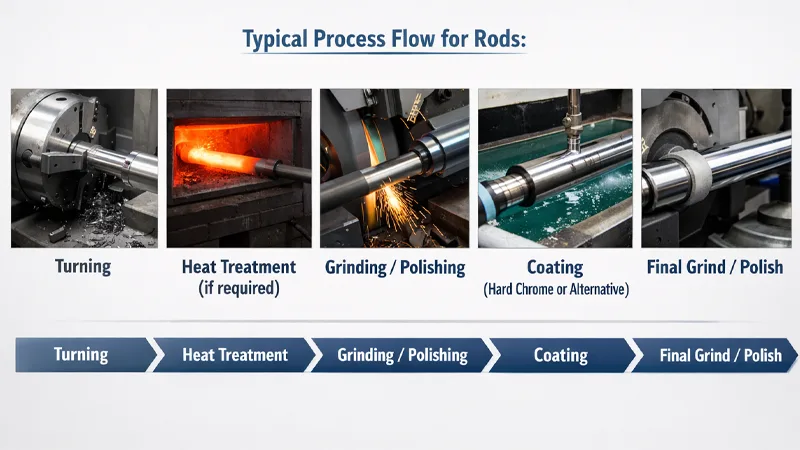
Typical process flow by part family:
- Rods: turning → heat treatment (if required) → grinding/polishing → coating (hard chrome or alternative) → final grind/polish.
- Barrels: rough boring → stress relief (if needed) → finish boring/honing → final inspection of size/finish/geometry.
- Caps/glands: turning/milling of shoulders and grooves → thread/port machining → deburr and clean → inspection.
Pro Tip: When tolerances tighten, inspection becomes part of the process—not a final check. General machining references commonly cite ±0.005 in (±0.13 mm) as a default CNC tolerance band, with tighter bands requiring additional controls (Protolabs: fine-tuning CNC machining tolerances).
Fits, Ra, straightness
For hydraulic cylinder components, the “headline” tolerance is rarely the whole story. The functional requirements usually cluster around:
- Fit between mating features (and what that fit implies for clearance, assembly, and seal/bearing behavior)
- Surface finish on sealing and bearing counterfaces
- Geometry (straightness/runout/coaxiality) over length
Practical callout patterns you’ll see in many hydraulic drawings include ISO fit systems such as H8/H9 for bore-related features and f7/g6-style fits for rod-related features. The key is that ISO fits are diameter-dependent; treat the fit code as a system, then verify the numerical tolerance per ISO 286 for your size range.
On surface finish: seal makers are consistent on the core point—counter-surface finish drives leakage and wear. SKF provides practical guidance on rod and bore counterfaces (SKF counter-surface finish properties). Trelleborg explains why parameters beyond Ra (and surface “lead”) can matter in some conditions (Trelleborg: An Introduction to Counter Surfaces).
⚠️ Warning: Don’t over-specify finish without stating the functional intent. A surface that’s too rough can wear seals fast; a surface that’s too smooth can reduce oil film retention and increase friction.
Long-part stability
Long rods and long barrels introduce issues you won’t see in short turned parts:
- Residual stress release: material can move after roughing, after heat treatment, and after plating.
- Thermal effects during machining: heat input changes size and can create taper if not controlled.
- Handling and measurement: Supporting long parts incorrectly can create false readings during inspection.
To reduce surprises, treat stability as a planned control:
- Rough machine, then allow a controlled rest period or intermediate stress relief when required.
- Specify straightness/runout to a meaningful datum system (don’t leave it implied).
- Make measurement method part of the supplier’s control plan (supports, locations, and instrument capability).
Sealing & Ports
Seal grooves & standards
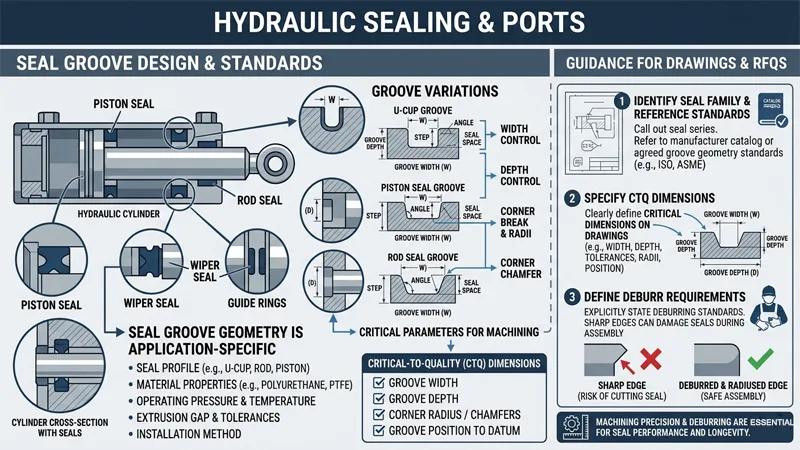
Seal groove geometry is not “one-size-fits-all.” Groove dimensions depend on seal profile (U-cup, rod seal, piston seal), material (e.g., polyurethane vs. PTFE), pressure, temperature, extrusion gap, and installation method. In practice, hydraulic cylinder seal groove machining lives or dies on the basics: groove depth/width control, corner break, and a deburr standard that prevents assembly damage.
Practical guidance for drawings and RFQs:
- Call out the seal family and reference the seal manufacturer’s catalog or an agreed standard for groove geometry.
- Define which dimensions are CTQ (typically groove width, depth, corner radii/chamfers, and groove position to datum).
- Define deburr requirements explicitly—sharp edges can cut seals during assembly.
Surfaces for sealing
The seal doesn’t care how pretty the part looks—it cares about counterface function:
- Too rough a surface can cause abrasive wear and leakage paths.
- Too smooth can reduce lubricant retention, increasing friction and heat.
Seal manufacturers emphasize these relationships in their technical guidance. For counterface basics and practical ranges, SKF’s notes are a solid baseline. For demanding applications or non-traditional coatings, Trelleborg’s white paper is helpful for understanding surface lead and peak/valley effects.
Ports/threads (ISO/SAE)
Port errors are a classic sourcing failure mode: threads fit, but sealing fails—or the fitting spec is correct, but the spotface/chamfer isn’t.
Common thread/port families in hydraulic cylinder parts include:
- SAE straight thread O-ring ports (often specified under SAE J1926 families)
- ISO 6149 metric O-ring ports
- NPT (tapered pipe)
- BSPP/BSPT (parallel/taper British pipe)
If your program spans regions or mixed legacy standards, make the port callout explicit. It’s a common sourcing pitfall to specify the thread size and omit the port family; for example, a drawing that clearly calls out SAE J1926 / ISO 6149 hydraulic ports removes ambiguity and protects sealing performance.
Two practical drawing rules:
- Always name the standard in the callout (don’t rely on a thread size alone). Even similar-looking ports can be incompatible.
- Treat the sealing features as CTQ: spotface, chamfer, surface finish, and concentricity to the thread.
For reference on the SAE straight thread O-ring port standard, SAE’s overview of SAE J1926-1 clarifies scope and working-pressure context (SAE J1926/1 standard landing page). For a practical overview of port families used globally, a concise summary is available in Hydraxio’s explanation of common thread types (thread port types: metric, BSP, SAE, NPT).
Quality & Testing
In-process & metrology
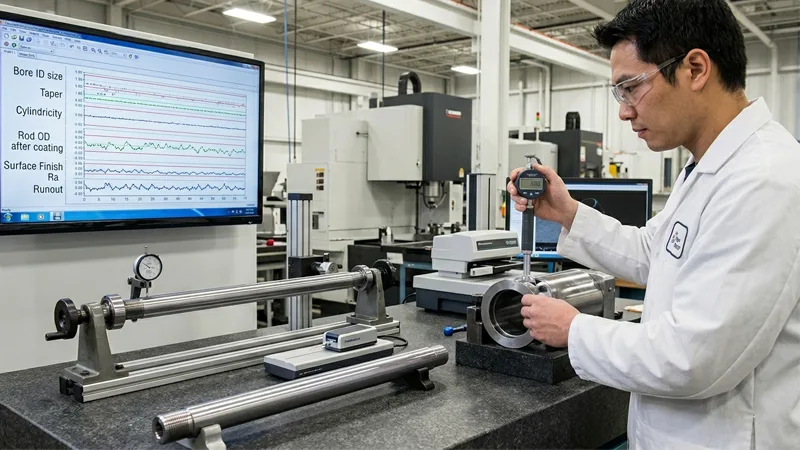
In-process controls should match what’s functionally critical:
- Bore ID: size, taper, and cylindricity where specified.
- Rod OD: size after coating and finishing.
- Surface finish: Ra (and any additional surface parameters if required).
- Runout/coaxiality: especially between seal surfaces, bearing surfaces, and thread axes.
Good practice is to define a measurement plan that is explicit about:
- gage type (bore gage, air gage, profilometer)
- support method for long parts
- sampling frequency and reaction plan when data drifts
Pressure & function tests
At a minimum, pressure or function testing should be clear on three points:
- What is tested (leak test, pressure hold, function stroke)
- At what conditions (pressure level, duration, temperature range, if applicable)
- What constitutes pass/fail (allowable leakage rate, permitted pressure decay, functional smoothness)
Even if full assembly testing isn’t part of the machining scope, component-level verification (ports sealing, surface condition, and cleanliness) prevents expensive downstream failures.
Docs, FAI/PPAP
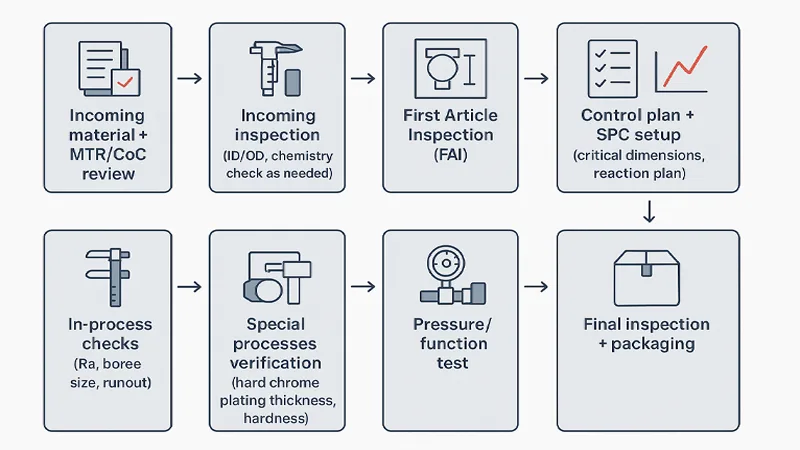
OEM sourcing teams often need documentation that’s consistent and audit-friendly:
- Material Test Report (MTR) / Certificate of Conformance (CoC)
- First Article Inspection (FAI) with ballooned drawing
- SPC (Statistical Process Control) records for CTQs where applicable
- Plating/coating certs and thickness verification where required
DFM, Cost & Lead Time
DFM guidelines
DFM for hydraulic cylinder components is mostly about preventing tolerance stack-up from turning into scrap, rework, or seal wear. Practical guidelines:
- Separate cosmetic from functional requirements: Don’t over-control non-sealing, non-mating surfaces.
- Use datums that match how the part functions: Seal/bearing axes should drive the datum scheme.
- Avoid over-tightening on long parts without a stability plan: Straightness and runout should be paired with a realistic machining/inspection route.
One brief example from AFI Industrial Co., Ltd., drawing-review practice: when a program calls for a tight rod OD tolerance and hard chrome, aligning the starting stock size and the plating allowance early can reduce risk. If you select stock that forces heavy cleanup after plating, you increase cycle time and the chance of going undersized at the low limit. A small change—choosing a closer pre-finish stock diameter and relaxing a non-functional shoulder tolerance—can keep the sealing surface in control while reducing rework.
Cost drivers
The biggest cost drivers in custom hydraulic cylinder parts, CNC machining, are usually predictable:
- Tight tolerances on long features (more passes, more inspection time, higher scrap exposure)
- Surface finish and counterface requirements (honing/polishing time, profilometer inspection)
- Coatings and special processes (hard chrome or alternatives, thickness verification, post-process finishing)
- Complex caps/glands (multiple setups, thread/port features, groove accuracy)
Key Takeaway: Cost is rarely “material vs machining” alone. The expensive part is the control plan needed to keep CTQs stable lot to lot.
Lead times & logistics
Lead time is driven by the longest pole in the tent:
- Raw material availability: tube/rod stock that matches your target size and certification requirements.
- Special processes: plating/coating queues and post-process grinding/polishing.
- Inspection and documentation: FAI/PPAP packs take time when done properly.
- Packaging: rods and honed tubes need protection against dents, corrosion, and contamination.
If you’re building a predictable delivery plan, align the timing windows up front:
- prototype vs. production lead times
- PPAP/FAI timing relative to tooling and process validation
- shipping method and import requirements (especially for overseas sourcing)
Conclusion
When you’re sourcing hydraulic cylinder components, quality is mostly the sum of a few controllable details: spec’d counterfaces, verified geometry, correct port standards, and a QC system that catches drift early.
Key takeaways:
- Use practical spec ranges and fit systems, then verify numerical limits by size.
- Treat sealing surfaces as CTQ: Ra, lead, and geometry are what protect seal life.
- Standardize ports/threads (SAE/ISO) and call out sealing features, not only thread size.
- Build QC gates that match risk: MTR → incoming checks → FAI → SPC → final release.
- Use DFM to reduce rework and lead-time variability—especially on long parts and coated rods.
Next steps:
- Confirm CTQs (bore ID/finish/geometry, rod OD/finish/runout, groove dims, port callouts).
- Align finishes/materials with seal selection and environment.
- Plan PPAP/FAI and logistics windows early so documentation doesn’t become the schedule driver.
If you want a second set of eyes on drawings and CTQs, AFI Industrial Co., Ltd. can support a spec-first DFM review and help align tolerances, finishing routes, and inspection documentation before production starts.
FAQ
Rods are typically made from medium-carbon steels like 1045 or alloy steels such as 4140, depending on the required strength and impact loading. 1045 steel is a cost-effective and widely used option, whereas 4140 is selected when applications demand higher strength and toughness margins.
While general CNC machining references often cite a default tolerance band of ±0.005 in (±0.13 mm), hydraulic components require much tighter controls. Practical drawings utilize ISO fit systems, such as H8/H9 for bore-related features and f7/g6 fits for rod features, to ensure proper clearance, assembly, and seal behavior.
The bore’s surface finish is a functional counterface for seals, directly dictating seal life and lubrication film quality. If the surface is too rough, it accelerates abrasive wear on the seals, while a surface that is overly smooth will struggle to retain an oil film, leading to increased friction and heat.
Long rods and barrels are highly susceptible to residual stress release and thermal expansion during machining, which can cause the material to move or taper. To maintain stability, the machining process should include a controlled rest period or intermediate stress relief after rough machining, paired with explicit straightness and runout callouts tied to a specific datum system.
The most widely used port families include SAE straight thread O-ring ports (often under SAE J1926), ISO 6149 metric O-ring ports, NPT (tapered pipe), and BSPP/BSPT. To prevent incompatibility and sealing failures, drawings must explicitly name the standard rather than just calling out the thread size.
The primary cost drivers include tight tolerances on long features (which require more passes and higher scrap exposure), strict surface finish requirements, complex setups for caps or glands, and special coating processes like hard chrome. Ultimately, the cost is driven by the rigorous control plan required to keep these critical-to-quality (CTQ) features stable across production lots.
To ensure consistent quality, OEM sourcing teams should require a comprehensive and audit-friendly documentation package. This typically includes a Material Test Report (MTR) or Certificate of Conformance (CoC), a First Article Inspection (FAI) with a ballooned drawing, Statistical Process Control (SPC) records for CTQs, and plating/coating certifications.