
Disclaimer & Risk Disclosure: This document is intended to provide an engineering technical overview of cryogenic machining technology based on current industrial practices and theoretical research. Operations involving cryogenic fluids such as liquid nitrogen (LN2) carry extremely high risks (including but not limited to asphyxiation hazards, cryogenic burns, and brittle fracture of equipment). All operations must strictly adhere to ISO standards and local EHS (Environment, Health, and Safety) regulations, including OSHA 29 CFR 1910.134 and ISO 23125:2015 (Machine Tools Safety). Unauthorized modification of CNC machine tools for cryogenic machining without professional training and equipment compatibility assessment is strictly prohibited.
Cryogenic Machining Technology Overview
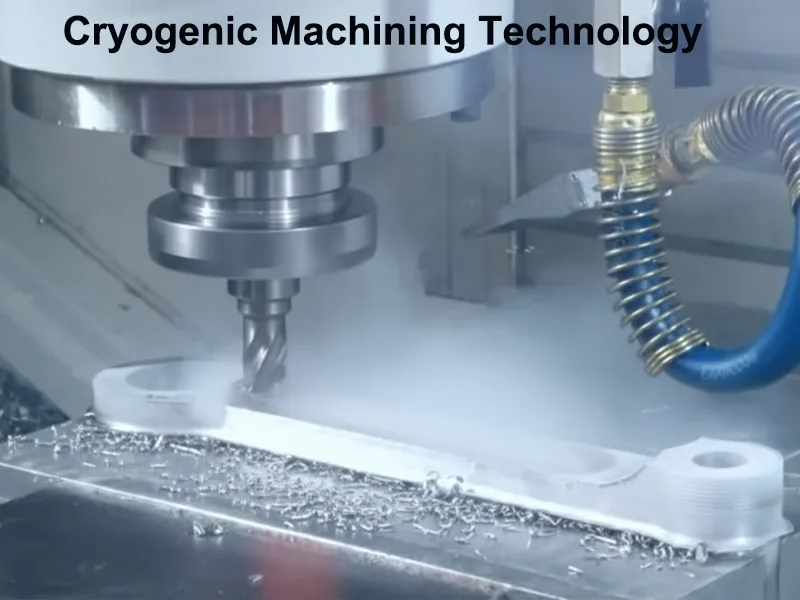
In the highly competitive field of modern precision CNC machining services, we view cryogenic machining technology as a revolutionary process upgrade for custom metal parts manufacturing. It is not merely “using cold temperatures”, but rather the precise control of the thermodynamic state of the cutting zone using deep-cold fluids(typically liquid nitrogen at -196°C).
Unlike traditional flood cooling with emulsions, this technology injects the cryogenic medium directly into the interface between the tool tip and the workpiece (Cutting Zone). For difficult-to-machine materials (such as superalloys and hardened steels) or custom metal components requiring high tolerances, this process significantly suppresses thermal softening effects. As manufacturing engineers, the core metrics we focus on—tool life extension and surface integrity—see significant improvements under this process. Furthermore, the high integration of this technology with modern 5-axis CNC systems makes thermal control of complex surfaces flexible and manageable.
Key Takeaways
To provide a rapid technical assessment for production managers and process engineers, here are the foundational pillars of our cryogenic approach:
- Media Characteristics: Utilizes liquid nitrogen (LN2) or carbon dioxide (CO2) as a cooling medium to rapidly dissipate cutting heat. The phase-change thermodynamics drastically alter the thermal boundary layer.
- Process Advantages: Significantly extends tool life and improves surface roughness, especially suitable for high-strength materials like titanium alloys and hardened steels.
- Industry Applications: Widely used in the processing of critical safety components in Aerospace and Automotive manufacturing.
- Precision Control: Achieves higher dimensional consistency by reducing tool wear and suppressing thermal distortion, meeting tight GD&T requirements.
- Automation Integration: Ensures process stability when combined with automatic fluid delivery in CNC systems, optimizing Overall Equipment Effectiveness (OEE).
- EHS Benefits: Drastically reduces or eliminates the use of chemical cutting fluids, which is not only environmentally friendly but also lowers occupational health risks for shop floor workers, aiding in ISO 14001 compliance.
- Cost Analysis: Although initial capital expenditure (CAPEX) is higher, long-term operating expenses (OPEX) show a clear advantage due to increased machining efficiency and reduced tool consumption.
- Maintenance & Safety: Strict system inspection protocols must be established to prevent system failures, and cryogenic operation safety training is mandatory.
Table of Contents
What Is Cryogenic Machining Technology
Technology Overview
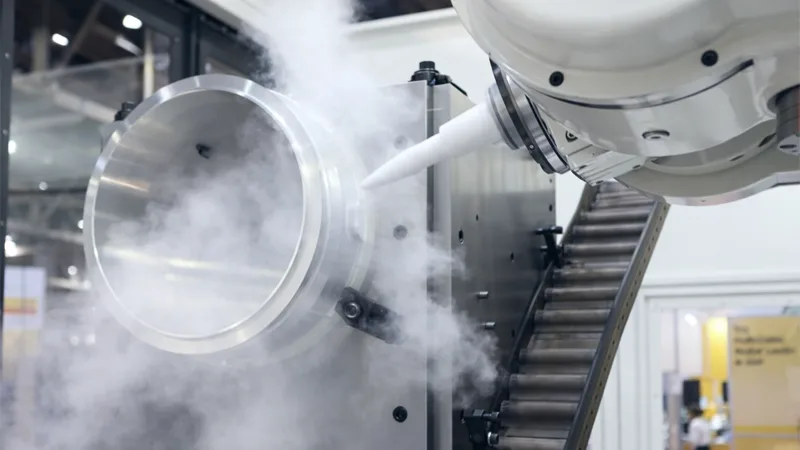
Cryogenic machining technology is a specialized machining process that utilizes cryogenic fluids to improve cutting tribological properties. Media like liquid nitrogen act directly on the shear zone, effectively disrupting the gas barrier (Leidenfrost Effect) and drastically reducing cutting temperatures.
This characteristic makes it the preferred solution for machining custom metal parts with poor thermal conductivity and concentrated cutting heat, such as titanium alloys and hardened steels. In aerospace, automotive, and medical device manufacturing, there are extremely high requirements for the fatigue strength and precision of components.
Advanced CNC systems allow us to integrate cryogenic fluid delivery into the spindle or tool holder (Through-tool delivery), achieving automated control. This highly repeatable cooling solution not only ensures tolerance band convergence but also significantly extends the replacement cycle of expensive tools by suppressing diffusion wear.
Core Principles
From a thermodynamic perspective, the core of cryogenic machining lies in “thermal control”. Utilizing extremely low temperatures to counteract the high heat generated by cutting prevents plastic deformation of the tool material while maintaining the microstructural stability of the workpiece material.
The heat dissipation mechanism can be quantified by the total heat transfer rate formula, evaluating both sensible and latent heat of the cryogenic fluid:
Qtotal = m • cp • ΔT + m • Lv
(Where m is mass flow rate, cp is specific heat, ΔT is the temperature differential, and Lv is the latent heat of vaporization).
Cryogenic fluids are sprayed directly onto the cutting point (Tool-Chip Interface), utilizing the latent heat of vaporization of liquid nitrogen to instantly remove massive amounts of heat. This not only allows us to adopt higher cutting parameters (Vc) but also effectively inhibits the formation of Built-up Edge (BUE), thereby directly improving the surface quality of the part.
It is worth noting that this technology is not limited to turning and milling; it is equally applicable to non-traditional machining processes such as Wire Electrical Discharge Machining (WEDM) and Electrical Discharge Machining (EDM). For example, introducing cryogenic cooling in WEDM processing of Ti6Al4V titanium alloy can significantly improve the Material Removal Rate (MRR) and improve the hardness of the recast layer.
Table 1: Performance Improvement Data for Cryogenic-Assisted Special Machining
| Process Type | Material | Improved machinability, reduced surface roughness (Ra), increased MRR, and increased surface hardness | Reference |
|---|---|---|---|
| WEDM | Ti6Al4V (Titanium Alloy) | Improved machinability, reduced surface roughness (Ra), increased MRR, increased surface hardness | Çakir & Celik (2021) |
| EDM | Titanium | Significant optimization in MRR, TWR (Tool Wear Rate), Ra, and geometric accuracy | Singh & Singh (2011) |
Differences from Conventional Machining
Conventional machining relies on water-based emulsions or pure oils for cooling and lubrication. However, during high-speed machining of difficult-to-cut materials, traditional coolants often fail to penetrate the high-pressure, high-temperature zone around the tool tip, leading to cooling failure, which in turn triggers severe tool wear and surface burns.
Cryogenic machining solves the permeability problem through high-pressure cryogenic jets. The constant low-temperature environment effectively inhibits thermal expansion deformation of the workpiece. More importantly, it eliminates the environmental burden caused by chemical additives. While improving productivity, it helps enterprises meet increasingly stringent ISO 14001 environmental management standards, making it particularly suitable for stress-free machining of complex thin-walled parts.
How Cryogenic Machining Works
Cryogenic Fluid Application System
The starting point of the precision CNC manufacturing process is the precise delivery of the fluid medium. Industrially, Liquid Nitrogen (LN2) is primarily used due to its chemical inertness and excellent cooling capacity. However, this is not simple spraying; a Subcooler System must be equipped.
The role of the subcooler is critical: it prevents the liquid nitrogen from gasifying in the pipeline before reaching the nozzle (two-phase flow leads to unstable cooling) and ensures constant pipeline pressure. This stable supply of single-phase liquid fluid is key to guaranteeing cutting force fluctuations when machining high-strength materials.
Process Steps (SOP)
At AFI Parts, our CNC operators and manufacturing engineers are required to follow these rigorous Standard Operating Procedures (SOP) to ensure safety and precision:
- Preparation: Select dedicated cryogenic alloy tools based on the workpiece material (e.g., Inconel 718) and verify that machine guarding and seals meet cryogenic operating conditions.
- Cryogenic Fluid Delivery Connection: Connect the liquid nitrogen storage tank to the machine interface, start the subcooler system, and wait until the pipeline temperature reaches the set value to ensure no vapor lock.
- Application to Cutting Zone: Adjust the nozzle angle to align with the main flank and rake face, ensuring the fluid contacts the heat source immediately.
- Machining Operation: Execute the program; the cryogenic environment will inhibit adhesive wear, resulting in a smooth cut surface.
- Monitoring and Adjustment: Monitor flow meters and thermal imaging data in real-time, dynamically adjusting injection pressure if necessary.
AFI Engineering Tip: A Leak Check must be performed before startup. Discontinuity in fluid flow will directly lead to thermal shock failure of the tool, jeopardizing the entire custom metal fabrication run.
CNC Integration Technology
Modern CNC systems (such as Siemens 840D or Fanuc 31i) already support M-codes to control the start/stop and flow rate of cryogenic systems. Through advanced CAM programming, we can achieve:
- Timing Control: Spray only when the tool contacts the workpiece to save costs.
- Multi-Process Switching: Seamlessly switch cooling modes between turning, milling, drilling, and EDM operations.
This automated integration eliminates the uncertainty of human intervention and ensures the consistency of mass production (improved CPK values).
Table 2: CNC Integration Advantage Matrix
| Feature | Benefit for You |
|---|---|
| Automated Fluid Control | Eliminates thermal fluctuations and significantly reduces auxiliary time |
| Programmable Delivery | Adjust cooling strategies for different steps (Roughing/Finishing) |
| Process Compatibility | Covers multiple machining forms like turning, milling, and EDM |
| High Repeatability | Reduces reliance on operator skills, ensuring batch stability |
Key Components in Cryogenic Machining
Specialized Equipment and Tools
Implementing cryogenic machining for precision custom metal parts requires a specific hardware ecosystem:
- Fluid Supply System: Must use Vacuum Insulated Piping (VIP) to transport liquid nitrogen.
- Specialized Tool Holders: Must withstand deep-cold contraction to prevent a decrease in tool clamping force (leading to tool pull-out or chatter).
- Precision Nozzles: Utilize micro-orifice designs to precisely control the jet vector.
Machining solutions provided by AFI Industrial Co., Ltd have deeply integrated these hardware components with CNC machine tools, supporting Single Minute Exchange of Die (SMED) and ensuring compliance with aerospace-grade quality standards.
AFI Engineering Tip: Coaxiality calibration of the nozzle is a top priority for daily spot checks.
Material Compatibility Engineering Analysis
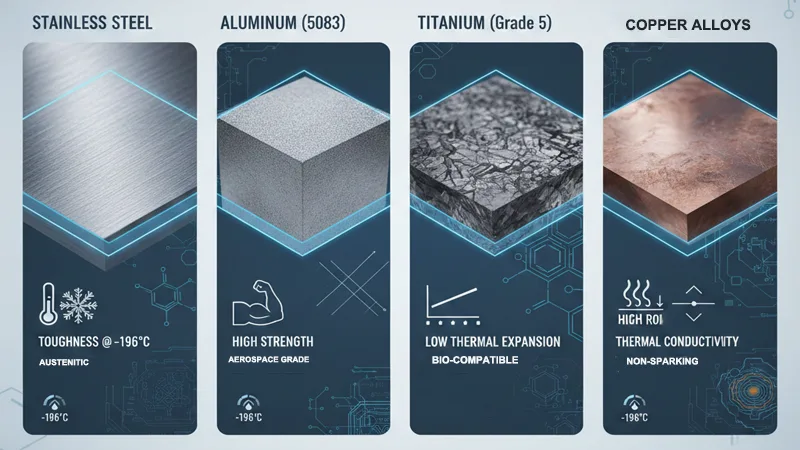
Not all custom metal materials are suitable for cryogenic machining. We need to focus on the ductile-to-brittle transition temperature of the material. The following is an analysis of cryogenic adaptability for common materials processed at AFI Parts:
Table 3: Material Characteristics Analysis in Cryogenic Environments
| Material Type | Properties & Cryogenic Performance |
|---|---|
| Stainless Steel | Austenitic stainless steels (e.g., 304/316) maintain excellent toughness at low temperatures; non-porous surface resists contamination. |
| Aluminum (5083) | Excellent strength-to-weight ratio; does not undergo brittle fracture in deep-cold environments. |
| Titanium (Grade 5) | Low coefficient of thermal expansion; maintains high strength and toughness at low temperatures; one of the materials with the highest ROI for cryogenic machining. |
| Copper Alloys | Excellent thermal conductivity, non-sparking; however, attention must be paid to high thermal contraction rates, requiring compensation in CAM programming. |
These properties dictate their application in storage tank inner walls, fluid pipelines, and valve bodies.
Workflow in Machining
A standardized workflow is the guarantee of quality for any precision CNC machining service:
- System Pre-cooling: Ensure pipelines reach operating temperature.
- Tool Loading & Offsetting: TCP (Tool Center Point) must be calibrated in the cold state.
- CNC Program Execution: Integrate cryogenic control commands.
- Process Thermal Compensation: Monitor machine body temperature to prevent cold bridge effects from affecting machine accuracy.
- Quality Inspection: Workpieces must return to room temperature before CMM measurement.
AFI Industrial Co., Ltd’s automation solutions optimize this flow, improving OEE (Overall Equipment Effectiveness) by reducing manual intervention.
Maintenance Note: Cryogenic seals (such as Teflon gaskets) are consumables and must be replaced regularly to prevent leaks.
Engineering Advantages of Cryogenic Machining Technology
Tool Life Extension Mechanism
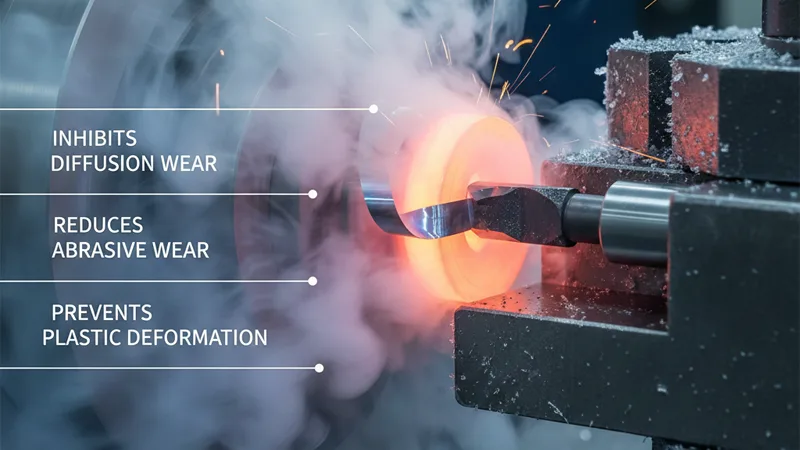
When machining difficult-to-cut materials, cutting heat is the primary cause of tool failure. Liquid nitrogen cooling effectively lowers the temperature of the cutting zone, thereby:
- Inhibiting Diffusion Wear: Reduces chemical affinity between the tool and chips.
- Reducing Abrasive Wear: Maintains the hardness of the tool substrate.
- Preventing Plastic Deformation: Avoids softening and collapse of the cutting edge.
Field tests show this significantly reduces Tooling Costs. The improvement can be mapped using an expanded Taylor Tool Life Equation:
In cryogenic states, the constant C increases significantly, allowing for higher velocities (Vc) without sacrificing tool life ( T ).
Monitoring Suggestion: It is recommended to use on-machine laser tool setters to regularly monitor flank wear (VB).
Surface Integrity Enhancement
The cryogenic environment inhibits the formation of “White Layers” and residual tensile stresses on the machined surface. The quenching effect of the cold medium fixes the workpiece dimensions, significantly reducing micro-scratches caused by burrs and built-up edges, ensuring strict Geometric Dimensioning and Tolerancing (GD&T).
Table 4: Surface Quality Improvement Comparison
| Benefit | How It Helps You |
|---|---|
| Less Surface Roughness | Improves hydrodynamic performance and fatigue life |
| Fewer Burrs | Reduces deburring operations, lowers assembly interference risks |
| Stable Dimensions | Guarantees high-precision fits (e.g., H7/g6 fits) |
Environmental Benefits
Abandoning traditional cutting fluids means eliminating the waste liquid disposal process. Liquid nitrogen vaporizes and returns directly to the atmosphere (nitrogen makes up 78% of the air), achieving zero emissions. This completely solves the hazard of shop floor oil mist to workers’ respiratory systems and skin allergies, helping enterprises obtain ISO 14000 certification.
Productivity Gains Analysis
Efficiency Multiplier Factor
Cryogenic machining allows us to break the limits of traditional Cutting Speeds (Vc). The intense cooling effect keeps the cutting zone temperature controllable even at high Feed Rates, drastically increasing the Material Removal Rate (MRR). Due to extended tool life, Downtime for tool changes is significantly reduced, increasing throughput per shift.
AFI Parts Internal Data Snapshot (Lab Test 2026-02): In a recent milling test on Ti-6Al-4V components, the engineering team at AFI Parts observed a 45% increase in MRR while simultaneously decreasing flank wear by 32% over a 60-minute continuous cut, validating the efficiency multiplier effect.
Quality Consistency
The consistency of thermal stability translates to lower Scrap Rates and Rework. Combined with CNC automation, it enables efficient switching for High-Mix Low-Volume production.
Table 5: Production Efficiency Comparison Data
| Feature | Traditional Machining | Cryogenic Machining |
|---|---|---|
| Cutting Speed | Moderate (Limited by heat) | High (Limited by machine power) |
| Tool Change Frequency | High | Low |
| Downtime | More | Less |
| Part Quality Consistency | Variable | High and Stable |
| Scrap/Rework Rate | Higher | Significantly Lower |
Industry Applications (Applications in Modern Manufacturing)
Aerospace and Automotive
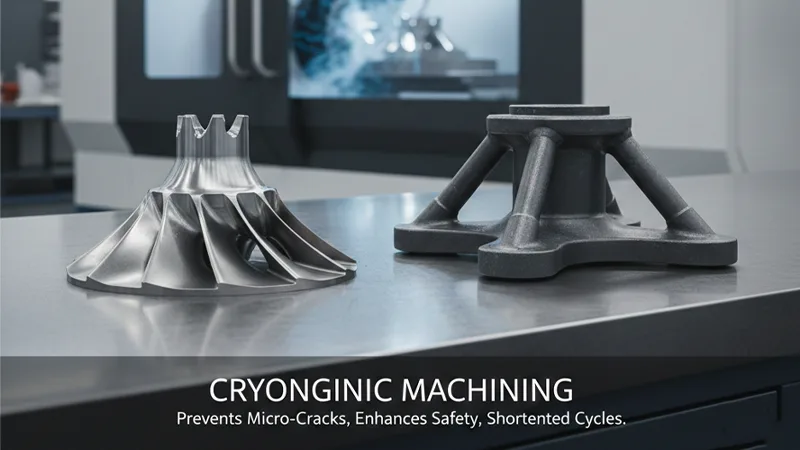
In these fields, Heat Resistant Super Alloys (HRSA) like Inconel 718, René 41, and titanium alloys are widely used. Cryogenic machining is a key technology for processing turbine blades and landing gear components. It prevents micro-cracks on part surfaces that lead to fatigue failure and significantly shortens processing cycles while ensuring safety.
Medical Device Manufacturing
Implants such as bone screws and artificial joints are typically made of titanium alloys or cobalt-chrome-molybdenum alloys. Cryogenic machining avoids chemical residues from traditional cutting fluids on part surfaces, which is crucial for Biocompatibility. At the same time, its excellent dimensional retention ensures the precise engagement of surgical instruments
Table 6: Medical Part Machining Advantages
| Medical Device Part | Material | Benefit of Cryogenic Machining |
|---|---|---|
| Bone Screws | Titanium Alloy | Smooth thread surface, burr-free |
| Surgical Scissors | Stainless Steel | Sharp edges, hardness maintained (no annealing) |
| Diagnostic Housings | Aluminum | No oil contamination, clean cuts |
Challenges, Limitations, and Risk Disclosure
Implementation Costs and ROI Analysis
We must honestly face high initial investments, including liquid nitrogen tanks, vacuum piping, subcooler systems, and machine retrofits. Additionally, as a continuous consumable, the logistics cost of liquid nitrogen must be accounted for. However, for high-value-added parts, TCO (Total Cost of Ownership) models show that tool savings and efficiency gains typically recover the investment within 12-24 months. Enterprises are advised to conduct detailed cost-benefit calculations before transitioning.
Technical Limitations
Technology is not a panacea; be alert to the following risks:
- LN2 Quality: Reduced vacuum in Dewars or tanks can lead to premature gasification of liquid nitrogen, creating “slug flow” and causing cooling failure.
- Thermal Deformation Risks: If the machine lacks thermal compensation, extreme cold may cause the spindle or bed to contract, adversely affecting accuracy.
Table 7: Common Technical Failures and Impacts
| Limitation Description | Impact on Machining Processes |
|---|---|
| Quality of cylinders (Vacuum failure) | Unstable delivery leads to instantaneous tool overheating and burnout |
| Internal wear/leaks | Insulation failure causes LN2 gasification, blocking pipelines |
| Fluctuations | Causes severe oscillation in cutting zone temperature, affecting surface texture consistency |
Safety and EHS Mandatory Regulations
Solemn Warning: Liquid nitrogen operations involve extremely high risks.
- Asphyxiation Risk: Liquid nitrogen has an expansion ratio of approximately 700:1; leaks can deplete oxygen in confined spaces. ODH (Oxygen Deficiency Hazard) monitors must be installed.
- Freeze Protection: Operators must wear dedicated cryogenic gloves, face shields, and splash aprons.
- Training: All personnel must undergo regular emergency drills.
Deep Benchmarking: Cryogenic Machining vs. Traditional Methods
Cooling and Lubrication Comparison
Traditional cutting fluids suffer from the “film boiling” phenomenon, making it difficult to enter the high-temperature contact zone, and post-process Cleaning costs are high. Cryogenic machining utilizes the high permeability of extremely low-temperature gas to achieve clean, efficient cooling, eliminating the environmental compliance risks of waste liquid disposal.
Comprehensive Performance Comparison
From engineering data, cryogenic machining leads across the board in hard material processing.
Table 8: Comprehensive Performance Comparison Table
| Feature | Traditional Machining | Cryogenic Machining |
| Cooling Method | Oil/Water-based Emulsion | Liquid Nitrogen (LN2) / CO2 |
| Tool Life | Shorter (Mainly affected by thermal wear) | Significantly Longer |
| Surface Finish | Higher (Rougher) | Low (Smoother) |
| Cleaning Needed | Necessary and tedious | Minimal or None |
| Environmental Impact | Generates hazardous waste liquid | Very Low (Gas emission) |
Cost-Benefit Overview
While liquid nitrogen has a cost, data shows that in large-scale production, the comprehensive per-unit cost using Cryo-LN2 is 1.12% lower than Cryo-CO2, 7.37% lower than Minimum Quantity Lubrication (MQL), and 26.67% lower than dry machining. This is mainly due to extended tool life and reduced auxiliary man-hours.
Conclusion
Cryogenic machining technology is reshaping the landscape of high-end manufacturing. By solving the thermal challenges of difficult-to-machine materials, it achieves a unity of high precision, high efficiency, and green manufacturing. For machining enterprises pursuing ultimate quality and competitiveness, such as AFI Industrial Co., Ltd, introducing this technology is an important step towards Industry 4.0.
FAQ
It is an advanced process utilizing deep-cold fluids (like liquid nitrogen at -196°C) to directly cool the cutting zone, aiming to suppress high cutting heat, thereby extending tool life and improving surface quality.
Aerospace (titanium structural parts), Automotive (hardened steel transmission parts), and Medical Devices (implants) are the primary beneficiary sectors.
They cannot be used directly. Dedicated vacuum insulated piping and cryogenic control kits must be installed; some machines may require spindle modifications and thermal compensation parameter adjustments.
Titanium alloys, nickel-based superalloys (e.g., Inconel), stainless steel, and hardened steels—materials with low thermal conductivity and severe work hardening—show the best results.
As long as EHS regulations are strictly followed, protective gear is worn, and oxygen deficiency alarms are installed, safety is controllable. Compared to traditional cutting fluids, it also reduces the risk of exposure to carcinogens.
It eliminates the procurement, storage, and waste disposal of cutting fluids. Liquid nitrogen evaporates into nitrogen gas and returns to the atmosphere, with no risk of soil or water contamination.