
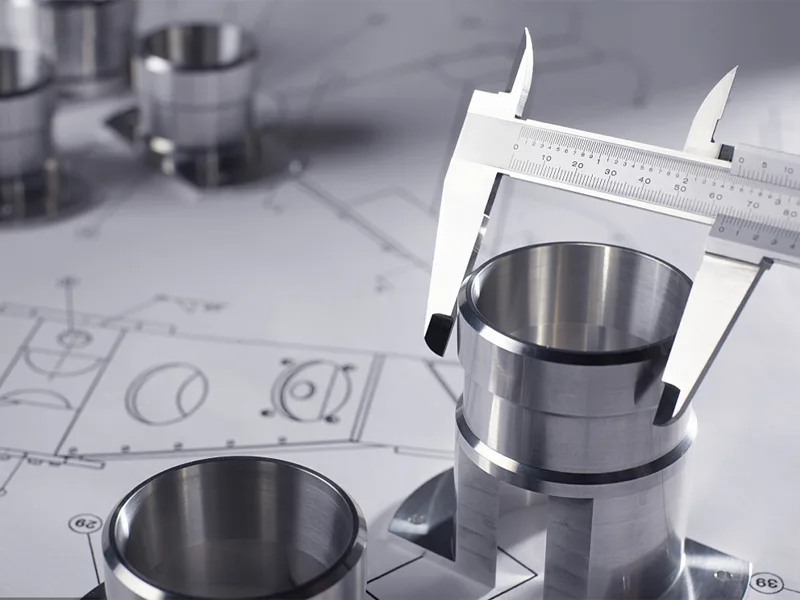
In the demanding world of modern manufacturing, the margin for error is virtually nonexistent. Whether you are assembling complex medical devices, engineering aerospace components, or developing high-performance automotive systems, A dimensional deviation of merely a few microns can transform a device from perfect operation into catastrophic failure. In these high-stakes industries, a rigorous approach to quality is an absolute necessity.
This brings us to a critical distinction in the supply chain: the difference between a standard machine shop and a top-tier CNC Machined Parts Manufacturer. While any shop can purchase turning and milling machines, a true industry leader should be grounded in steadfast, comprehensive quality control (QC). Quality should not be guaranteed solely by parts at the end of the product line; it must be implemented into the entire manufacturing lifecycle, from the moment raw material enters the loading dock to the final packaging and shipment.
At AFI Parts (www.afiparts.com), our senior engineering team understands that our B2B partners do not just buy metal components; they buy reliability, consistency, and peace of mind. This guide explores the meticulous quality control protocols that a premier CNC machining partner employs to achieve zero-defect manufacturing, strictly adhere to your most complex specifications, and ultimately lower your overall procurement costs.
Table of Contents
The Foundation of Precision: Rigorous Incoming Material Verification
The journey of a perfect component begins long before the first metal chip is cut. You cannot machine a high-precision part from compromised, counterfeit, or flawed raw material. A world-class CNC Machined Parts Manufacturer implements a draconian incoming material verification process to ensure the fundamental integrity of every project.
Positive Material Identification (PMI) Testing
To eliminate the risk of supplier error or counterfeit materials, manufacturers do not rely solely on paperwork. We utilize Positive Material Identification (PMI) testing, often employing Handheld X-Ray Fluorescence (XRF) analyzers or Optical Emission Spectrometry (OES). These non-destructive testing methods allow our inspectors to instantly verify the exact elemental composition of the raw stock on our dock. If a client specifies an exact alloy variant for superior corrosion resistance or specific magnetic properties, PMI testing guarantees that the raw material matches the specification down to the molecular level.
Robust Material Traceability Systems
In highly regulated industries like aerospace and medical manufacturing, knowing the origin of a material is a strict regulatory requirement. A professional B2B metal manufacturing partner utilizes advanced Enterprise Resource Planning (ERP) systems coupled with physical tagging and barcoding. This creates an unbroken chain of custody. If a field issue occurs years down the line, we can trace a specific finished component back to its specific production run, the machine it was milled on, the operator who ran the program, and the exact heat or lot number of the original raw material.
Advanced Inspection Equipment & Technology
To verify tight tolerance machining—where dimensions are often specified in ten-thousandths of an inch or single-digit microns—a manufacturer must invest heavily in state-of-the-art metrology equipment. Human vision and basic hand tools are entirely insufficient for this level of precision.
Coordinate Measuring Machines (CMM Inspection)
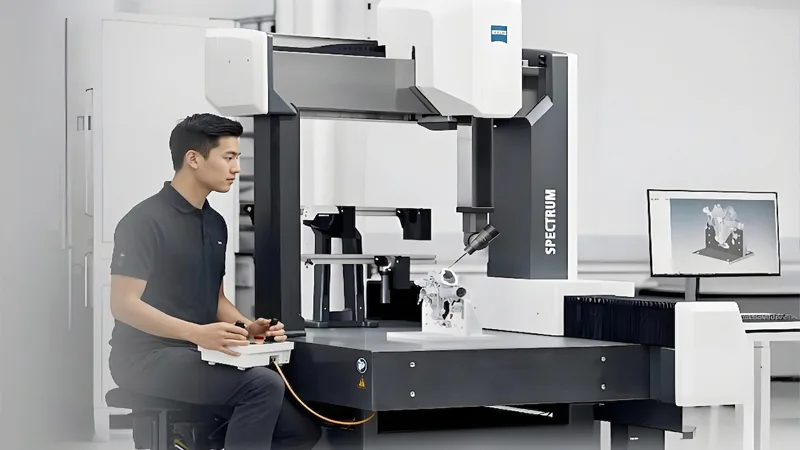
The cornerstone of any advanced quality control lab is the Coordinate Measuring Machine (CMM). These highly sophisticated machines utilize delicate electronic touch probes (such as those from Renishaw) to record the precise X, Y, and Z coordinates of a part’s geometry. CMM inspection is critical for validating complex geometric shapes, intricate internal features, and strict Geometric Dimensioning and Tolerancing (GD&T) callouts such as true position, cylindricity, flatness, and concentricity. By running automated, programmable inspection routines, CMMs eliminate human measurement error and provide highly repeatable, verifiable data for every production batch.
Optical Image Measurement Systems and Vision Systems
For micro-machined parts, extremely fragile components, or flat profiles where a physical touch probe might cause distortion, optical comparators and automated vision systems are indispensable. These systems use high-resolution cameras, customized lighting arrays, and advanced edge-detection software to magnify the part and measure its profile against the original CAD data. This non-contact measurement method is exceptionally fast and accurate, making it ideal for inspecting intricate two-dimensional profiles and verifying the presence of micro-features that are nearly invisible to the naked eye.
Surface Roughness Testers (Profilometers)
Surface finish is rarely just a cosmetic requirement; it is usually a critical functional parameter. Whether a surface needs to form a high-pressure hydraulic seal, reduce friction in a bearing application, or prepare for specialized medical coating adhesion, surface roughness matters. Top-tier manufacturers use highly sensitive digital profilometers to drag a microscopic diamond stylus across the machined surface, measuring variations at the micro-inch level. We rigorously document Ra (Average Roughness), Rz (Mean Roughness Depth), and other critical parameters to ensure the surface topography meets the exact engineering specifications.
Custom Gauging, Thread Plugs, and Hard Gauges
While digital metrology is essential, high-volume precision CNC machining services also rely on fast, deterministic physical gauges. We maintain a vast, calibrated library of thread plug gauges, thread ring gauges, pin gauges, and custom-designed go/no-go gauges. These tools allow our machinists to perform rapid, highly accurate checks on the shop floor, ensuring that tapped holes, critical bores, and complex threads are perfectly sized before the part moves to the next operation.
In-Process Quality Control (IPQC): Catching Deviations in Real-Time
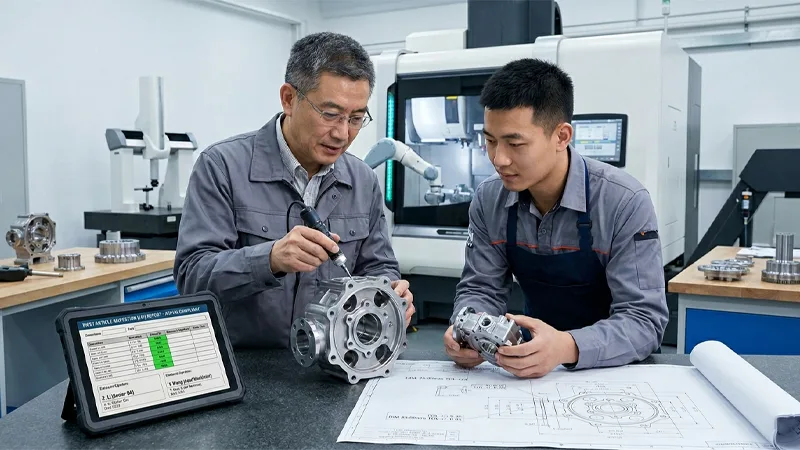
A reactive quality control system that only inspects finished parts at the end of the line will inevitably result in high scrap rates, delayed shipments, and inflated costs. A leading CNC Machined Parts Manufacturer utilizes proactive In-Process Quality Control (IPQC) to monitor production continuously and stop deviations before they result in non-conforming parts.
The First Article Inspection (FAI) Protocol
Before transitioning into full production, a rigorous First Article Inspection is mandatory. The first part produced from a new setup or a new CNC program undergoes an exhaustive, 100% dimensional layout inspection. A senior quality engineer and the lead machinist work together to verify every single dimension, note, and specification on the engineering drawing. We often utilize the stringent AS9102 First Article Inspection Report format, creating a comprehensive document that proves the manufacturing process is capable of producing a fully compliant part. Actual production begins only after the first piece has been approved and signed off.
On-Machine Probing and Automated Compensation
Modern CNC turning and milling services leverage the power of on-machine probing. High-precision probes integrated directly into the CNC machine’s spindle allow the machine to measure the part while it is still fixtured in the work envelope. This technology serves multiple purposes: it verifies that the raw stock is loaded correctly, establishes precise work coordinate offsets, and measures critical features immediately after cutting. If the probe detects that a tool is beginning to wear and a dimension is drifting toward the edge of its tolerance band, the CNC controller can automatically update tool wear offsets, bringing the dimension back to nominal without human intervention.
Statistical Process Control (SPC)
For high-volume production runs, maintaining consistency across thousands of parts requires a mathematical approach. We employ Statistical Process Control (SPC) methodologies to monitor the stability of our machining processes. By measuring a sample of parts at regular intervals and plotting the data on control charts, our engineers can visualize the process behavior.
We closely monitor capability indices such as Cp and Cpk. A high Cpk value indicates that our process is not only centered on the target dimension but also has very little variation, mathematically guaranteeing that the defect rate will remain astonishingly low. By tracking these trends, we can replace cutting tools or adjust machine parameters long before a part actually fails inspection.
Final Quality Control, Finishing, and Compliance
The final stages of production are just as critical as the machining itself. After all milling, turning, and secondary operations are complete, the components enter the Final Quality Control phase to ensure they are fully ready for the client’s assembly line.
AQL Sampling and 100% Inspection Protocols
Depending on the criticality of the component and the client’s specific requirements, we apply scientifically sound inspection sampling plans. For standard B2B commercial parts, we often utilize recognized statistical sampling standards like MIL-STD-105E (ANSI/ASQ Z1.4), determining the appropriate Acceptable Quality Limit (AQL) to balance efficiency with rigorous quality assurance. However, for ultra-critical applications—such as life-saving medical implants or flight-critical aerospace components—we implement stringent 100% final inspection protocols, where every single part is individually measured and verified before leaving the facility.
Cosmetic, Surface Treatment, and Packaging Inspection
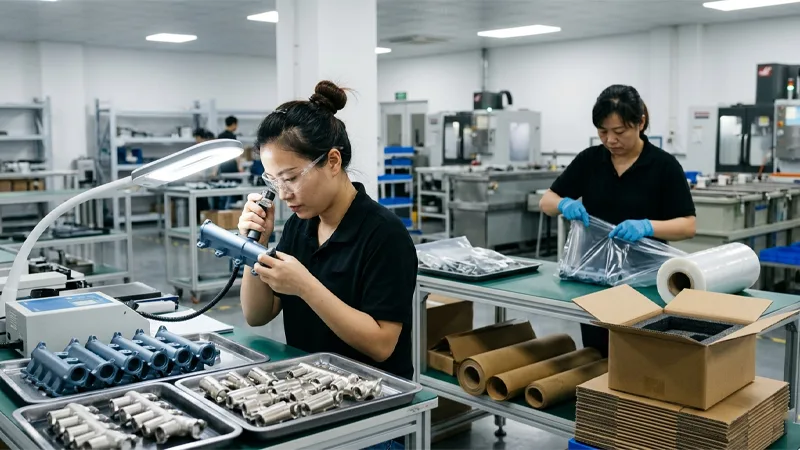
A part that measures perfectly but looks terrible or arrives damaged is a failure. Many custom metal parts undergo secondary surface treatments such as Type II or Type III hard coat anodizing, electroless nickel plating, passivation, or bead blasting. Our final inspectors meticulously check these finishes for uniformity, proper coating thickness (using eddy current or X-ray thickness testers), and color consistency.
Furthermore, they conduct rigorous visual inspections under controlled lighting conditions to ensure the parts are free of burrs, tool marks, scratches, or handling damage. Finally, we engineer custom packaging solutions—utilizing rust inhibitors (VCI paper/bags), custom foam inserts, and reinforced crating—to ensure these precision components survive the global logistics chain and arrive at your company in pristine condition.
Comprehensive Compliance Documentation
A professional B2B relationship is built on transparency and verifiable data. We do not just ship parts; we ship confidence. Along with the physical components, we provide comprehensive documentation packages tailored to the client’s needs. This typically includes the Outgoing Quality Control (OQC) report detailing the final dimensional measurements, the original Material Mill Certificates, certificates of conformance (CoC) for any plating or heat treatments, and declarations of compliance for international environmental standards such as RoHS and REACH. This documentation provides your incoming inspection team with everything they need to seamlessly integrate our parts into your inventory.
Quality Management Systems: The Culture of Continuous Improvement
A truly exceptional CNC Machined Parts Manufacturer recognizes that quality is not just a department; it is an organizational culture governed by strict, internationally recognized frameworks.
Operating as an ISO 9001 Certified Machine Shop
At AFI Parts, our commitment to excellence is formalized through our adherence to the ISO 9001:2015 Quality Management System. This certification is not a static plaque on the wall; it is a dynamic, living system that dictates how we manage risk, standardize procedures, train our personnel, and evaluate our suppliers. Every process, from quoting and contract review to manufacturing and shipping, is governed by controlled, documented procedures. Regular internal audits and rigorous third-party surveillance audits ensure that our management system remains robust, effective, and fully compliant with global best practices.
Corrective and Preventive Action (CAPA) and the PDCA Cycle
Even in the most controlled environments, anomalies can occur. The mark of a top-tier manufacturer is how they respond to these anomalies.
We utilize the Plan-Do-Check-Act (PDCA) cycle to drive continuous improvement. If a non-conformance is detected, either internally or by a client, we immediately initiate a Corrective and Preventive Action (CAPA) protocol. We do not just scrap the bad part and move on; our engineering team utilizes root cause analysis tools—such as the 8D (Eight Disciplines) problem-solving method, Fishbone diagrams, or the “5 Whys”—to isolate the exact systemic failure that caused the defect. We then implement permanent corrective actions, update our standard operating procedures, and train our staff to guarantee that the specific issue can never occur again.
The Human Element: Expert Machinists and Senior Engineers
While multi-axis CNC machines and robotic CMMs are technological marvels, they are ultimately just tools. The true driving force behind flawless quality control is the human intellect programming, operating, and overseeing these machines.
A premier CNC Machined Parts Manufacturer relies heavily on the deep expertise of its personnel. Our team at AFI Parts comprises seasoned machinists, meticulous quality inspectors, and senior manufacturing engineers. It takes years of hands-on experience to deeply understand how different metal alloys behave under extreme cutting forces, how to manage thermal expansion during heavy milling, and how to design rigid, vibration-free workholding fixtures.
Furthermore, accurately interpreting modern engineering drawings requires a profound understanding of complex GD&T (Geometric Dimensioning and Tolerancing). Our senior engineers work closely with our clients during the quoting and pre-production phases, often providing critical Design for Manufacturability (DFM) feedback. By identifying potential tolerance conflicts or excessively difficult-to-machine features early in the process, we collaborate with our clients to optimize their designs, improving the final product’s quality while simultaneously driving down manufacturing costs. The integration of high-level engineering oversight into the production floor is the ultimate safeguard of quality.
Conclusion: Partnering for Precision and Reliability
Navigating the complexities of global supply chains requires partners you can trust implicitly. When evaluating potential vendors for your precision CNC machining services, you must look beyond the hourly machine rate and evaluate their holistic approach to quality. A facility that cuts corners on incoming material checks, relies on outdated inspection tools, or lacks a formalized quality management system will inevitably cost you far more in rejected assemblies, delayed product launches, and damaged brand reputation.
Choosing a top-tier CNC Machined Parts Manufacturer means investing in a robust, multi-layered quality ecosystem. It means partnering with a team that utilizes cutting-edge metrology, relentless in-process monitoring, strict ISO-certified protocols, and elite engineering talent to guarantee that every single component meets your exact specifications.
Would you like to experience the difference that uncompromising quality control can make for your supply chain? At AFI Parts, our senior engineering team is ready to review your most challenging projects. Upload your CAD drawings or 3D models to our secure portal today. We will provide a comprehensive DFM analysis and a highly competitive, transparent quote within 24 hours. Let us show you how true precision is manufactured.
FAQ
What certifications should you look for in a CNC-machined parts manufacturer?
You need to look for ISO 9001, AS9100, or IATF 16949. These certifications mean the company follows strict rules. Certified companies make sure your parts are safe.
How do you know if your parts meet specifications?
You get inspection reports and certificates with your order. These papers show sizes and test results. You can ask for more reports if you want extra proof.
Why is digital traceability important for your projects?
Digital traceability helps you track every part from start to finish. If something goes wrong, you can find the problem fast. This keeps your business safe and builds trust.
How often should you expect quality checks during production?
You should expect checks at every step. Manufacturers check materials, first parts, parts during work, and finished products. Lots of checks help catch mistakes early.
Can you request custom inspection or testing for your parts?
Yes, you can ask for special checks or tests. Just tell your manufacturer what you need. They will follow your instructions and give you the right papers.