
Introduction
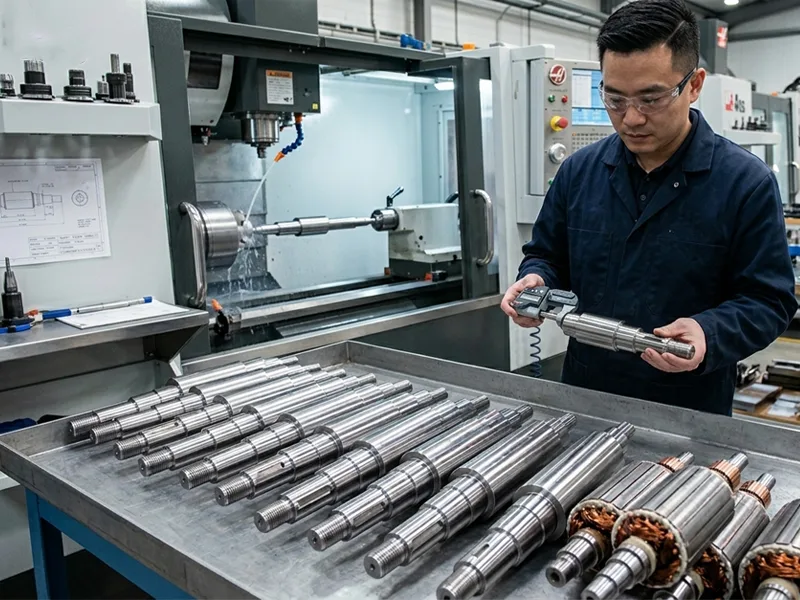
Precision motor shafts and rotors manufacturing sits at the intersection of motor shaft manufacturing, metrology, and rotating equipment physics. It’s not just “make a round part.” It’s the discipline of producing a shaft/rotor system that assembles cleanly, runs quietly, survives duty cycles, and stays within vibration limits across temperature, speed, and load.
In practical sourcing terms, “motor shafts and rotors manufacturing” usually covers a full lifecycle:
- Prototype build: prove geometry, fits, and stack-up assumptions before committing to tooling, fixtures, and long lead items.
- Pilot/pre-production: lock processes, validate inspection methods, and confirm capability on critical features.
- Mass production: maintain stability across lots—material, heat treat, grinding, balancing, and final inspection—while controlling total cost of ownership (TCO).
That lifecycle is where standards, tolerances, and validation do the most work. They prevent the expensive failures you don’t see on day one:
- bearing creep, fretting, or early noise issues because a seat fit was “close enough.”
- Vibration-driven field returns because the balancing grade and acceptance method were never aligned
- Scrap spikes during ramp because datums weren’t defined in a way inspection could repeat
In 2025, qualified suppliers will be evaluated less on broad capability claims and more on whether they can prove control of:
- fit strategy and GD&T intent (what is controlled, from which datum)
- runout/concentricity behavior and how it is validated
- balance quality targets and vibration acceptance logic
- documentation discipline (FAI/PPAP where required), traceability, and controlled change
This article gives you a technical baseline to translate drawings into sourcing and acceptance criteria—and to engage suppliers with questions that surface risk early.
Table of Contents
Technical Baselines
To keep supplier conversations crisp, treat these technical baselines as the minimum “shared language” for precision motor shafts and orbors manufacturing services.
Fits, GD&T, finishes
A motor shaft/rotor assembly is a tolerance stack-up problem. The “right” numbers depend on how the part functions: torque transmission, bearing retention, thermal behavior, serviceability, and NVH targets.
Fits (ISO 286) give you a standardized language for hole/shaft relationships (clearance, transition, interference). ISO 286 defines how tolerance zones are designated and compared across global supply chains—so a drawing means the same thing to a shop in Michigan as it does to one in Shenzhen. The official system is documented in the ISO 286 code system for tolerances.
In motors, the common fit questions are not abstract (and they show up repeatedly in supplier RFQs for precision motor shafts and rotors manufacturing services):
- Bearing seats: Do you need an interference fit to prevent creep under rotating load, or a fit that allows thermal growth without over-preloading the bearing?
- Press-fit components (gears, sleeves, laminations, hubs): What contact pressure is needed, and what assembly method is realistic (thermal, press, shrink)?
- Location features: Which shoulders, pilots, and faces actually control axial position in the assembly?
GD&T is where many sourcing problems start—because the part can be dimensionally “in tolerance” but still run poorly.
For rotating parts, the most frequent high-impact controls include:
- Runout / total runout: composite controls that capture roundness + coaxiality effects during rotation.
- Coaxiality / concentricity concepts: how tightly multiple diameters share a common axis.
- Datum strategy: which feature defines the functional axis (often bearing journals) and which features must be controlled relative to it.
A practical point for supplier evaluation: runout and total runout are often confused.
- According to CrossCo’s runout vs total runout explainer, runout is typically treated as a 2D check at a section, while total runout is a 3D control across the full surface length.
- Total runout better represents “how the shaft behaves” over the whole bearing seat or functional surface—but it’s also more demanding to grind, to measure, and to keep stable in production.
Surface finish is the quiet cost multiplier. On motor shafts and rotor interfaces, finish matters because it affects:
- friction and assembly behavior (press-fit stability and repeatability)
- fretting risk at micro-movements
- bearing life (especially on journal surfaces)
The baseline sourcing rule is straightforward: specify tight roughness only on the surfaces that functionally need it (bearing seats, seal lands, critical pilots). For everything else, leave room so the supplier can choose efficient processes.
Runout and concentricity

Runout-related requirements are where “prototype works” can still turn into “production is unstable.” The reason is that runout is not one dimension—it’s the outcome of:
- setup strategy (how many times the part is re-chucked)
- datum transfer quality (how the axis is carried from CNC turning to grinding)
- heat treat distortion (and how it is corrected)
- grinding process capability
Two practical sourcing takeaways:
- Make the functional axis explicit. If the bearing journals define the functional rotation axis, datums should reflect that. Otherwise, inspection can produce numbers that look good but don’t predict assembly performance.
- Tie runout requirements to the acceptance method. A dial indicator check on a V-block is not equivalent to a CMM-based axis fit or a roundness instrument sweep. If the drawing requires total runout, confirm the supplier can measure it repeatably.
If your project involves repair/rewind ecosystems or needs a recognized acceptance reference, ANSI/EASA has updated guidance in recent revisions. The ANSI/EASA AR100-2025 recommended practice (runout guidance) frames allowable total indicated runout (TIR) versus RPM, and includes notes differentiating runout expectations by machine characteristics. You don’t have to adopt AR100 verbatim for new components, but it’s a useful sanity check when suppliers propose “typical” runout targets.
Balancing grades (ISO 21940)
Balancing is where geometric perfection meets rotating reality. You can grind a rotor and shaft beautifully and still have unacceptable vibration if residual unbalance is not controlled at the appropriate grade.
ISO 21940 is the core standard family for rotor balancing. ISO 21940-11 describes balance quality requirements for rigid rotors using G-grades (balance quality grades). The “right” G-grade depends primarily on:
- operating speed (higher speed tightens permissible residual unbalance)
- duty and NVH sensitivity
- rotor mass and geometry
For many sourcing conversations, the fastest way to align engineering and procurement is to make G-grade selection explicit and then agree on the acceptance method (residual unbalance measurement vs vibration limits).
If you need an accessible explanation to align stakeholders quickly, the balance quality grades (ISO 21940-11) explained page provides an application-oriented overview you can use as a shared reference.
Key Takeaway: Balancing grade is not a “nice to have.” It’s an engineering contract that links process capability to vibration performance—and it must match the rotor’s operating speed and NVH sensitivity.
To make this more actionable, here’s a compact mapping of fits, balancing grades, and vibration acceptance framing.
If you want a visual, real-world walkthrough of rotor balancing (what “two-plane balancing” looks like on actual equipment), this public explainer is a solid embed for engineering teams:
Shaft Manufacturing
Materials and heat treatment
Shaft material selection is not just about strength. It’s machinability, stability after heat treatment, corrosion behavior, and how the material responds to grinding.
In motor shafts, you’ll often see:
- alloy steels for strength and fatigue performance
- stainless steels where corrosion resistance is needed
- aluminum in weight-sensitive assemblies (less common for high-load bearing seats)
Heat treat is frequently where precision risk enters the system:
- Distortion can move journals out of alignment.
- Hardness variation changes grind behavior and surface integrity.
Supplier evaluation questions that surface risk early:
- What is the planned heat treat route, and is it internal or outsourced?
- How is distortion measured (before/after), and what is the correction strategy?
- For critical journals, is grinding planned after heat treat (often required for tight runout/finish)?
A qualified supplier should be able to show a control plan that treats heat treatment as a process step with measurable outputs, not a black box.
Machining and grinding flow
A robust shaft flow is about controlling datums through the process.
A common high-control sequence (varies by part):
- Rough turning to establish reference features and remove bulk material.
- Heat treat/stress relief as required by material and load.
- Semi-finish turning to bring features close, leaving grind stock where needed.
- Grinding (often cylindrical grinding) on journals and critical diameters to hit size, finish, and runout.
- Final deburr + cleaning to protect bearing and magnet surfaces from contamination.
The key sourcing question isn’t “can you grind?” It’s whether the supplier can grind in a way that preserves the functional axis. That depends on:
- how the part is supported (centers vs chuck)
- How many setups are used
- whether the supplier can hold the diameter and total runout across the length
If you’re looking for a supplier that can cover the machining stack from turning to grinding within one controlled workflow, AFI Parts’ public pages on AFI Parts CNC turning and precision grinding services are useful starting points for capability screening and terminology alignment.
Keyways, splines, and surfaces
Torque transmission features (keyways, splines) are deceptively costly when treated as “minor details.” They interact directly with stress concentration, assembly repeatability, and NVH.
Key evaluation points:
- Datum consistency: Are keyways indexed from the functional axis, or from an arbitrary face/OD?
- Burr control: Burrs on keyways and splines create assembly damage and contamination risk.
- Surface integrity: Splines and keyways can introduce micro-cracks if machined aggressively after heat treatment.
From a TCO perspective, these are common hidden cost drivers:
- Rework during assembly because the keyway edge rolls or burrs interfere
- field failures from fretting because the fit and surface were not treated as a system
Pro Tip: When you request a quote, include a simple “functional surfaces list” (bearing seats, pilots, seal lands, torque features) and ask the supplier to confirm which operations control each one (turning vs grinding vs broaching vs milling).
Rotor Manufacturing
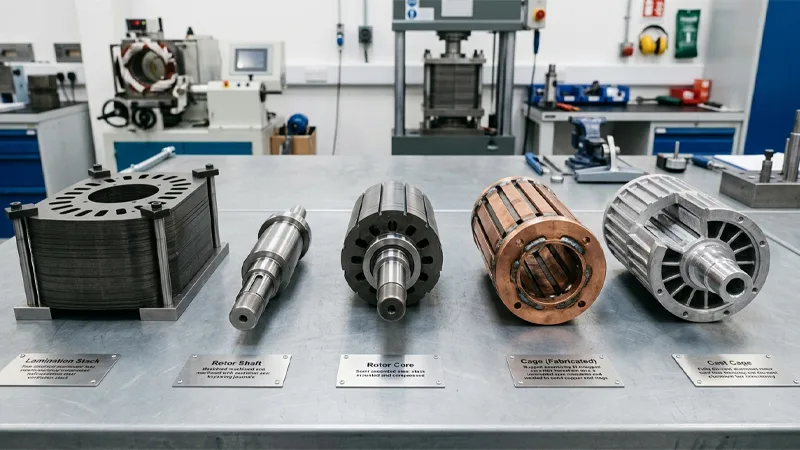
Induction rotor stacks and cages
Induction rotors are process systems: laminations, shaft, rotor core, and cage (casting or fabricated) all contribute to final balance and air-gap uniformity.
Key manufacturing considerations:
- Lamination stack geometry: stack squareness and uniform compression affect rotor straightness.
- Shaft-to-core interface: fit choice must prevent micro-movement under torque reversals while controlling distortion.
- Cage quality (if applicable): porosity, fill consistency, and end-ring integrity can shift mass distribution.
For supplier evaluation, treat induction rotors as more than “press the stack on the shaft.” Ask:
- How is stack runout measured relative to bearing journals?
- What is the balancing plan (component balance vs assembly balance)?
- What is the reaction plan if the stack runout drifts (fixture correction, process change, rework limits)?
PM rotors, magnets, sleeves
Permanent magnet (PM) rotors compress multiple risk vectors into one assembly: magnet handling, retention, concentric sleeves, and tight air-gap sensitivity.
Practical points that affect sourcing decisions:
- Magnet retention strategy: sleeves, adhesives, mechanical features—each has temperature and speed implications.
- Sleeve concentricity: sleeve OD/ID control and final grind strategy often dominate rotor runout.
- Contamination control: magnet and adhesive systems can be damaged by chips and grinding dust; cleanliness becomes a quality requirement.
When you evaluate suppliers for PM rotors, look for explicit controls on:
- adhesive cure validation (if used)
- sleeve press/shrink process validation
- post-assembly grinding and balancing capability
AFI Parts supports engineering review and end-to-end manufacturing delivery.
Precision grinding and balance
Rotor grinding and balancing should be planned together.
Why: grinding changes mass distribution slightly, and balance correction can change stiffness or local geometry depending on the method (drill, mill, add weights, etc.). A stable flow typically includes:
- grind critical diameters to the final size and finish
- verify runout/concentricity relative to defined datums
- perform balancing to the specified grade
- re-verify key dimensions and runout after correction
The acceptance plan should define:
- balancing grade target (ISO 21940-11 G-grade)
- measurement method (balancing machine residual unbalance; vibration acceptance criteria)
- correction method limits (how much material removal is allowed; where correction is permitted)
Inspection and Quality
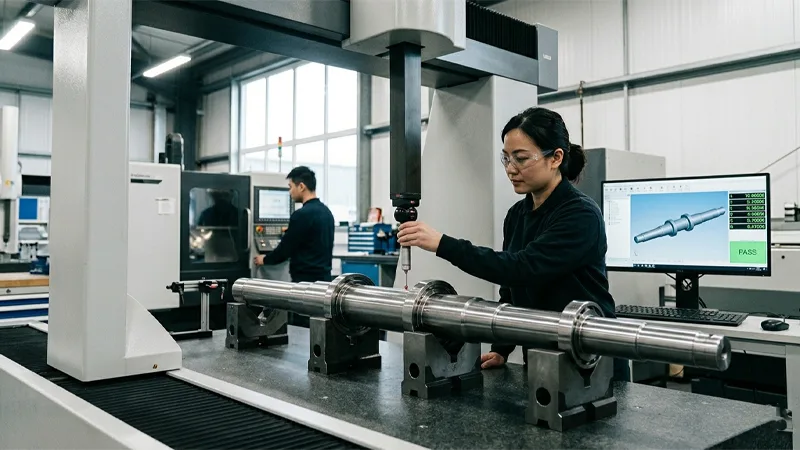
In-process and final checks
For shafts and rotors, “final inspection” is not enough. In-process checks are what prevent batches from drifting to scrap.
A qualified supplier should be able to show how they control:
- diameter and form (especially on bearing seats)
- runout/total runout where specified
- surface finish on functional surfaces
- balance results and how they trend lot-to-lot
Typical metrology stack you may encounter:
- CMM for geometric relationships and feature position (when appropriate)
- roundness/form measurement for critical journals and rotor ODs
- balancing machine for residual unbalance and correction verification
What matters for sourcing is not the instrument list—it’s measurement repeatability (MSA/GR&R where required) and whether the measurement method matches the drawing intent.
Documentation and PPAP/FAI
If your organization runs APQP/PPAP or aerospace-style FAI, rotor/shaft suppliers must be comfortable producing audit-ready packets.
Common expectations include:
- FAI (First Article Inspection) that ties measured values to drawing characteristics
- control plan for critical-to-quality (CTQ) characteristics
- material certs (chemistry, mechanicals) and heat treat records, where applicable
- process change control: how the supplier notifies you and how re-validation is handled
If you need a vendor-facing overview of how a supplier frames inspection discipline and engineering review, AFI’s quality control and inspection FAQ is a relevant internal reference.
Traceability and certificates
Traceability is a cost control tool. When something goes wrong, you want to contain it to a lot—not a whole quarter’s production.
For precision rotating components, traceability often covers:
- raw material heat/lot
- heat treat batch
- key process steps (grind, balance) and operator/machine
- final inspection record linked to serial/lot
Certificates commonly requested:
- ISO quality management certifications
- material certifications
- surface treatment certifications (when present)
Your acceptance criteria should specify what traceability is required (lot-level vs serial-level) and what records must be retained.
Lead Time and Cost
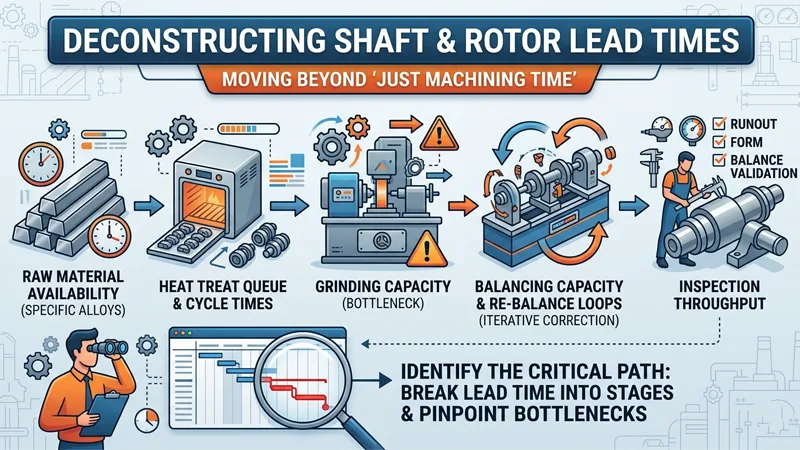
Major lead-time drivers
Lead time is rarely “just machining time.” For shafts and rotors, the long poles are usually:
- raw material availability (especially specific alloys)
- heat treat queue and cycle times
- grinding capacity (often a bottleneck)
- balancing capacity and re-balance loops if correction is iterative
- inspection throughput for runout, form, and balance validation
A practical buyer move: ask the supplier to break lead time into stages and identify which stage is on the critical path.
Tolerance-by-function levers
If you want cost-down without increasing field risk, loosen tolerances only where function allows.
Examples of tolerance-by-function thinking:
- keep tight size/runout on bearing seats and critical pilots
- relax less critical diameters that don’t drive balance, fit, or sealing
- specify surface finish only where it affects bearing/seal performance
This approach reduces grinding time, inspection burden, and scrap risk—often the real TCO drivers.
Batch size and logistics
Batch size influences:
- setup amortization (especially for grinding and balancing)
- inspection sampling plans (if allowed)
- packaging and handling time
Logistics influences your true cost:
- transit time buffers
- damage risk in shipping (shafts and rotors need protective packaging)
- expedite costs when ramp schedules slip
For suppliers that offer end-to-end capability across processes (turning, milling, grinding, finishing, inspection coordination), a consolidated workflow can reduce handoffs and scheduling variability. AFI’s prototype-to-production machining services page is one internal reference for how such consolidation is positioned.
EV vs. Industrial
Tighter specs and NVH (EV)
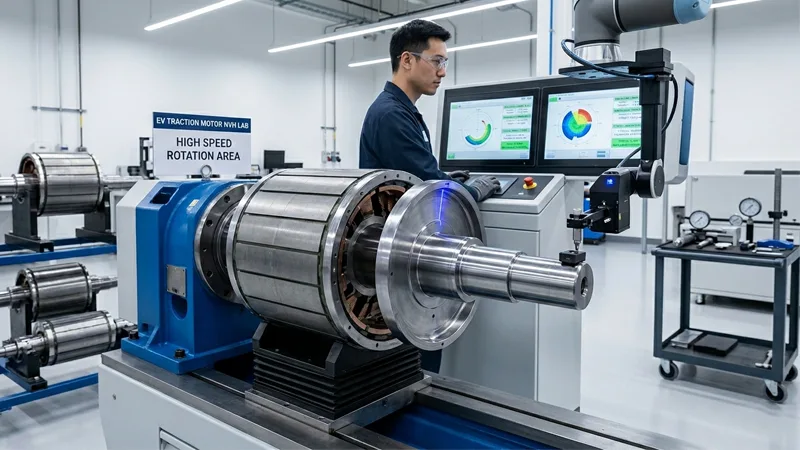
EV traction applications tend to amplify NVH sensitivity. High-speed operation and customer expectations for quiet cabins push for tighter control on:
- balance grade selection and consistent correction
- runout/total runout on rotor and shaft features
- repeatability of assembly stack-up
Even when the drawing looks similar, EV programs often require more validation evidence and tighter process capability on rotating features.
Cost and durability focus (industrial)
Industrial motors frequently optimize for:
- long service life in harsh environments
- maintainability and predictable replacement cycles
- cost targets across long production runs
That doesn’t mean “loose tolerances.” It means engineering teams may accept different trade-offs: a slightly looser balance grade at a lower speed, or finishes that are sufficient for bearing life without pushing ultra-fine roughness everywhere.
Validation differences
Validation tends to differ in emphasis:
- EV: heavier focus on NVH, high-speed testing, and tight acceptance windows
- industrial: heavier focus on durability testing, thermal cycling, and long-run stability
Your supplier should be able to show how validation will be executed and what artifacts you’ll receive (inspection results, balance reports, traceability records).
Conclusion
A precision shaft/rotor program becomes far easier to source when you turn “tight tolerance” into a set of explicit acceptance criteria:
- which fits are required (and why)
- which GD&T controls govern the functional axis
- what runout/total runout is acceptable, and how it will be measured
- what balancing grade applies, and what acceptance method will be used
- what documentation, traceability, and change control are required
Here’s a checklist you can use for next steps in supplier evaluation and pilot runs:
- Confirm the supplier’s proposed datum strategy matches the functional axis in your assembly.
- Ask for capability evidence on CTQs (sample inspection, MSA/GR&R where required).
- Align balancing grade (ISO 21940) with speed, duty, and NVH expectations.
- Define what the pilot run must prove (scrap rate, runout stability, balance stability, documentation completeness).
- Lock a change-control path before ramp (process changes, tool changes, alternate materials).
Risk buffers and dual sourcing still matter:
- add buffer for grinding/balancing capacity during ramp
- qualify at least one alternate path for heat treat and critical finishing
- dual source where failure cost is high (EV traction rotors, high-speed spindles)
If you’re ready to price and validate a shaft/rotor build, request a quote with your drawing set and a short CTQ list (fits, runout/total runout, finish, and balancing grade). You’ll get a more accurate quote—and fewer surprises—when the acceptance criteria are explicit.
FAQ
It depends on the functional surfaces (bearing seats, pilots, press-fit features) and how speed/NVH targets translate into runout and fit requirements. In practice, shops usually need the drawing to define fit class (ISO 286) plus runout/total runout and surface finish on the critical journals to quote and control the process.
Specify a balance quality grade from ISO 21940-11 (G grade) based on operating speed, rotor mass, and vibration sensitivity. Then align the acceptance method—residual unbalance report from the balancing machine and/or a vibration limit—so the supplier can verify compliance consistently.
Common methods include a dial indicator setup (quick checks), CMM-based axis evaluation, and roundness/form instruments for higher repeatability. The key is matching the measurement method to the drawing requirement and defining the functional datum axis (often the bearing journals) so results predict real assembly behavior.