
Introduction
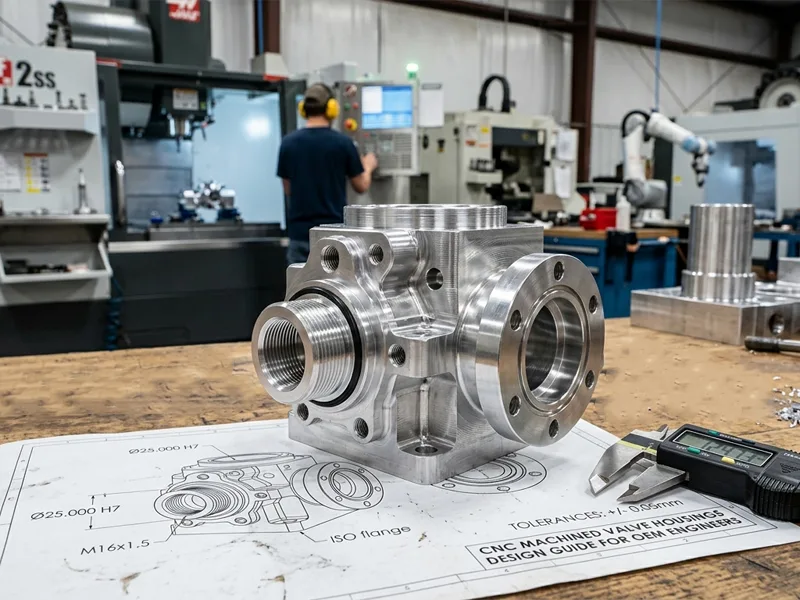
CNC machined valve housings sit at an uncomfortable intersection: they’re “just a metal body” until a sealing face weeps, a bolt circle doesn’t clock, or a bore-to-seat relationship drifts after heat treatment. For OEM teams, the fastest way to reduce that risk is to treat the housing as a specification and verification problem first, and a machining problem second.
This guide is written for mechanical engineers and procurement managers who need to define requirements that a supplier can actually build and a quality team can actually verify.
You’ll learn how to translate service conditions into standards and tests, build a functional datum scheme, apply valve-housing-appropriate GD&T, call out finishes where they matter, and request the documents that make traceability auditable.
Key Takeaway: A valve housing drawing is only “complete” when it includes a datum strategy, sealing-surface finish targets, a test plan reference, and a documentation package requirement.
Table of Contents
Standards and Service Conditions
Pressure-temperature classes and media
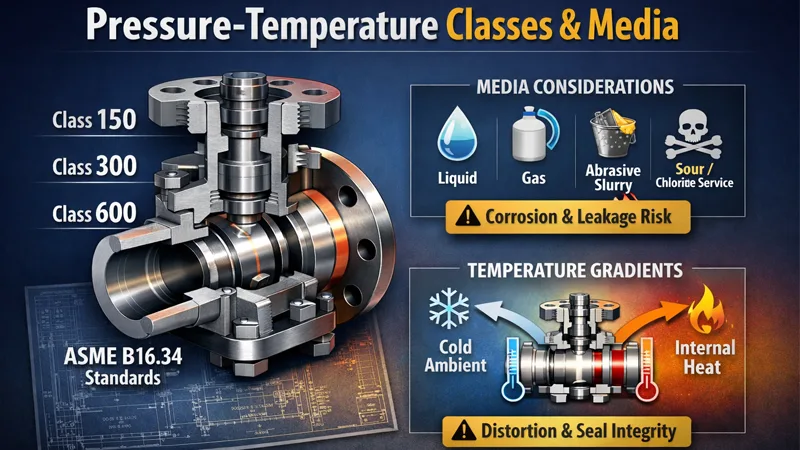
Start with service conditions because they drive everything downstream: wall sections, materials, sealing architecture, and test requirements.
For many industrial valves, pressure capability is expressed in ASME pressure classes (for example, Class 150/300/600), with allowable pressure derated by temperature and tied to the body material group. In practice, OEM drawings and procurement specs often reference this framework through ASME body standards (commonly ASME B16.34) and companion end-connection standards.
Two reminders that prevent costly misalignment in sourcing:
- Media matters: liquid vs gas, abrasive slurries, sour service, and high-chloride environments change not only corrosion risk, but also what “acceptable leakage” means to your program.
- Temperature gradients matter: a housing that sees external ambient swings plus internal hot spots may need conservative assumptions around distortion and seal compression.
In other words, you’re designing the housing to survive its valve pressure testing (API 598 / ISO 5208) reality, not a lab-perfect nominal condition.
Applicable codes and pressure tests
Most OEM purchase specs for metallic valve bodies/housings end up referencing three buckets of standards:
- Body/pressure boundary design (pressure-temperature rating logic and material groupings)
- End connections and interchangeability (flanges and face-to-face dimensions)
- Inspection and pressure/seat testing (shell integrity and closure leakage)
For end connections, common references include flange standards and dimensional interchangeability standards. ASME’s own overview of the B16 series describes B16.10 as covering face-to-face and end-to-end valve dimensions for interchangeability (see ASME’s B16 brochure description of B16.10 dimensions).
For testing requirements, ISO and API frameworks are widely used in supplier QA plans. ISO describes the scope of metallic valve pressure testing in ISO’s ISO 5208:2015, the pressure testing overview.
Practical spec-writing guidance:
- Call out which standard governs the test method and what you will accept as records (test certificate format, serial/heat traceability on the report).
- If you require both shell hydrostatic and seat leakage tests, state that explicitly—don’t assume your supplier will infer it.
Marking, traceability, and records
If you want to qualify suppliers and avoid “paper compliance,” define traceability as a deliverable, not a nice-to-have.
At minimum, align internally on:
- What is traceable: heat/lot for pressure-boundary material, weld filler, where applicable, and the final housing serial.
- How it is marked: permanent marking location and method that does not compromise sealing surfaces.
- What records are retained and shipped: MTR/CMTR, heat treat charts (if applicable), NDE reports (if applicable), dimensional inspection results, and pressure/seat test records.
Procurement-friendly wording that works: require a traceability package that ties each shipped part to its material certificate(s) and inspection/test record(s) by serial number.
Design for Sealing and Function
Sealing interfaces and datum structure
Valve housings rarely fail because a nonfunctional outer face is 0.2 mm off. They fail because the features that create and maintain sealing stress are not controlled relative to the features that locate the valve internals.
A useful mental model is to separate features into:
- Pressure boundary features (body walls, critical bosses)
- Sealing interfaces (gasket faces, O-ring grooves, metal-to-metal seats)
- Functional alignment features (bores, bearing pockets, pilot diameters)
- Assembly location features (bolt patterns, dowel holes, locating shoulders)
Your datum strategy should reflect how the part is actually located during assembly and inspection:
- Use a primary datum that represents the most critical mating plane (often a sealing face or mounting face).
- Use a secondary datum that captures the axis or feature that drives alignment (often a main bore/pilot).
- Use a tertiary datum to clock the part (often a second face, keyway, or a controlled feature in the bolt pattern).
From there, control the sealing surface with form controls (flatness or profile) and control alignment relationships with position/runout as appropriate.
⚠️ Warning: If the drawing has no explicit datum reference frame, suppliers will create their own “shop datums,” and you’ll debug fit-up problems during assembly instead of in inspection.
Bolt patterns and end connections
Bolt patterns do more than “hold the valve together.” They also define how the housing is clamped to a mating part, which affects gasket compression and leak risk.
Design and GD&T points that make bolt patterns supplier-proof:
- Define the bolt circle using basic dimensions and control the pattern with true position relative to your datum reference frame.
- Treat the pattern as a functional system: if the assembly locates off the pattern, consider whether the pattern itself should participate in datum establishment.
- If the joint is sensitive (thin gaskets, high cycling), consider how bolt-hole clearance, flange stiffness, and surface finish interact—don’t let the bolt circle be “close enough” while sealing faces are held too tight form.
For end connections, specify the standard (flanged class/type, facing, and face-to-face length standard where required), so the housing is interchangeable in the OEM’s system.
DFM for CNC machined valve housings
Good DFM decisions show up as fewer set-ups, stable datums, and predictable surface finishes—especially around ports, intersecting passages, and sealing planes.
DFM practices that usually reduce cost and risk:
- Design for tool access: keep critical bores and sealing faces reachable in as few orientations as practical. Features that require awkward approach angles typically increase set-ups and variability.
- Avoid deep, skinny pockets and passages: they amplify tool deflection, chatter, and finish variability.
- Specify realistic internal radii on milled pockets/ports so standard tools can be used.
- Only tighten tolerances where they protect function: sealing faces, locating bores, and critical hole patterns. Leave nonfunctional surfaces at the general machining tolerance.
If you’re evaluating suppliers, it’s reasonable to ask how many set-ups the part requires and which features are finished in the final set-up (those are the features most likely to hold mutual relationships).
For manufacturing capability context (without turning this into a sales pitch), pages such as AFI Parts’ CNC milling capabilities and AFI Parts’ 5-axis machining overview show the kinds of multi-axis processes suppliers may use to reduce re-clamping and preserve alignment.
Materials and Corrosion Choices
Carbon and stainless steels
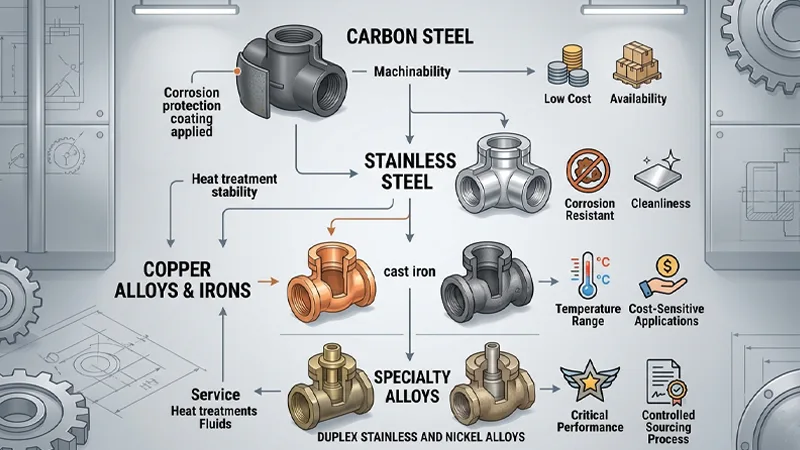
For procurement packages, treat valve housing material selection as a service-condition-driven decision: corrosion resistance, cost, machinability, and how stable the housing remains after heat treatment.
- Carbon steels are common where corrosion risk is controlled by the environment or coatings and where cost and availability matter.
- Stainless steels become attractive when corrosion resistance is a primary design driver, or where cleanliness and long-term appearance are important.
From a spec perspective, the risk isn’t “carbon vs stainless” in the abstract—it’s whether the supplier can provide material certificates, meet any required heat treatment condition, and maintain critical dimensions after thermal processing.
Copper alloys, irons, and specials
Copper alloys and cast irons show up in certain fluids, temperature ranges, and cost-sensitive applications—but they often change machining behavior and inspection strategy (for example, surface integrity, tool wear, and how sealing finishes are achieved).
For specials (duplex stainless, nickel alloys, or other corrosion-resistant alloys), treat sourcing as a controlled process:
- Lock the exact grade and condition
- define heat number traceability expectations
- ensure the test plan matches the service criticality
If you need a general materials refresher for CNC part sourcing, AFI Parts’ CNC machining materials guide is an example of how suppliers present material options and selection factors.
Heat treatment and NACE compliance
Heat treatment is not just a mechanical-property step. It can change:
- distortion and datum stability
- machinability of finishing operations
- surface integrity in sealing interfaces
If the valve housing may see sour service or other corrosion-cracking-sensitive environments, your project may require NACE-related material controls. In that case, the drawing/PO should call out not only the material spec but also the documentation you expect (heat treatment condition, hardness limits where applicable, and traceability).
Tolerances, GD&T, and Finishes
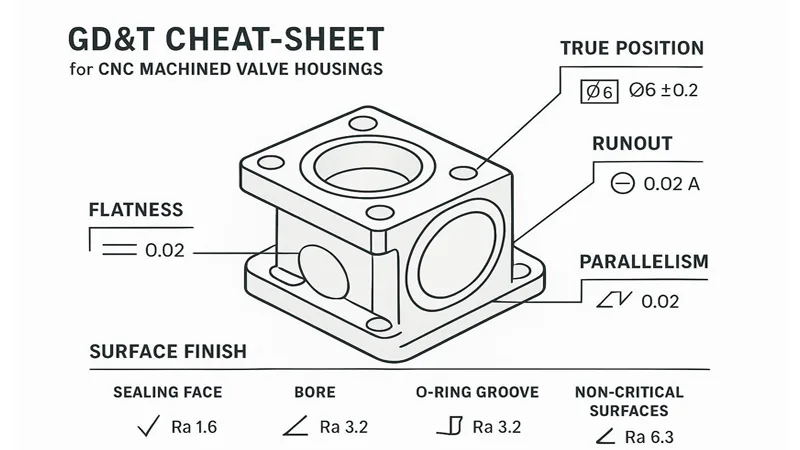
This section is your working reference for valve housing GD&T decisions: build the datum reference frame around functional surfaces, then control patterns and bores to that frame.
Datum strategy and true position
A valve housing drawing becomes easier to manufacture and inspect when it uses GD&T to express what “must be true” for assembly, instead of relying on stacked ± dimensions.
A practical approach:
- Establish the datum reference frame from functional surfaces (sealing/mounting face + main bore axis + clocking feature).
- Use true position to control bolt patterns and critical port/feature locations relative to that frame.
- Consider whether MMC/LMC modifiers make sense for clearance features to reduce false rejects without changing function.
For supplier evaluation, request sample CMM outputs early (prototype/FAI stage) to confirm the datum scheme is being interpreted consistently.
Runout, flatness, and parallelism
Common controls by feature type:
- Sealing faces: flatness or profile (and sometimes parallelism to another functional face) to protect gasket compression uniformity.
- Critical bores: runout (or position/profile as appropriate) to ensure bore-to-datum alignment, especially when the bore locates an internal cartridge, seat, or bearing.
- Mounting faces: parallelism between faces that clamp or locate the valve in an assembly.
A good rule for drawings: choose the control that matches the failure mode you’re trying to prevent. If the leakage risk is driven by face warp, control face form. If the risk is misalignment between bore and seat, control the bore’s relationship to the datum frame.
Surface roughness targets by feature
If you’re writing requirements, treat surface finish for valve sealing faces as a functional callout—not a cosmetic one. Surface roughness is one of the most misunderstood cost drivers in valve housings because it’s easy to over-specify.
Make roughness requirements feature-specific:
- Sealing faces and metal-to-metal seats: specify the finish needed for the seal design (and state the test method/acceptance expectation that implies that finish).
- O-ring grooves: call out a finish that supports elastomer life and reduces leak paths at the groove walls.
- Locating bores: specify finishes that support stable fits and repeatable measurement.
- Noncritical outer surfaces: allow as-machined or a general finish so suppliers don’t add unnecessary secondary ops.
When you require secondary finishing (polish, grind, coat), state where it is allowed and where it is forbidden (for example, no coating buildup on sealing faces unless explicitly designed for it). For general finishing context, see AFI Parts’ surface finishing overview.
Machining and Inspection Workflow
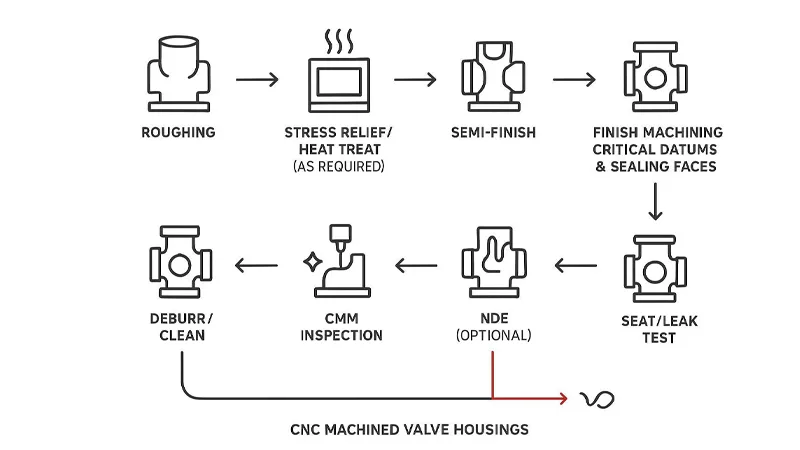
Process plan and sequencing
Sequencing is where many “looks fine on the drawing” housings lose accuracy.
A robust high-level process plan often follows this logic:
- Rough machining to remove bulk material while leaving stock for finishing.
- Stress relief/heat treatment (when required by material/spec) before final datum creation.
- Semi-finish to establish near-net features and confirm stability.
- Finish machining of critical datums, sealing faces, and bores in a controlled final set-up.
- Deburr and clean with attention to intersecting passages and sealing edges.
From an OEM standpoint, the supplier conversation you want is: “Which features are finished last, and what do you measure before you commit to the final cut?”
CMM, leak, and hydro testing
Dimensional inspection and pressure/seat testing should be treated as complementary:
- The CMM report tells you the housing is geometrically correct relative to the datum scheme.
- The pressure/seat tests tell you the pressure boundary and closure interfaces perform under the defined test conditions.
When your spec references ISO or API testing, cite the governing standard and require that test reports identify the part (serial), media, pressure, hold time, and acceptance criterion. For ISO-based programs, align terminology and record expectations to the ISO 5208 overview page already referenced earlier.
To give cross-functional teams a shared mental model (especially procurement teams who don’t live in the standards), this video is a useful explainer:
Supplier documents and traceability
A supplier is easier to qualify when they can show a repeatable documentation package without improvisation.
For CNC machined valve housings, a practical acceptance package typically includes:
- Material certificates (MTR/CMTR) tied to heat/lot
- Heat treatment records, where applicable
- First Article Inspection (FAI) or equivalent dimensional report
- CMM report keyed to the drawing’s datum scheme
- Surface roughness measurement records for specified features
- Pressure test record (shell) and seat/leak test record, per the referenced standard
- Nonconformance and deviation control (if anything is out-of-print)
AFI Industrial Co., Ltd. context (non-promotional): In typical CNC programs, AFI describes an approach that starts with drawing review and GD&T-based engineering analysis, then builds a process plan and defines inspection steps (including CMM procedures) around the customer’s functional requirements. The useful takeaway for OEMs is not “who does it,” but what to request: ask suppliers to show how the datum scheme in your drawing maps to their fixturing plan and to the coordinate system used in their CMM report. For an example of how a supplier explains quality checkpoints, see AFI Parts’ quality and inspection process.
Conclusion
If you want CNC machined valve housings that assemble cleanly and pass pressure tests without rework, treat your drawing and PO as an integrated control plan.
Action items you can apply immediately:
- On drawings: define a functional datum scheme, control bolt patterns with true position, and call out sealing-face form and finish where it affects leakage.
- On POs: reference the test standard (ISO/API as required), require traceability by serial/heat, and list the exact inspection and test records you expect in the shipment package.
- In QA acceptance: verify that CMM datums match the drawing DRF, confirm roughness records for critical sealing features, and ensure test reports identify media/pressure/hold time and acceptance criteria.
Supplier evaluation criteria and risk controls:
- Can the supplier explain their set-up strategy and which features are finished last?
- Do they provide complete, audit-ready documentation without being prompted repeatedly?
- Do they proactively surface DFM risks (tool access, distortion after heat treat) and propose measurable mitigations?
- Can they show how they protect IP and control drawing confidentiality in their workflow?
If you want, you can use this guide as a starting point for a one-page acceptance checklist in your RFQ package.
FAQ
Common materials are driven by service conditions and include carbon steels for general applications and stainless steels for environments requiring higher corrosion resistance. Depending on the specific fluid and temperature ranges, copper alloys, cast irons, or special alloys (like duplex stainless and nickel alloys) may also be used. For sour service environments, materials may also need to comply with NACE controls.
OEM purchase specifications typically reference established industry frameworks for inspection and pressure testing. The most widely used standards in supplier QA plans are API 598 and ISO 5208. These standards govern the requirements for shell hydrostatic integrity tests and closure/seat leakage tests.
Surface roughness in valve housings should be treated as a feature-specific, functional callout rather than a general cosmetic requirement. Designers should specify targeted finishes for metal-to-metal seats and O-ring grooves to support elastomer life and prevent leak paths. Meanwhile, noncritical outer surfaces can be left at a general machining finish to prevent unnecessary secondary operation costs.
A robust GD&T strategy establishes the datum reference frame around the part’s functional surfaces. Best practice involves using a critical mating or sealing face as the primary datum, a main bore or pilot axis as the secondary datum, and a clocking feature as the tertiary datum. Bolt patterns and critical ports should then be controlled using true position relative to this established frame.
To ensure reliable quality control, a comprehensive traceability package must tie each shipped part to its corresponding records via a permanent serial number. A standard acceptance package typically includes Material Test Reports (MTR/CMTR) tied to heat/lot numbers, heat treatment records, First Article Inspection (FAI) or CMM dimensional reports, surface roughness measurements, and referenced pressure/leak test records.