
Introduction
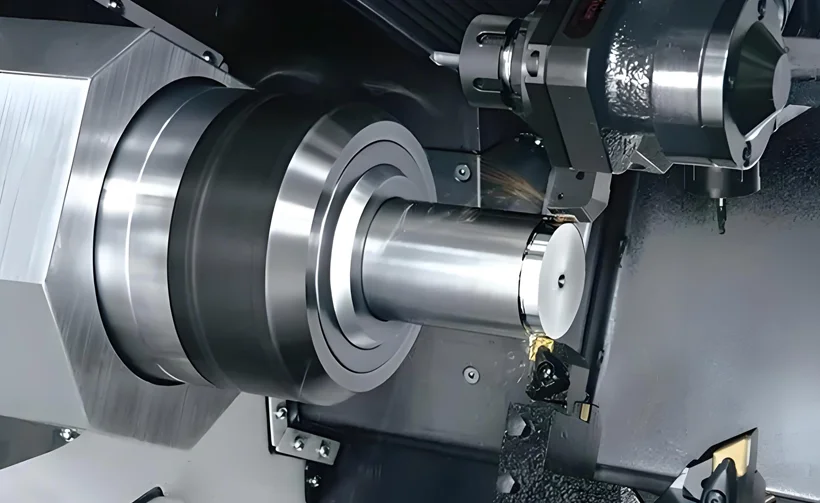
If you buy precision turned parts for automotive programs, stainless steel 316L is rarely “just another material.” It’s a corrosion-resistant alloy that can punish unstable processes: work hardening, burr formation, and surface contamination show up fast as scrap, rework, or field risk.
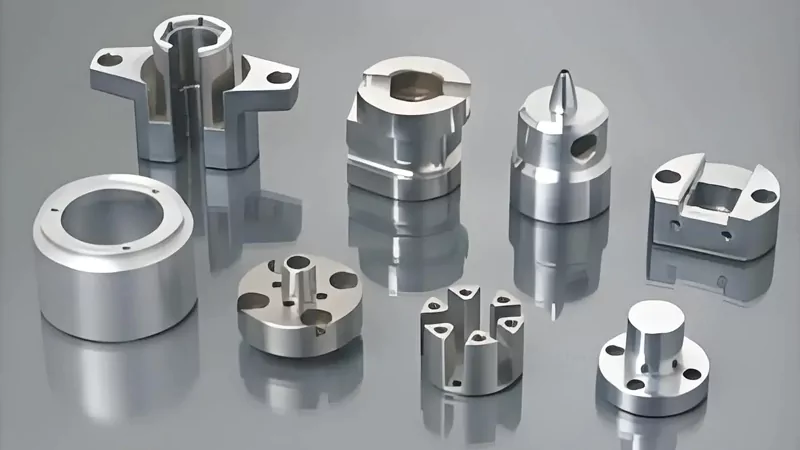
This guide is for OEM and Tier 1–2 purchasing teams, Supplier Quality Engineers (SQE), and supply-chain leaders operating in IATF environments—where supplier qualification is driven by evidence, not promises.
What “good” looks like is consistent across programs:
- Auditable evidence: revision-controlled documents, records, and objective proof of control
- Stable quality: capability demonstrated in the characteristics that matter, with clear reaction plans
- JIT delivery: packaging, labeling, ASN/EDI, and traceability that work at scale
- Optimized TCO: unit price plus scrap, changeovers, finishing risk, logistics buffers, and compliance overhead
Key Takeaway: Treat every stainless steel 316L precision turned parts manufacturer as a process you’re qualifying—not a quote you’re comparing.
How to use this: build a shortlist, then score each manufacturer against the criteria in each section. For every topic below, you’ll see (1) what to ask for and (2) what “pass” evidence looks like.
Table of Contents
Compliance and Documentation
IATF 16949 status and audit evidence
Start with the hard gate: do they operate under the quality system your program requires? For many teams, this is the core of IATF 16949 supplier audit evidence—not the certificate alone, but the internal audit and corrective-action records that prove the system is alive.
What to request:
- Current IATF 16949 certificate (if applicable to your program) with site scope, issuing body, and expiration date
- Recent internal audit schedule and a sample of completed audits (process audit + product audit)
- Management review records (showing KPI review and corrective action follow-through)
- Evidence of control of external providers (sub-tier approval and monitoring)
What “good” looks like:
- Certificate scope matches the manufacturing site producing your parts (not just an office address)
- Audit evidence shows findings, containment, and closure—not just check-the-box forms
- Document control is disciplined: revision history, approval signatures, and effective dates are consistent
APQP/PPAP package completeness
Even strong machining can fail qualification if the APQP/PPAP package is incomplete or inconsistent. Your goal is not to “collect documents.” Your goal is to verify the supplier can control the process the way they say they do.
Ask for a sample PPAP package from a comparable part family (materials, tolerances, and finishing complexity). A good PPAP documentation checklist is simply a fast way to confirm the package is complete before anyone spends time arguing about piece price.
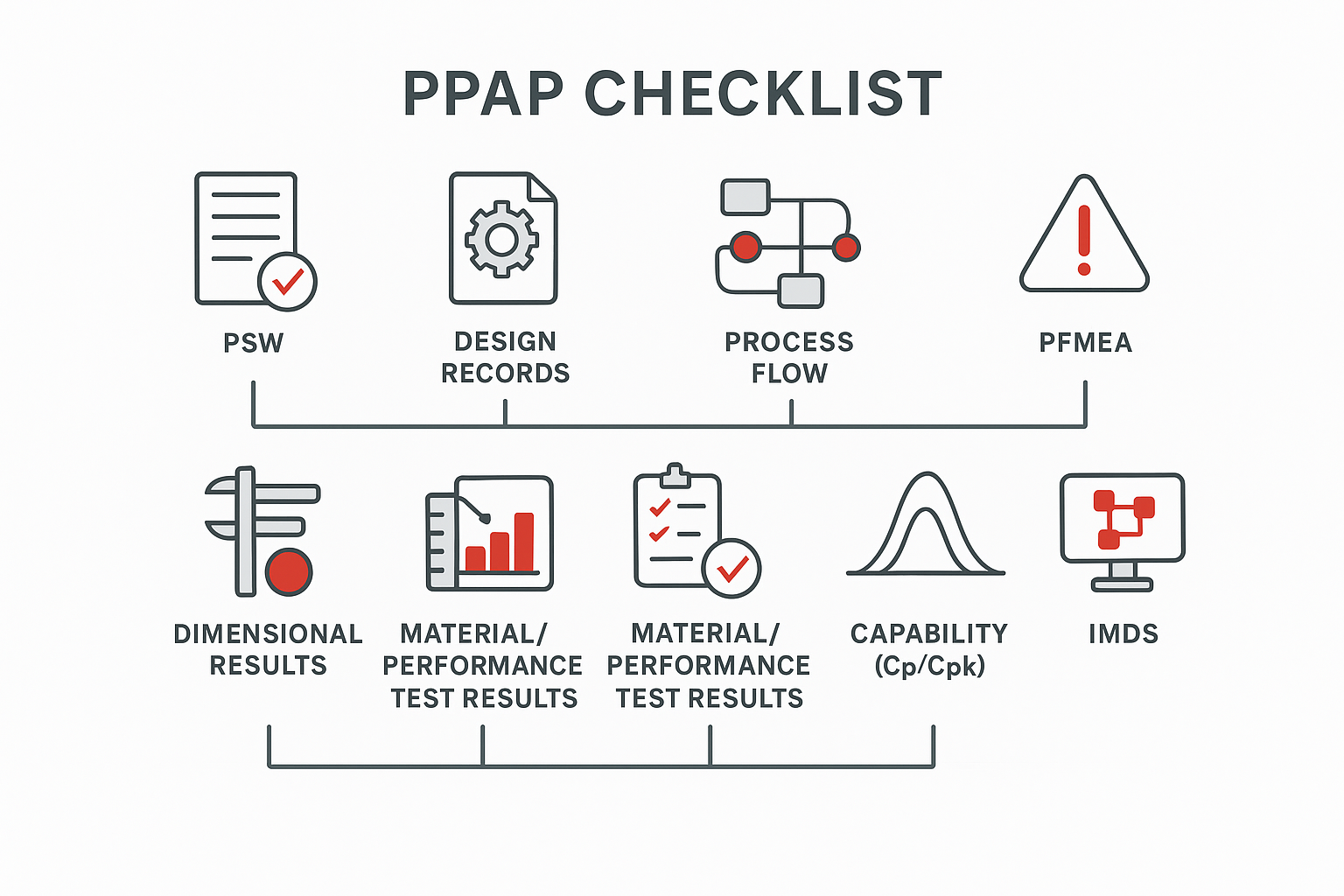
Practical screening questions:
- Does the Process Flow match the actual routing (machining → deburr → clean → finish → inspect → pack)?
- Are PFMEA and Control Plan clearly tied to special characteristics and real failure modes (burrs, work hardening, contamination, corrosion risk)?
- Is the measurement system supported with a current MSA (GR&R) for key gages?
- Are the capability results (Cp/Cpk) shown for the right characteristics and the right sample size?
Regulatory and data security readiness
Automotive supplier qualification increasingly includes “non-machining” readiness: material declarations, cybersecurity, and drawing confidentiality.
What to request:
- Material compliance posture for your program needs (e.g., IMDS submission readiness where required)
- Documented traceability method: raw material heat/lot → WIP routing → final pack label
- NDA process and access control policy for customer drawings and inspection data
- Backup/retention rules for quality records (how long, where stored, how retrieved during audits)
What “good” looks like:
- A clear, repeatable process to produce traceability evidence quickly during an audit
- Controlled access to drawings and specs (role-based access; no uncontrolled sharing)
- Practical proof: sanitized screenshots or SOPs demonstrating how records are stored and retrieved
Machining Capabilities of a 316L Stainless Steel Turned Parts Manufacturer
If you want a quick refresher on what stable turning looks like—chip control, coolant strategy, and why stainless can get “sticky” at the tool—this process-focused walkthrough is a useful reference:
Tooling, parameters, and heat/chip control
316L is an austenitic stainless steel that can work-harden under poor conditions. In turn, that usually means the tool starts rubbing instead of cutting—raising heat, accelerating wear, and making burr control harder.
What to ask:
- Tooling strategy by feature type (OD/ID turning, grooving, drilling, threading)
- How they control heat and chips (coolant strategy, chip breaker selection, chip evacuation)
- Parameter governance: who owns speed/feeds updates, and how changes are validated
What “good” looks like:
- Parameters are tied to an internal standard or proven baseline, not “operator preference.”
- Chip control is treated as a quality characteristic (stable chip form reduces surface damage and tool breakage risk)
- Tool life control is defined: tool-change triggers, tool-life tracking, and containment steps for tool-related drift
Fixturing, stability, and distortion management
Precision turned parts often fail not because a machine can’t hold tolerance, but because the holding method and process sequence introduce variation.
What to ask:
- Workholding method (collets, chucks, guide bushings for Swiss turning) and runout control
- Strategy for long, slender, or thin-wall geometries (support, step turning, controlled cuts)
- How they verify stability across lots (first-off approval plus in-process checkpoints)
What “good” looks like:
- A documented approach for high-risk geometries (thin walls, deep grooves, long stick-out)
- Clear control of concentricity, runout, and form—especially when parts transfer between operations
- Evidence of “process window” thinking: the supplier knows where stability breaks and how they prevent it
Deburr, edge-break, and finish repeatability
On 316L, burrs and edge breaks are not cosmetic. They can be functional hazards (assembly damage), contamination risks, or corrosion initiators if they trap residues.
What to ask:
- Edge-break specification method (e.g., defined chamfer/radius, or “break sharp edges” translated into measurable criteria)
- Deburr process controls: method, media, cycle time, and verification
- How surface finish is protected through post-machining steps (handling, cleaning, finishing)
What “good” looks like:
- Edge break is measurable and verified (not subjective)
- Deburr is validated for the part family and doesn’t create embedded media or inconsistent edges
- Repeatability is demonstrated in records, not just “we always deburr.”
Surface Integrity and Cleanliness
Passivation/electropolish standards and verification
If your drawing or customer standard calls for passivation or electropolishing, treat the finish supplier like a critical process—not a commodity subcontractor.
What to ask:
- The process specification they use (standard referenced, chemistry control, bath maintenance rules)
- Verification method and acceptance criteria (what constitutes pass/fail)
- Sub-tier control: how the manufacturer qualifies and monitors the finishing provider
What “good” looks like:
- Process spec and verification are tied to your requirements (not generic “we can passivate” claims)
- Clear controls over rework loops (how many cycles, what happens if a part fails verification)
- Traceability preserved through finishing (parts don’t lose lot identity)
Surface finish targets and measurement
Surface finish is a manufacturing output that depends on tooling condition, parameters, and post-process handling.
What to ask:
- Surface roughness targets (Ra/Rz) and measurement method
- Gage type, calibration/traceability, and measurement locations on the part
- How they correlate finish changes to tool wear or parameter drift
What “good” looks like:
- Measurement is standardized (same stylus settings, cutoff, and locations)
- Operators aren’t improvising: there is a defined sampling plan and escalation path
- Finished data is used to prevent defects, not just to sort defects
Cleanliness, contamination control, and corrosion checks
For stainless parts, cleanliness is often where “good machining” becomes “bad assemblies.” Residues, embedded particles, and handling contamination can all create corrosion risk or functional issues.
What to ask:
- Cleaning process (aqueous/solvent/ultrasonic), bath control, and drying method
- Handling rules post-clean: gloves, dedicated bins, separation of dissimilar metals
- Corrosion check approach when required (what test, when applied, what records)
What “good” looks like:
- Clear contamination control (especially avoiding iron contamination from carbon steel contact)
- Defined cleanliness verification when your program needs it
- Packaging and storage practices that maintain cleanliness, not undo it
Metrology and Quality Evidence (Score Each Stainless Steel 316L Precision Turned Parts Manufacturer)
MSA (GR&R) and gage traceability
In supplier qualification, “we measure it” is not enough. You need to know that the measurement system can actually distinguish good from bad parts.
What to ask:
- MSA studies (GR&R) for the gauges used on key characteristics
- Calibration certificates and a traceability chain for those gauges
- Gage control: storage, handling, and out-of-tolerance response
What “good” looks like:
- GR&R is recent, relevant to the part/feature, and uses trained operators
- Calibration is current and traceable; gage IDs match inspection records
- Clear containment when a gauge is found out of tolerance (what lots are suspect, how they’re handled)
Capability indices and SPC reaction plans
Capability (Cp/Cpk or Pp/Ppk) is useful only when it’s calculated on a stable process and paired with a reaction plan.
What to ask:
- Capability results for critical-to-quality (CTQ) dimensions, with subgroup logic and sample size
- SPC charts for characteristics where drift is likely (diameters, runout, surface finish proxies)
- Reaction plan: who reacts, how fast, and what actions are taken
What “good” looks like:
- Capability targets are agreed up front (e.g., program requirement) and supported with evidence
- SPC is not “charting for show”—it triggers defined actions
- Evidence of learning: past out-of-control events and documented corrective actions
First off, in-process and final inspection records
If you want stable PPM and fewer surprises at receiving, ask to see how the supplier “closes the loop” during production.
What to ask:
- First-off approval record (setup verification) and criteria
- In-process inspection frequency tied to risk, not convenience
- Final inspection records that match labeling/traceability on the shipped product
What “good” looks like:
- Records are consistent and retrievable by lot/date/shift
- Inspection plans connect to PFMEA/Control Plan (what you measure matches what you say is risky)
- Clear escalation path for nonconformances (containment, disposition, corrective action)
Packaging, Labeling, and JIT Logistics

AIAG labels, ASN/EDI, and traceability
A supplier can have perfect machining and still fail your program if labeling and traceability don’t survive real-world operations. If you run JIT lanes, treat JIT automotive packaging and labeling as a controlled process with verification—not a shipping clerk’s best effort.
What to ask:
- Label format: AIAG label capability where required, and how label data is generated (ERP/MES vs manual)
- ASN/EDI readiness: what transaction set is supported, and how exceptions are handled
- Traceability granularity: heat/lot, work order, pack slip, and container ID mapping
What “good” looks like:
- Traceability is testable: the supplier can run a mock recall and produce the chain quickly
- ASN errors have a defined correction process
- Labeling and packing are treated as controlled operations (training, audits, verification)
Corrosion-safe packaging for global transit
For 316L, the packaging objective is to keep the surface in the condition it passed inspection, through weeks of handling and climate changes.
What to ask:
- Packaging specification by part family (bag type, desiccant, VCI where appropriate, separators)
- Handling rules to prevent surface damage and contamination
- Transit risk plan for long lanes (humidity, salt air, multi-leg handling)
What “good” looks like:
- Packaging is validated for the lane (not just “bubble wrap and hope”)
- Parts are physically separated to prevent fretting and cosmetic/functional damage
- Lot identity is preserved at every repack or consolidation point
OTD performance, buffers, and recovery plans
JIT supply is a system: capacity planning, buffers, packaging throughput, and logistics partners all matter.
What to ask:
- OTD (On-Time Delivery) history by lane and lead-time commitments
- Capacity and buffer policy: what safety stock exists (raw material, WIP, finished goods), and where
- Recovery plan: how the supplier handles disruptions (machine down, finish delay, customs issues)
What “good” looks like:
- A written recovery playbook with decision thresholds (when they expedite, when they reroute)
- Clear communication cadence for exceptions
- Evidence that they manage packaging and logistics as engineered processes, not as afterthoughts
A neutral example of the type of evidence you want: AFI Industrial Co., Ltd. (AFI Parts) describes an approach that combines machining with inspection discipline and coordinated global shipping—emphasizing packaging selection and logistics planning as part of delivery execution on its site materials (see AFI Parts’ metal cutting overview and AFI Parts’ manufacturing & logistics description). Use this as a template for what to request (process description + documented controls), not as a performance benchmark.
TCO and Cost Model
Material, tooling wear, and cycle time drivers
The piece price for 316L turned parts is dominated by three levers:
- Material: bar stock price and yield loss (cutoff, remnants)
- Machining time: cycle time plus tool-change losses
- Tooling: insert consumption, tool break events, and stability of tool life
Ask suppliers to break down the quote into time, tooling assumptions, and material basis (grade/standard, heat treatment state if applicable).
Setup/changeover, scrap/rework, and compliance costs
Hidden costs often come from instability:
- High changeover time on high-mix work increases lead time and premium pricing
- Scrap and rework increase true cost even when the unit price looks good
- Compliance packages (PPAP updates, IMDS submissions, record retrieval) consume engineering and quality capacity
Request a simple, auditable cost narrative: what drives scrap risk, what drives rework risk, and what actions reduce both.
Packaging, freight, duties, and inventory buffers
For North American programs using overseas suppliers, logistics and buffers can dominate TCO:
- Corrosion-safe packaging cost vs the cost of one corrosion-related containment event
- Air freight exposure when schedules slip
- Duties and brokerage
- Inventory buffers required to protect line-side availability
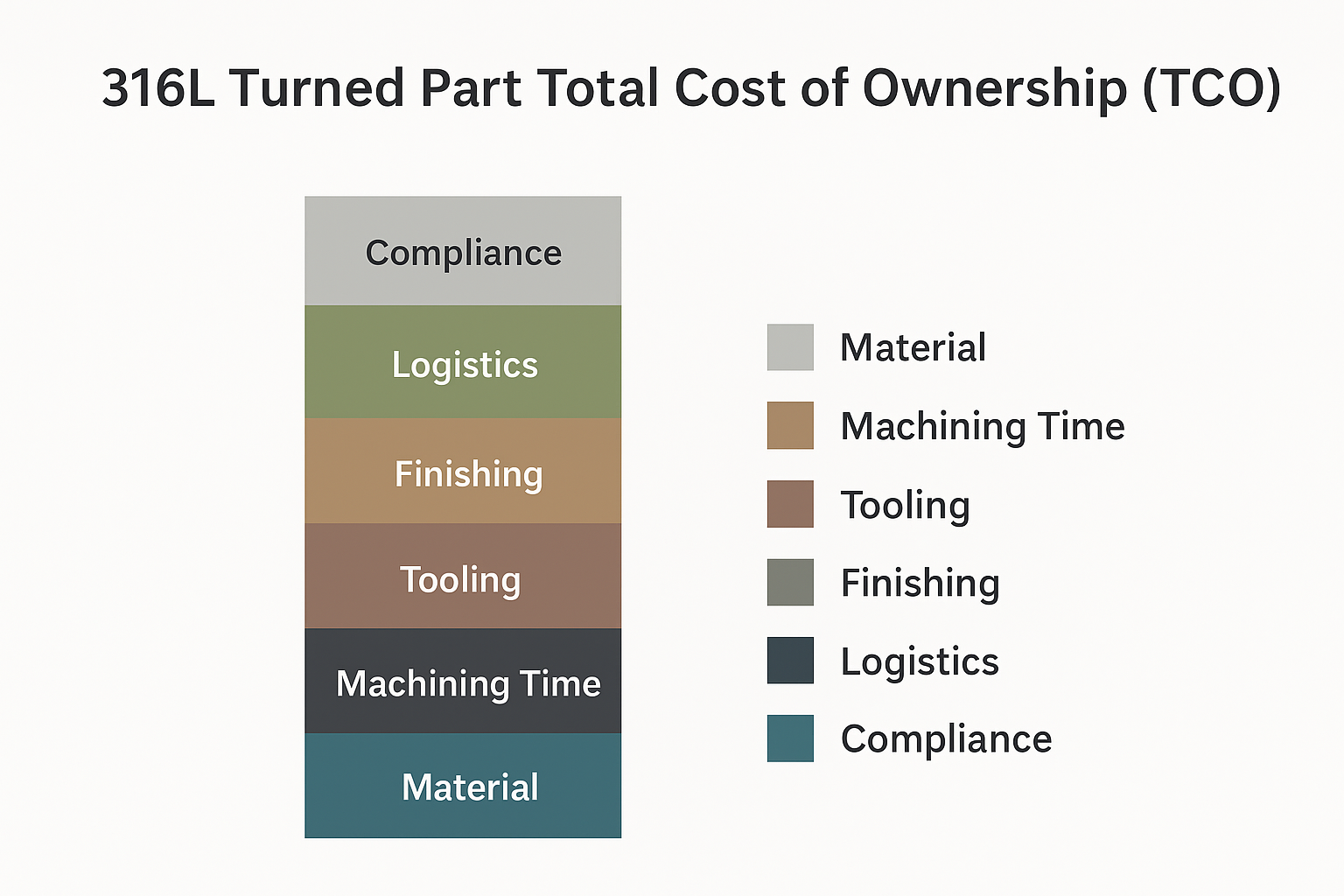
Use the chart above as a discussion tool: if the supplier cannot explain what they do to control each segment (especially machining time stability, finishing risk, and logistics exceptions), you’re likely underestimating TCO.
Red Flags to Disqualify Early
Documentation gaps (PPAP, IMDS, traceability)
Disqualify early when you see patterns like:
- “We can do PPAP,” but they can’t produce a coherent sample package quickly
- No control plan linkage to PFMEA (documents exist, but they don’t match reality)
- IMDS is “handled by a partner” with no defined process, timeline, or owner
- Traceability is manual, inconsistent, or breaks at subcontract processes
Weak 316L process control or contamination risk
316L process risk is often visible in behavior:
- Parameter control is informal (“our operator knows what works”)
- Tool-life control is absent; burrs and surface variation are accepted as normal
- Mixed-material handling with no contamination control plan
- Cleaning and packaging are treated as low-skill tasks with no verification
Conclusion
Choosing a stainless steel 316L precision turned parts manufacturer is a risk-management decision. The must-haves are consistent:
- Compliance evidence you can audit, including coherent APQP/PPAP artifacts
- 316L machining competence that controls heat, chips, burrs, and stability—not just tolerances on a good day
- Metrology discipline: GR&R-backed measurement, traceable gages, and capability with reaction plans
- JIT logistics readiness: labeling/traceability, corrosion-safe packaging, and recovery plans
- TCO clarity: a quote you can explain and defend after launch, not just a low unit price
Next steps:
- Send an RFI/RFQ that explicitly requests the evidence listed above (certificate scope, sample PPAP set, MSA, Cp/Cpk/SPC examples, traceability method, packaging spec, and OTD/recovery plan).
- Align on a sample plan: first-off criteria, in-process sampling, and the PPAP timing you need for your SOP schedule.
- Run a pilot build and treat PPAP submission as a project with milestones—then approve mass production only after evidence matches commitments.
FAQ
Stainless steel 316L is an austenitic alloy that is highly prone to work hardening under poor machining conditions. If the cutting tool rubs against the material instead of cleanly cutting it, it raises the heat, accelerates tool wear, and makes burr control significantly harder. These unstable processes can quickly result in surface contamination, scrap, or field risks.
To properly qualify a supplier, you should request a current IATF 16949 certificate with a scope that matches the actual manufacturing site producing your parts, rather than just an office address. You must also request audit evidence (like internal audits and management reviews) and a complete APQP/PPAP package from a comparable part family to prove they can control their processes.
On 316L stainless steel, burrs are not just cosmetic issues; they are functional hazards that can cause assembly damage, act as contamination risks, or initiate corrosion by trapping residues. A qualified manufacturer must use measurable and verified edge-break specifications and employ a validated deburring process that prevents embedded media and ensures repeatable results.
The base piece price is primarily driven by three factors: material costs (including yield loss from cutoffs), machining cycle time, and tooling consumption (such as insert wear and tool breakages). However, the true TCO also includes hidden costs stemming from process instability, such as high changeover times, scrap and rework, compliance management, and logistics requirements like corrosion-safe global packaging.
You should disqualify a manufacturer early if they exhibit documentation gaps, such as claiming they “can do PPAP” but failing to produce a coherent sample package quickly, or having manual, inconsistent traceability that breaks down during subcontracted processes. Process-related red flags include informal parameter controls (relying on “operator preference”), a lack of tool-life management, and mixed-material handling with no contamination control plan.