
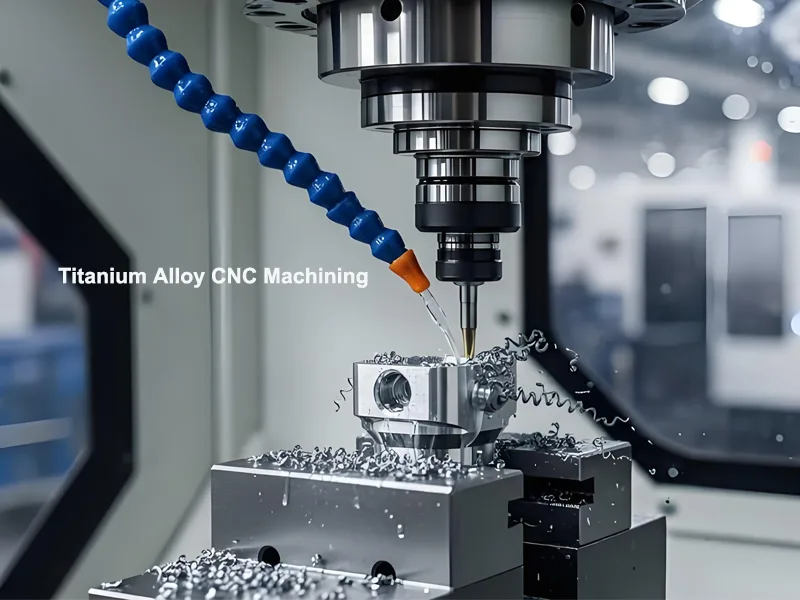
The modern engineering landscape is constantly pushing the boundaries of what is possible. In industries ranging from aerospace and medical device manufacturing to high-performance automotive and subsea oil exploration, engineers are demanding materials that offer uncompromising strength, exceptional corrosion resistance, and remarkably low weight. Grade 5 Titanium, also known as Ti-6Al-4V, is almost universally the material of choice to meet these rigorous demands. It is the undisputed king of high-performance alloys.
However, there is a fundamental paradox at the heart of manufacturing with this extraordinary material: the same physical and chemical properties that make Grade 5 Titanium the ultimate choice for industrial design engineers also make it an absolute nightmare for machinists to cut, mill, and turn.
When international procurement personnel and mechanical engineers source customized grade 5 titanium alloy CNC machining, they frequently run into a wall of delayed delivery times, drastically inflated costs, and out-of-tolerance parts. Why? Because many generalist machine shops lack the specialized knowledge needed to tame this alloy. They attempt to machine titanium using the same methodologies they use for aluminum or standard carbon steel, leading to catastrophic tool failure and warped, unusable components.
At AFI Parts, we do not rely on guesswork. With two decades of hands-on, frontline production experience in the machining industry, our team has encountered and overcome every conceivable challenge associated with titanium fabrication. We have spent twenty years on the shop floor optimizing tool paths, dialing in custom fixturing, and analyzing chip formation. In this comprehensive technical guide, we are pulling back the curtain on our manufacturing processes to explain exactly how we solve the two most critical bottlenecks in precision titanium machining services: rapid, unpredictable tool wear and severe workpiece deformation.
Table of Contents
Why Grade 5 Titanium Demands Specialized Machining Expertise
To understand the solutions, we must first deeply understand the enemy. Grade 5 Titanium (Ti-6Al-4V) consists of 90% titanium, 6% aluminum, and 4% vanadium. This specific metallurgical composition creates a unique set of machinability challenges that require specialized 5-axis CNC machining titanium capabilities and deep engineering expertise.
Exceptionally low thermal conductivity
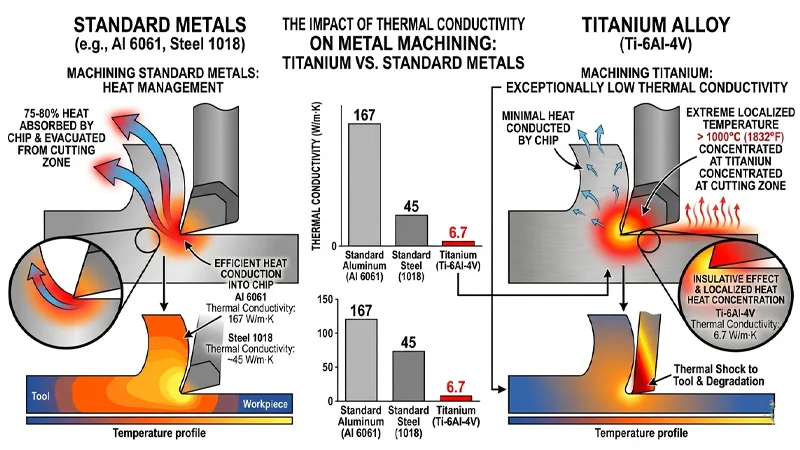
The most significant hurdle in custom aerospace parts manufacturing involving titanium is heat management. In standard metal cutting (such as machining 6061 aluminum or 1018 steel), the vast majority of the heat generated by the shearing action of the cutting tool—often up to 75% or 80%—is absorbed by the metal chip and carried away from the cutting zone as the chip is evacuated.
Titanium, however, has an incredibly low thermal conductivity. To put this into perspective, the thermal conductivity of Ti-6Al-4V is approximately 6.7 W/m·K. In stark contrast, standard aluminum sits at around 167 W/m·K, and even standard steel is around 45 W/m·K. Because titanium cannot conduct heat away effectively, the heat generated by the machining process has nowhere to go. Instead of leaving with the chip, the extreme temperatures are concentrated directly at the cutting edge of the CNC tool and the immediate surface of the workpiece. This localized heat zone can easily exceed 1000°C (1832°F) during aggressive milling operations, leading to immediate thermal shock and tool degradation.
High chemical reactivity at elevated temperatures
Titanium is a highly reactive metal. While it forms a beautiful, protective oxide layer at room temperature (which gives it its famous corrosion resistance), its behavior changes drastically at the high temperatures generated during CNC milling and turning. When the temperature at the cutting edge rises, titanium develops a strong chemical affinity for the materials used in standard cutting tools.
The titanium chips literally begin to weld themselves to the carbide inserts or end mills, a phenomenon known as galling or built-up edge (BUE). As the tool continues to rotate, these micro-welded chips are violently torn away, pulling microscopic chunks of the cutting tool’s carbide substrate with them. This leads to rapid edge chipping and premature, catastrophic tool failure.
Low modulus of elasticity (the “springback” effect)
For mechanical engineers designing thin-walled structural components, the low modulus of elasticity of titanium is a major consideration. The Young’s Modulus of Grade 5 Titanium is roughly 114 GPa, which is only about half that of steel (approx. 200 GPa).
In practical machining terms, this means titanium is relatively “bendy” or elastic under the pressure of a cutting tool. Instead of shearing cleanly when the cutting edge engages, the titanium workpiece tends to deflect or push away from the tool. Once the tool passes, the material springs back to its original position. This springback causes severe rubbing on the flank or clearance face of the cutting tool, generating even more friction and heat. More critically, this deflection makes it incredibly difficult to hold tight geometric dimensioning and tolerancing (GD&T), resulting in severe workpiece deformation, especially in thin-wall titanium machining.
Work hardening characteristics
While not as pronounced as in some stainless steels or Inconel alloys, Grade 5 Titanium does exhibit work-hardening characteristics. If a cutting tool is allowed to rub or dwell against the material rather than taking a decisive chip, the localized area becomes instantly work-hardened. The next cutting pass will then attempt to cut material that is significantly harder than the base alloy, instantly destroying the cutting edge.
For B2B metal fabrication buyers, understanding these four metallurgical traits is vital. It highlights why partnering with a facility that has deep, specialized experience is not just a preference, but a strict requirement for successful project execution.
Battle-Tested Strategies for Combating Tool Wear
At AFI Parts, our twenty years of production experience have taught us that there is no “magic bullet” for extending tool life when working with Ti-6Al-4V. Instead, achieving titanium tool life optimization requires a holistic approach that perfectly balances tool substrate, edge geometry, advanced coatings, and highly optimized feeds and speeds.
Choosing the right tool material and substrate
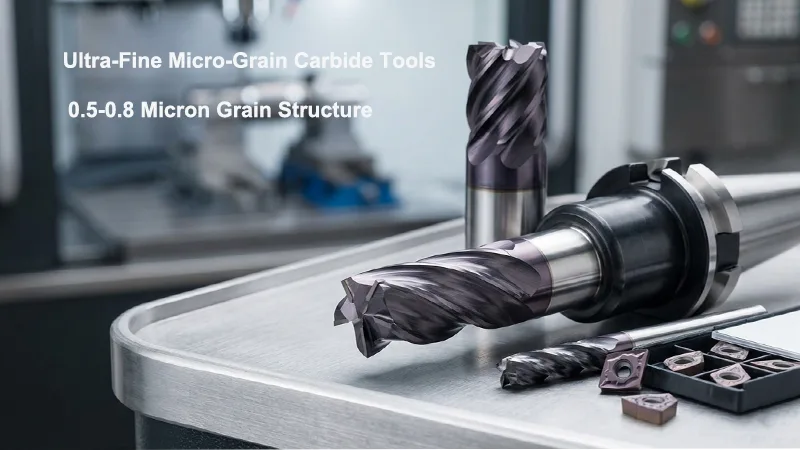
Standard high-speed steel (HSS) and general-purpose carbide tools have no place in a professional titanium machining cell. The intense heat and chemical reactivity will destroy them within minutes.
Through extensive trial and error on our CNC mill and lathe centers, we utilize exclusively ultra-fine micro-grain solid carbide tools. The micro-grain structure (typically 0.5 to 0.8 microns) provides the high transverse rupture strength required to withstand the high cutting forces of titanium, while also offering the exceptional hardness needed to resist abrasive wear. The core substrate must possess maximum toughness to absorb the vibrations and shock loading that inherently occur when milling this tough alloy.
Advanced physical vapor deposition (PVD) coatings
Because bare carbide will chemically react with titanium at high temperatures, a protective barrier is absolutely mandatory. However, not all coatings are created equal.
Common coatings like standard Titanium Nitride (TiN) or Titanium Carbonitride (TiCN) are often ineffective because they contain titanium, which can actually exacerbate the chemical affinity and galling issues. Instead, our engineers rely heavily on advanced Physical Vapor Deposition (PVD) coatings specifically engineered for high-temp alloys.
- Aluminum titanium nitride (AlTiN): This is our go-to coating for severe titanium milling. Under the extreme heat of the cutting zone, the aluminum in the coating oxidizes to form a microscopic layer of aluminum oxide (Al2O3). This ceramic-like layer acts as a supreme thermal barrier, reflecting the heat into the chip rather than letting it penetrate the carbide substrate. It remains stable at temperatures up to 800°C.
- Titanium aluminum nitride (TiAlN): Similar to AlTiN but with a slightly different ratio of elements, TiAlN is excellent for applications where toughness and resistance to edge chipping are the primary concerns.
Optimizing tool geometry for shearing, not rubbing
The physical shape of the cutting tool dictates how the chip is formed and evacuated. Due to titanium’s elasticity and tendency to smear, the tool must slice cleanly through the material.
- Positive rake angles: We exclusively utilize tools with high positive rake angles. A positive rake creates a sharper, more aggressive cutting edge that shears the titanium rather than plowing through it. This significantly reduces the cutting forces, which in turn reduces heat generation and minimizes the deflection of the workpiece.
- Adequate clearance angles: To combat the “springback” effect mentioned earlier, the tool must have sufficient primary and secondary relief (clearance) angles. If the clearance angle is too shallow, the elastic titanium will spring back and violently rub against the flank of the tool behind the cutting edge, leading to instant heat build-up and rapid flank wear.
- Variable pitch and variable helix designs: Chatter (harmonic vibration) is a tool killer in titanium machining. To break up harmonics, we employ end mills with variable pitch (unequal spacing between the flutes) and variable helix angles. This disrupts the rhythmic vibrations that cause chatter, resulting in a superior surface finish and exponentially longer tool life.
- Edge preparation (honing): While a sharp edge is needed to shear titanium, an edge that is too sharp is fragile and will micro-chip under heavy loads. We ensure our tools have a tightly controlled, microscopic edge hone (often just a few microns thick) to strengthen the cutting edge without sacrificing its ability to slice the material.
Dialing in speeds and feeds (the shop floor reality)
In the realm of custom grade 5 titanium alloy CNC machining, speed is the enemy. The most common mistake inexperienced machinists make is running the spindle too fast.
- Surface footage (SFM): While aluminum might be milled at 1000+ Surface Feet per Minute (SFM), titanium demands patience. For roughing Grade 5 Titanium with coated carbide, we strictly regulate our cutting speeds, typically operating in the conservative window of 120 to 180 SFM. For finishing passes, where a lighter depth of cut is taken, we may push to 200-250 SFM. Exceeding these limits causes the temperature to spike exponentially, melting the tool coating and destroying the carbide.
- Aggressive chip loads: While we drop the RPM (speed), we maintain a relatively heavy feed rate (chip load). If you feed too slowly in titanium, the tool will rub rather than cut, causing instant work-hardening. The tool must stay engaged in a constant state of shearing. We aim for a thick chip that can absorb as much heat as possible before being evacuated.
Conquering Workpiece Deformation in Thin-Walled Titanium Parts
Managing tool wear is only half the battle. For industrial product design engineers who require complex aerospace housings, medical implant devices, or lightweight automotive components, maintaining geometric stability is the ultimate challenge.
Deformation in titanium machining is caused by a combination of the material’s low modulus of elasticity (springback) and the introduction of severe residual stresses during the roughing process. Over our 20 years in production, AFI Parts has developed a rigorous, multi-stage methodology to guarantee dimensional accuracy on even the most delicate thin-walled structures.
Advanced workholding and custom fixturing
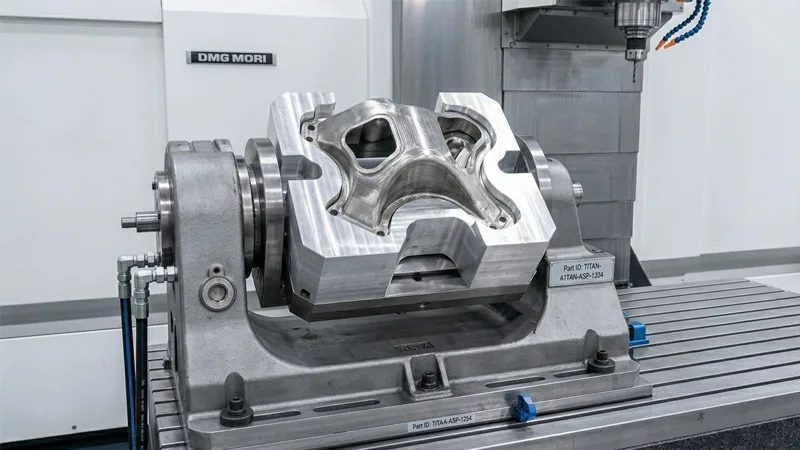
You cannot machine a precise part if the part is moving. Standard vise jaws are often insufficient for complex titanium geometries because squeezing the part too tightly will induce stress, which then releases and warps the part once it is removed from the vise.
- Custom soft jaws and potting: We routinely design and machine custom aluminum or mild steel soft jaws that perfectly encapsulate the complex profiles of the titanium blank. This distributes the clamping force evenly across the entire surface area, preventing pinch-point distortion.
- Vacuum fixturing: For flat, thin-walled plates, mechanical clamping is often impossible without bowing the material. We employ high-precision vacuum chucks that pull the titanium flat against a precision-ground sub-plate, allowing us to machine the entire top surface without any mechanical interference or induced stress.
- Vibration damping: Because titanium requires high torque to cut, the fixtures themselves must be incredibly rigid. We design our fixtures with maximum mass to absorb vibration and prevent the workpiece from resonating during heavy roughing passes.
Strategic CAM programming and tool paths
How the CNC machine is programmed is just as critical as the tooling used. Modern Computer-Aided Manufacturing (CAM) software allows us to manipulate the tool paths to drastically reduce cutting forces and heat.
High-efficiency milling (HEM) and trochoidal toolpaths
Traditional roughing involves burying the tool into a corner, which creates a massive spike in tool engagement angle, instantly overloading the cutter and violently pushing the workpiece.
Instead, our CAM engineers utilize High-Efficiency Milling (HEM) or trochoidal milling strategies. These dynamic toolpaths use circular, sweeping motions to keep the tool engagement angle (the Radial Depth of Cut, or Step-over) constant at all times. By taking a very light radial depth of cut (e.g., 10% to 15% of the tool diameter) but a very deep axial depth of cut (using the entire flute length of the end mill), we distribute the wear evenly across the tool. More importantly, this constant, low-pressure engagement prevents the tool from violently pushing against thin walls, drastically reducing deformation.
Climb milling vs. conventional milling
Whenever physically possible, we utilize Climb Milling. In climb milling, the tool cuts into the material at the thickest part of the chip and exits at the thinnest. This directs the cutting forces downward, pushing the workpiece securely into the fixture. Conventional milling, conversely, starts at zero thickness and rubs its way into the cut, creating friction, work-hardening, and pulling the part upward, which introduces massive instability and deformation.
The art of stress relief: roughing vs. finishing protocols
Perhaps the most crucial lesson learned in our two decades of experience is that you cannot machine a high-precision titanium part in a single operation. The intense forces required to remove the bulk material will inevitably introduce internal residual stresses into the titanium matrix. If you immediately machine the part to its final dimensions, those internal stresses will slowly release over the next few hours or days, causing the part to warp entirely out of tolerance.
Our standard operating procedure for precision titanium machining services involves a strict, multi-stage process:
- Aggressive roughing: We remove the bulk of the material using high-torque toolpaths, deliberately leaving a specific amount of stock material (usually 0.5mm to 1.0mm) on all critical surfaces.
- Stress relief and normalization: After roughing, the part is removed from the rigid fixture. By releasing the clamping pressure, the part is allowed to naturally flex, warp, and release the internal stresses introduced during the roughing phase. For highly critical aerospace components, we may even introduce a thermal stress-relief baking cycle in a specialized oven at this stage.
- Light semi-finishing: The relaxed part is re-fixtured with very light, delicate clamping pressure. A semi-finish pass is taken to true up the warped geometry, leaving perhaps 0.1mm of stock.
- High-precision finishing: Finally, using brand new, razor-sharp end mills dedicated exclusively to finishing, we take the final passes at optimized speeds to achieve the final dimensions and superior surface finish.
This meticulous, multi-step approach is exactly why international procurement personnel trust AFI Parts to deliver parts that remain perfectly flat and dimensionally stable long after they leave our facility.
The Critical Role of Coolant and Thermal Management
In the world of custom grade 5 titanium alloy CNC machining, coolant does not just provide lubrication; it is a critical structural component of the machining process. Without aggressive thermal management, success is impossible.
The Inadequacy of Standard Flood Coolant
Most standard CNC machines utilize “flood coolant”—a low-pressure stream of fluid aimed roughly at the cutting zone. When milling titanium, temperatures easily exceed the boiling point of the coolant mixture. When low-pressure flood coolant hits this extreme heat, it instantly vaporizes, creating a microscopic blanket of steam around the cutting tool. This vapor barrier physically prevents the liquid coolant from reaching the cutting edge. As a result, the tool runs completely dry, hidden behind a wall of steam, leading to rapid thermal breakdown.
High-Pressure Coolant (HPC) Systems
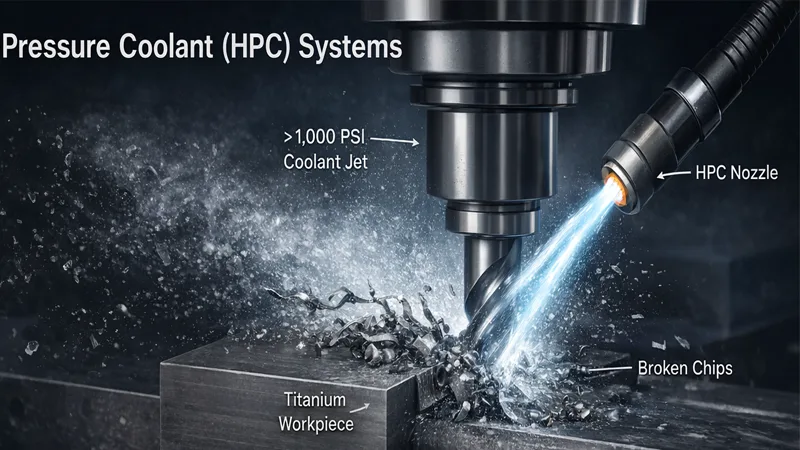
To shatter this vapor barrier, AFI Parts utilizes High-Pressure Coolant (HPC) systems. We pump specially formulated coolant at pressures exceeding 1,000 PSI directly at the cutting interface. This high-velocity jet literally blasts through the steam barrier, forcibly removing the heat from the cutting zone.
Furthermore, this high-pressure stream acts as a mechanical wedge. Titanium chips are notoriously stringy and ductile. The 1,000 PSI coolant jet hits the underside of the chip as it is forming, breaking the chip into small, manageable pieces and evacuating them rapidly from the cutting zone. This prevents recutting of chips—a major cause of catastrophic tool failure and ruined surface finishes.
Through-Tool Coolant Technology
For drilling operations and deep pocket milling, we utilize advanced tooling featuring through-tool coolant holes. The high-pressure coolant travels down the center of the spindle, through the core of the cutting tool, and exits directly at the cutting edges. This ensures that no matter how deep the tool is buried inside a pocket or hole, the exact point of metal shearing is receiving maximum cooling and lubrication, eliminating the risk of chip packing and tool breakage.
Coolant Concentration and Lubricity
The chemical makeup of the coolant is just as vital as the pressure. Titanium requires a delicate balance. It needs high water content for maximum heat dissipation (water is an excellent thermal conductor), but it also requires intense lubricity to combat titanium’s tendency to gall and stick to the cutter. We rigorously maintain our coolant concentration levels (typically between 8% and 12% using premium synthetic or semi-synthetic aerospace-grade fluids) using daily refractometer checks. We also monitor tramp oil levels and bacterial growth, as degraded coolant quickly loses its lubricity and cooling properties.
Case Study: 20 Years of Experience in Action
To illustrate the practical application of these methodologies, let us examine a recent project undertaken by the AFI Parts engineering team for a leading aerospace contractor. This case study demonstrates how true expertise bridges the gap between theoretical engineering and shop-floor reality.
The challenge: An international procurement manager approached us with a highly complex Grade 5 Titanium (Ti-6Al-4V) housing for a drone gimbal system. The part was fraught with manufacturability issues. It featured incredibly thin walls measuring just 0.6mm in thickness, deep internal pockets that required long tool reach, and strict geometric tolerances requiring a true position of 0.02mm across multiple datums.
The client’s previous machining vendor had struggled massively. Their cycle time was exceeding 3 hours per part, they were consuming three expensive solid carbide end mills per housing, and their scrap rate due to thin-wall warping and chatter was an unacceptable 45%.
The AFI Parts solution: Our engineering team immediately recognized the familiar symptoms of improper titanium machining and completely overhauled the manufacturing process, utilizing the principles outlined in this guide.
- Fixturing overhaul: We abandoned the previous vendor’s rigid vise clamping, which was inducing massive stress into the thin walls. Instead, we designed a custom aluminum encapsulation fixture coupled with a vacuum base to hold the part delicately but securely without pinching.
- Tooling upgrade: We replaced the general-purpose tooling with application-specific, variable-pitch, micro-grain solid carbide end mills coated with a highly specialized AlTiN layer designed specifically for high-temp alloys.
- CAM strategy redesign: We reprogrammed the entire roughing cycle utilizing High-Efficiency Milling (HEM) trochoidal toolpaths. We reduced the radial engagement to just 10% but utilized the full flute length of the cutter. This drastically reduced the cutting pressure against the fragile 0.6mm walls.
- Stress relief implementation: We broke the operation into three distinct phases. We roughed the part, leaving 0.8mm of stock, removed it from the fixture to allow the internal stresses to normalize overnight, and then performed the final precision finishing passes the next day using pristine tooling and 1,000 PSI through-tool coolant.
The result: The results were transformative for the client. By applying our 20 years of accumulated machining knowledge, we reduced the total cycle time from over 3 hours to just 75 minutes. Tool life was extended by over 400%, allowing us to complete two entire housings on a single set of end mills. Most importantly, the deformation issues were eliminated. We delivered a batch of 500 gimbal housings with a 0% scrap rate, perfectly adhering to the strict 0.02mm true position tolerances. This case study exemplifies why B2B metal fabrication buyers rely on specialized experts rather than generalist machine shops.
Quality Control: Ensuring Precision in Every Batch
In the B2B sector, particularly when dealing with international procurement for high-stakes industries like aerospace and medical devices, trust is not built on promises; it is built on verifiable data. Excellent machining techniques mean nothing if the results cannot be proven and repeated.
At AFI Parts, our quality control department is integrated deeply into the manufacturing process. We operate under strict ISO-compliant quality management systems to ensure that every titanium component leaving our facility meets exact client specifications.
- First article inspection (FAI): Before any production run begins, the first machined component undergoes a rigorous FAI process. We utilize high-precision Coordinate Measuring Machines (CMM) to map the geometry of the part in 3D space, verifying every dimension, angle, and GD&T callout against the original CAD model.
- In-process inspection: Quality is not just checked at the end; it is monitored constantly. Our machinists are equipped with calibrated micrometers, bore gauges, and surface roughness testers to verify tolerances at critical intervals during the production run, ensuring tool wear does not slowly push the parts out of spec.
- Surface finish verification: Due to titanium’s tendency to gall, achieving a flawless surface finish can be challenging. We utilize profilometers to guarantee that surface finishes meet the exact Ra or Rz values specified by the industrial design engineers, ensuring perfect mating surfaces for structural assemblies or proper osseointegration for medical implants.
- Full material traceability: We understand that the aerospace and medical sectors require total transparency. We provide complete material test reports (MTRs) and certificates of conformance (CoC) with every shipment, ensuring complete traceability from the raw titanium billet to the final machined component.
To further assist procurement personnel and mechanical engineers in sourcing the right manufacturing partner, we have compiled answers to the most common questions we receive regarding custom titanium CNC machining.
Conclusion: sourcing reliable customized grade 5 titanium alloy CNC machining partners
Machining grade 5 titanium (Ti-6Al-4V) is not a task that can be mastered overnight. It is a highly complex discipline that requires a perfect synchronization of advanced metallurgy, specialized cutting tools, rigid CNC machinery, dynamic CAM programming, and most importantly, deep historical shop-floor intuition.
As we have explored in this guide, the rapid tool wear and severe workpiece deformation associated with this alloy are formidable challenges. However, they are not insurmountable. By understanding the root causes of thermal shock, chemical galling, and springback, and by applying rigorous, multi-stage stress relief and high-pressure coolant strategies, these challenges can be systematically eliminated.
Whether you are an industrial design engineer prototyping a revolutionary new medical device or an international procurement manager seeking to stabilize the supply chain for high-volume aerospace components, finding the right manufacturing partner is your ultimate competitive advantage. You need a team that relies on proven, battle-tested methodologies rather than trial and error at your expense.
With 20 years of dedicated production experience in the machining industry, the team at AFI Parts possesses the exact expertise required to execute your most demanding projects. We do not just machine metal; we engineer manufacturing solutions.
If you are facing challenges with your current custom grade 5 titanium alloy CNC machining projects, or if you are preparing to launch a new product that demands the uncompromising performance of Ti-6Al-4V, we invite you to leverage our expertise.
Take the next step in optimizing your supply chain: Send your 2D manufacturing drawings and 3D CAD models to the AFI Parts engineering team today. We provide a comprehensive, complimentary DFM (Design for Manufacturing) review and a highly competitive, transparent quotation. Let our two decades of experience become your competitive edge.
FAQ
Yes, Wire EDM and Sinker EDM are highly effective for Grade 5 Titanium, particularly for intricate geometries like sharp internal corners or splines that cannot be achieved with traditional rotary cutting tools. Because EDM is a non-contact thermal process, it completely bypasses the issues of tool wear and mechanical cutting forces (springback). However, it is a slower process, and care must be taken to manage the “recast layer” (the microscopic layer of resolidified metal on the surface) if the part is subject to high fatigue stress.
The cost discrepancy is driven by three main factors:
- Raw material cost: Aerospace-grade Ti-6Al-4V billet is inherently more expensive than most stainless steels.
- Increased cycle times: As discussed, titanium must be machined at lower spindle speeds (SFM) to manage heat, which naturally increases the time the part spends on the CNC machine.
- Tooling consumption: Even with perfect optimization, carbide cutting tools degrade faster in titanium than in steel, leading to higher consumable costs per part. Partnering with an experienced vendor like AFI Parts minimizes these costs through efficient programming and tool management.
While not strictly necessary for simple brackets, 5-axis CNC machining of titanium is highly recommended for complex aerospace or medical parts. A 5-axis machine can rotate the workpiece and the tool simultaneously. This allows the use of shorter, more rigid cutting tools (reducing vibration and chatter) and enables the machining of complex contoured surfaces in a single setup. Reducing the number of setups is crucial for maintaining tight GD&T tolerances across the entire part.
While solid blocks of Grade 5 titanium are highly stable, titanium dust, shavings, and ultra-fine chips are highly combustible and can ignite if exposed to a spark or extreme heat. This is another reason why High-Pressure Coolant (HPC) is non-negotiable. The high-volume liquid completely extinguishes any fire risk during the cutting process. Furthermore, we maintain strict housekeeping standards, utilizing specialized vacuum systems and safe storage protocols for titanium swarf to ensure complete facility safety.