
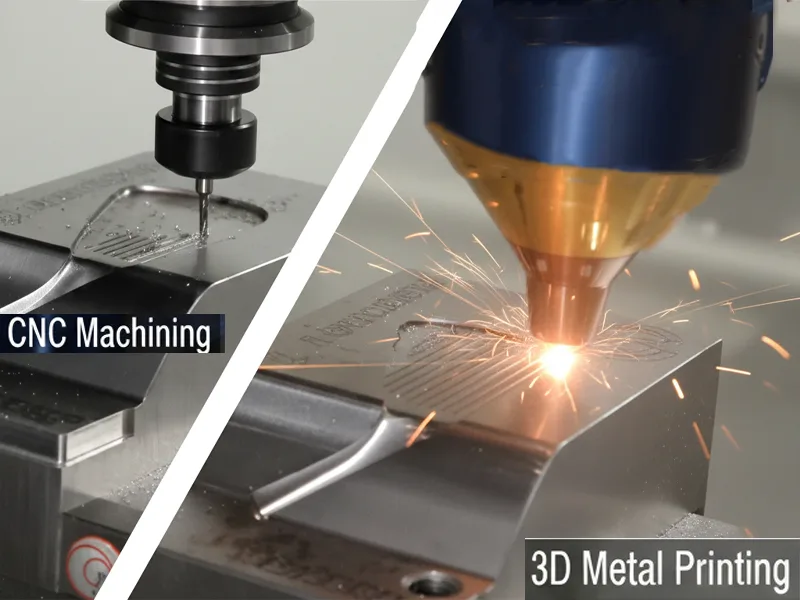
Hybrid manufacturing represents a paradigm shift in industrial production, synergizing the geometric freedom of Metal Additive Manufacturing (AM) with the dimensional precision of CNC Machining (Subtractive Manufacturing). As the manufacturing landscape evolves towards highly complex, lightweight, and custom-engineered components, relying solely on traditional subtractive or additive methods presents inherent limitations. This dual-process methodology enables the fabrication of metal components with superior structural integrity, intricate internal geometries, and tight tolerances. By leveraging the “Near-Net-Shape” capabilities of AM and the “Net-Shape” finishing of CNC, manufacturers can accelerate prototyping cycles, optimize material usage, and achieve superior operational outcomes.
At AFI Parts, our daily interaction with complex custom metal parts requires us to constantly evaluate advanced manufacturing ecosystems. Market analysis projects the hybrid additive manufacturing sector will expand at a CAGR of 12.3% from 2026 to 2033, driven by the escalating demand for high-performance, complex components in regulated industries. This sustained growth is not merely a trend; it is a fundamental restructuring of how we approach Design for Manufacturing (DfM). In this comprehensive guide, we will dissect the mechanical, metallurgical, and operational intricacies of hybrid manufacturing, providing actionable insights for mechanical engineers, product designers, and quality inspectors.
Table 1: Technical Advantages of Hybrid Manufacturing
The integration of these two distinct manufacturing paradigms yields a synergistic effect that transcends the capabilities of either standalone process. Below is a detailed technical analysis of these advantages:
| Advantage | Engineering Benefit | Operational Impact |
|---|---|---|
| Cost Efficiency | Reduces “Buy-to-Fly” ratio by minimizing initial material stock. Traditional milling of aerospace alloys can see up to 90% material removal. Hybrid deposition places material only where necessary. | Long-term amortization of costs via reduced waste and energy consumption. Decreases capital tied up in raw billet inventory. |
| Repair & Rework (MRO) | Enables Cladding/DED for restoring worn critical surfaces. Worn bearing journals or turbine blade tips can be rebuilt metallurgically soundly. | Extends the lifecycle of high-value assets like molds and turbine blades. Reduces the need for complete component replacement, significantly lowering MRO downtime. |
| On-Demand Customization | Facilitates rapid design iteration without hard tooling constraints. Bypasses the need for expensive die-casting molds or complex forging dies during the prototyping phase. | Supports “High-Mix, Low-Volume” production strategies. Highly responsive to supply chain disruptions or sudden design modifications. |
| Unparalleled Design Flexibility | Allows for conformal cooling channels and lattice structures. Engineers can utilize topology optimization software to design parts based purely on load paths. | Realizes geometries impossible via conventional machining alone. Eliminates the need for multi-part assemblies joined by welding or fasteners. |
| Improved Accuracy | Achieves ISO-grade tolerances on critical mating surfaces. CNC finishing ensures that bearing fits and sealing surfaces meet strict GD&T requirements. | Ensures functional fit and superior surface finish (Ra < 0.8)㎛. Critical for dynamic load-bearing components and fluidic sealing applications. |
| Reduced Material Waste | Subtracts only the necessary stock vs. high-removal billing machining. Reduces swarf generation, particularly important when machining expensive superalloys. | Subtracts only the necessary stock vs. high-removal billing machining. Lowers coolant contamination and chip recycling overhead. |
Key Takeaways
Before diving into the granular technical details, it is crucial to establish the foundational pillars of hybrid manufacturing:
- Process Synergy: Systematically combines 3D printing for mass accumulation and CNC machining for feature refinement. This is not merely putting two machines next to each other; it is the algorithmic integration of toolpaths.
- Operational Efficiency: Drastically reduces lead times and production costs through workflow consolidation. By eliminating setup changes between discrete machines, cumulative positional errors and idle times are eradicated.
- Agility: Enables rapid design iterations and the economical production of small batches. Engineers can pivot designs overnight without waiting for tooling adjustments.
- Quality Assurance: CNC integration ensures printed parts meet rigorous surface roughness and dimensional specifications. The subtractive phase removes the inherent stair-stepping effect and surface oxidation typical of powder-bed fusions.
- Digital Transformation: Relies on integrated CAD/CAM workflows to control manufacturing parameters and quality inspection. The digital thread connects the initial solid model directly to the final CMM verification.
- Sector Adoption: Widely implemented in the aerospace and medical sectors for its versatility and capacity for innovation. These heavily regulated industries demand both complex geometries and zero-defect traceability.
Table of Contents
What Is Hybrid Manufacturing?
Hybrid manufacturing is fundamentally the convergence of opposing physical processes. To understand its true value, one must analyze it not as a novel concept, but as a logical evolution of industrial machining. In traditional environments, a billet of material is mounted in a 5-axis machining center, and cutting tools subtract material until the final shape is revealed. In pure additive manufacturing, powder or wire is melted layer by layer until the part is formed. Hybrid manufacturing intelligently sequences these operations.
Additive and Subtractive Processes
Hybrid manufacturing integrates two distinct methodologies into a unified workflow.
Additive Manufacturing (AM), typically governed by standards such as ISO/ASTM 52900, constructs components layer-by-layer using metal powder or wire. This process relies on intense localized heat sources to achieve metallurgical bonding between layers. Common modalities include Directed Energy Deposition (DED) and Powder Bed Fusion (PBF). DED is particularly prominent in true hybrid machines (where deposition and milling occur in the same spindle environment) because it uses a nozzle to blow powder or feed wire directly into a melt pool created by a laser or electron beam.
Conversely, Subtractive Manufacturing (CNC Machining) utilizes cutting tools to remove material, refining the workpiece to its final specifications. This process relies on rigid machine tools, precise spindle rotation, and carefully calculated feed rates to shear metal away.
In a hybrid workflow, AM creates complex internal features (e.g., lattice structures, internal channels) inaccessible to cutting tools. For example, a hydraulic manifold can be printed with sweeping, curved internal channels that minimize fluid turbulence—a geometry impossible to achieve with straight drill bits. Subsequently, CNC machining ensures that critical interfaces meet strict geometric tolerances and surface quality requirements. The milling spindle will engage to bore out bearing journals, tap threads, and face off sealing surfaces to precision grades.
These processes are complementary, resolving the limitations inherent to each standalone method. Additive provides the shape; subtractive provides the precision.
AFI Parts Senior Engineer’s Log: While ideal for complex, low-volume components like medical implants, engineers must account for challenges such as high initial tooling costs, design constraints imposed by process compatibility, and the necessity for precise calibration. It is not a plug-and-play solution. In our experience, the thermal dynamics of depositing molten metal inside a precision CNC enclosure require aggressive spindle cooling and robust thermal compensation algorithms to prevent the machine casting from warping and introducing datum shifts.
Workflow Integration
Digitization is the backbone of hybrid manufacturing; a unified CAD/CAM environment is essential to coordinate additive and subtractive toolpaths within a single coordinate system. Without a singular digital source of truth, transitioning between adding and removing material would result in catastrophic tool crashes or out-of-tolerance parts.
- Digital Thread: A comprehensive digital model guides both deposition and cutting phases, ensuring design intent is maintained throughout. This means the CAM software must understand not just the final geometry, but the intermediate “as-printed” geometry to calculate safe tool engagement angles.
- Process Handover: Software synchronizes automated and manual tasks, optimizing cycle times and safety. Automatic tool changers (ATC) swap laser deposition heads for carbide endmills seamlessly.
- Quality Control: Continuous digital workflows facilitate real-time monitoring and rapid design modifications. In-process probing can measure a deposited layer, feed that data back to the controller, and adjust the subsequent milling pass dynamically.
- System Connectivity: Software bridges the gap between 3D printing parameters and CNC machining strategies, minimizing translation errors and waste.
3D Printing in Hybrid Manufacturing
The additive phase of hybrid manufacturing dictates the internal structural integrity and the baseline material properties of the final component. Understanding the specific metallurgical processes is vital for downstream machining operations.
Metal Additive Techniques
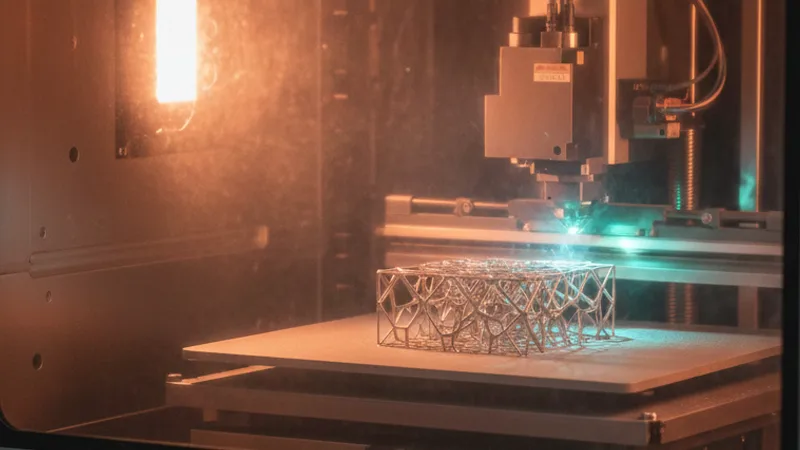
To achieve high-density metal components, hybrid systems primarily utilize high-energy beam technologies that fuse metal powder or wire. The selection of technique dictates the component’s microstructural quality and feature resolution. Wire-fed systems generally offer higher deposition rates but lower resolution, making them suitable for large structural components. Powder-fed systems offer finer resolution but are slower and require careful handling of combustible metallic dust.
Common AM Technologies :
- Direct Metal Laser Sintering (DMLS) / Selective Laser Melting (SLM): Uses a laser to fully melt and fuse metal powder. Ideal for intricate geometries. In DMLS, the powder is spread in a thin layer (often 20-50 microns thick), and a fiber laser selectively melts the cross-section. The extreme cooling rates (up to $10^6$ K/s) result in very fine, albeit often highly stressed, microstructures.
- Electron Beam Melting (EBM): Utilizes an electron beam in a vacuum, suitable for high-temperature alloys. Because it operates in a vacuum at elevated temperatures, EBM produces parts with very low residual thermal stress, which significantly reduces the risk of part distortion during subsequent CNC machining.
Table 2: Analysis of Metal 3D Printing in Hybrid Systems
| Advantages (AM) | Limitations (AM) | Hybrid Solution |
|---|---|---|
| Design Freedom: Enables complex lattices. | High Initial Costs: Equipment investment. | Offset by reduced tooling and lead times. |
| Part Consolidation: Reduces assembly count. | Size Constraints: Build volume limits. | Large parts can be segmented or repaired via DED. |
| Material Efficiency: Near-Net-Shape reduces waste. | Surface Finish: Often rough (Ra > 10㎛). | A hybrid allows printing only complex features on standard stock. |
| Rapid Prototyping: Accelerates R&D. | Production Speed: Slower than casting. | Hybrid allows printing only complex features on standard stock. |
Geometric Freedom and Efficiency
Complex Geometries: 3D printing empowers engineers to fabricate topologically optimized shapes—such as internal channels and lattice structures—that maximize strength-to-weight ratios but are impossible to machine from solid billets. Topology optimization uses finite element analysis (FEA) to mathematically determine where material is necessary to bear loads, removing everything else. The resulting organic, bone-like structures cannot be manufactured via traditional 3-axis or even 5-axis milling due to tool access limitations.
Synergy: Following the additive phase, CNC machining is employed to refine tolerances and surface finishes, ensuring the part meets industrial standards. This integration resolves the inherent surface-quality limitations of AM. The rough, partially fused powder particles on the exterior of an AM part act as stress concentrators; machining them away restores the fatigue life of the component.
Material Utilization
Traditional machining often results in high material waste. When machining complex aerospace bulkheads from solid titanium blocks, it is not uncommon to machine away 80-90% of the raw material. Hybrid manufacturing significantly mitigates this by depositing material only where structurally necessary.
This “Near-Net-Shape” approach is critical for cost-efficiency when working with expensive alloys, such as Inconel 718, Hastelloy, or Grade 5 Titanium. Furthermore, hybrid systems (e.g., combined CNC milling and laser ablation) streamline the production chain, reducing secondary operations and enabling rapid functional testing of new designs. By starting with a standard wrought substrate and only printing the complex features onto it, manufacturers can drastically cut down on costly powder consumption and printing time.
CNC Machining in Hybrid Manufacturing
As specialists in custom metal parts at AFI Parts, we understand that near-net shape is only half the battle. The functionality of a mechanical component depends heavily on its interfacing surfaces. This is where subtractive manufacturing reclaims its critical role in the hybrid ecosystem.
Precision and Surface Finish
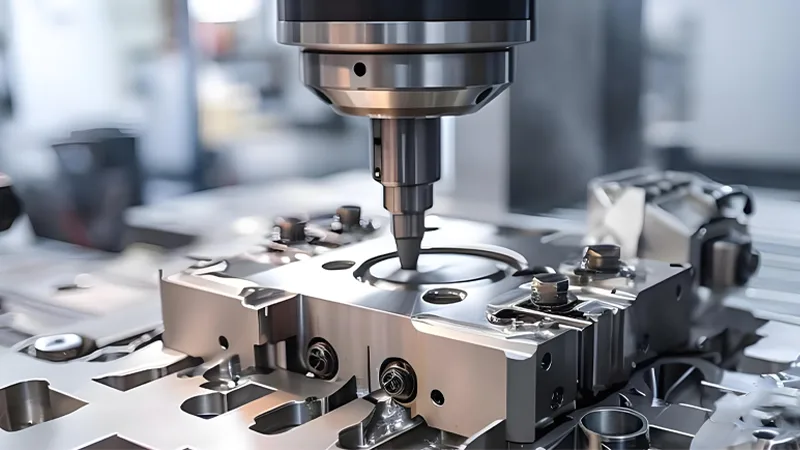
While AM defines the geometry, CNC machining ensures engineering precision. Subtractive processes remove the rough, “as-printed” surface layers to achieve tight tolerances and superior finishes required for assembly. The “as-printed” surface is often characterized by a rough, matte finish caused by partially melted satellite particles. If a component requires an O-ring seal or an interference fit with a bearing, this surface is unacceptable.
Precision Capabilities in Hybrid Systems :
Formalloy: Achieves tolerances of ±0.5µm with 70% reduction in surface roughness.
UnionMT: Delivers ±0.005 mm precision in a single pass.
JLCCNC: Attains surface roughness of Ra 0.4µm with ±0.01mm tolerance.
AFI Parts Engineering Audit & Verification: It is our responsibility to critically evaluate vendor specifications. While claims of tolerances like ±0.5µm are theoretically possible under strictly controlled laboratory conditions using ultra-precision spindles and aerostatic bearings, they are exceptionally difficult to maintain in a standard hybrid production environment. The thermal expansion of the machine tool during the DED heating phase introduces volumetric errors. In our practical experience at AFI Parts, a highly capable 5-axis hybrid mill operating in a temperature-controlled facility realistically maintains reliable Cpk > 1.33 for tolerances of ±0.005mm to ±0.01mm. Furthermore, achieving Ra 0.4µm on laser-sintered titanium often requires specialized wiper inserts and customized feed-speed ratios due to the altered hardness of the printed microstructure.
This subtractive capability is essential for ensuring proper fitment and maintaining tight tolerances on complex features generated by AM. By integrating machining immediately after deposition, engineers can achieve complex geometries without sacrificing dimensional accuracy.
Material Versatility
Hybrid manufacturing leverages the extensive material compatibility of CNC machining. The process supports a wide range of materials, including metals, composites, and high-performance plastics. Advanced CNC systems can machine complex composite structures, offering flexibility that is crucial for modern engineering applications.
This versatility allows for the optimization of material properties—such as strength and weight—tailored to specific functional requirements. It is important to note that machining printed metal is not identical to machining billet. The layer-by-layer deposition creates anisotropic properties; the material may exhibit different yield strengths parallel to the build direction versus perpendicular to it. CNC programmers must adjust chip loads and engagement angles accordingly to prevent chatter and premature tool wear.
3D Printing and CNC: Combined Workflow
The true art of hybrid manufacturing lies in the orchestration of the workflow. Moving seamlessly from a localized melt pool of 1600°C to high-precision rigid milling requires an immaculate standard operating procedure.
Seamless Process Integration
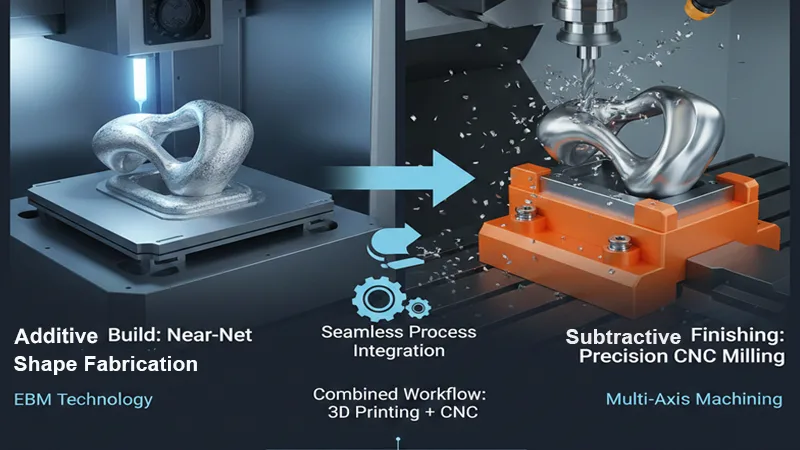
A successful hybrid workflow requires rigorous planning and the synchronization of additive and subtractive operations.
Standard Operating Procedure (SOP):
- Additive Build: The component is fabricated to near-net shape. During this phase, shielding gases (like Argon) are strictly monitored to prevent oxidation of the melt pool.
- Alignment: Engineers establish a precise datum to align the printed part for machining, preventing runout errors. This is critical. Because the part was “grown,” it does not have perfectly square edges to grip in a standard vise.
- Subtractive Finishing: Multi-axis CNC milling machines the part to final dimensions, smoothing surfaces, and refining complex features. Dynamic milling toolpaths are often employed here to maintain a constant chip load across the irregular printed geometry.
- Fixture Management: Custom 3D-printed fixtures are often utilized to secure complex parts during machining, enhancing stability and reducing setup time. Soft jaws can be 3D printed with negative conformal profiles of the part to hold organic shapes securely without crushing them.
- Quality Check: Critical dimensions are verified against the CAD model using in-process probing. Spindle-mounted probes (such as Renishaw systems) execute automated macro routines (e.g., G31) to touch-off on the printed surface, calculate the exact amount of excess material, and automatically update the tool offset registers before the cutter even engages.
AFI Parts Quality Assurance Note: Challenges such as high equipment costs, limited material compatibility, and the regulatory hurdles of qualifying new processes must be managed through strategic material selection and robust design-for-manufacturing (DfM) practices. At AFI Parts, our rigorous First Article Inspection (FAI) process involves not just dimensional checks, but non-destructive testing (NDT) such as dye penetrant or ultrasonic inspection to ensure the interface between the substrate and the deposited material is free of micro-porosities.
Digitization and Automation
Digital Twin & CAD/CAM: Advanced software systems unify the design, simulation, and execution phases, allowing engineers to visualize the entire hybrid process and preemptively resolve collisions or errors. Software like Siemens NX or Mastercam allows for accurate kinematic simulation of both the deposition head and the milling spindle, ensuring no mechanical interference occurs in the tight workspace.
Supply Chain Integration: Real-time data sharing and digital manufacturing platforms enhance transparency, allowing for rapid problem resolution and improved collaboration across the supply chain.
Automated Quality Control: Automated inspection systems collect metrology data to identify trends and defects early, ensuring consistent product quality and process stability. Closed-loop feedback systems can detect if a laser deposition pass was slightly under-extruded and automatically adjust the subsequent milling pass to compensate.
Benefits of Hybrid Manufacturing
The implementation of hybrid manufacturing represents a substantial capital investment. However, the Return on Investment (ROI) is justified through several compelling operational benefits that directly impact the bottom line.
Reduced Production Timelines
Hybrid manufacturing dramatically compresses the “Concept-to-Part” cycle. By consolidating additive and subtractive steps into a single workflow or cell, companies can reduce lead times from weeks to days.
- Throughput: Automated processes can increase production velocity by up to 75%.
- Rapid Turnaround: Eliminates the need for multiple setups and transfers between machines. Every time a part is moved from one machine to another, “stack-up” tolerance errors occur. Single-setup machining eliminates this.
- Agility: Facilitates immediate design modifications in response to customer feedback. If a flow analysis reveals a manifold needs a slightly wider channel, the CAD model is updated, and the hybrid machine adapts immediately on the next cycle.
Enhanced Part Quality
The convergence of processes ensures components meet stringent industry standards. AM facilitates the creation of optimized internal structures, while CNC machining guarantees the external precision and surface integrity necessary for high-cycle fatigue resistance. Surface integrity is paramount; rough micro-notches left by 3D printing can initiate fatigue cracks under cyclic loading. Machining these surfaces away fundamentally alters the part’s survivability. Digital monitoring throughout the workflow minimizes human error and ensures repeatability.
Cost and Efficiency Gains
Total Cost of Ownership (TCO): Hybrid manufacturing reduces operational costs through minimized scrap rates, lower energy consumption, and reduced labor requirements.
Table 3: Cost Benefit Analysis
| Factor | Contribution to Efficiency | Detail & Mechanism |
|---|---|---|
| Reduced Scrap Rates | Lowers raw material expenditure via near-net-shape fabrication. | Instead of paying for a 50kg block of titanium to make a 5kg part, manufacturers purchase only the wire/powder needed, plus a minimal machining allowance. |
| Minimized Labor | Automation reduces manual intervention and handling time. | Operators are not required to tram vises, set multiple work coordinate systems (G54-G59), or move heavy pallets between departments. |
| Lower Energy Use | Focused energy deposition and reduced machining time conserve power. | High-horsepower roughing operations draw significant electrical current. Depositing material near its final shape drastically reduces heavy spindle utilization. |
| Logistical Efficiency | Consolidating processes reduces “Process Travel” and associated handling risks. | Reduces WIP (Work in Progress) inventory sitting on the shop floor, streamlining lean manufacturing initiatives. |
Applications and Industry Impact
The theoretical benefits of hybrid manufacturing are most clearly validated in industries where failure is not an option and component complexity is exceptionally high.
Aerospace and Automotive
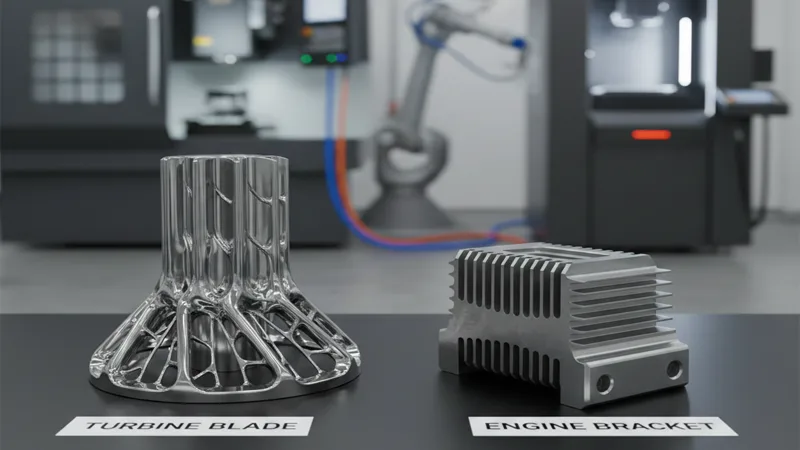
Impact: Hybrid manufacturing has revolutionized the production of lightweight, high-strength components. By integrating 3D printing, CNC machining, and robotics, manufacturers can produce complex parts like turbine blades and engine brackets with optimized strength-to-weight ratios.
Technologies:
- Composites: Enables the fabrication of specialized, lightweight structures for fuel efficiency.
- DED (Directed Energy Deposition): Utilized for adding features to existing parts and repairing high-value components (MRO).
AFI Parts Internal Case Study – Blisk Repair: In aerospace applications, an integrally bladed rotor (blisk) suffering from foreign object damage (FOD) traditionally required complete replacement—costing hundreds of thousands of dollars. Utilizing hybrid DED technology, we can mill away the damaged blade tip, precisely deposit compatible titanium alloy to rebuild the tip, and use 5-axis simultaneous milling to blend the repaired section back to the original airfoil profile within ±0.015mm, fully restoring aerodynamic efficiency.
Medical Devices
Impact: The technology is critical for producing patient-specific implants and surgical instruments. AM creates porous structures for osseointegration, while CNC machines the precise mating surfaces required for joint articulation. This capability allows for the economical production of custom, “batch-of-one” medical devices.
For example, a hip replacement stem can be printed with a trabecular titanium structure that mimics human bone to encourage cell growth, while the Morse taper that connects to the femoral ball must be precision CNC turned to guarantee a fluid-tight, mechanically sound lock.
Custom Tooling
Impact: Ideal for “High-Mix, Low-Volume” scenarios, hybrid manufacturing enables the rapid production of custom jigs, fixtures, and molds.
Conformal Cooling: It allows for the creation of molds with internal cooling channels that follow the part’s geometry—impossible with standard drilling—reducing injection molding cycle times. Traditional mold cooling relies on straight cross-drilled holes, which cool unevenly. Conformal channels printed close to the mold cavity surface dissipate heat uniformly, reducing part warpage and cutting cycle times by up to 30%.
Future Trends in Hybrid Manufacturing
As hardware and software ecosystems mature, hybrid manufacturing will transition from a niche solution to a foundational industrial process.
Emerging Technologies
- Advanced Hybrid Systems: The next generation of machines will feature enhanced multi-material capabilities, allowing for the creation of functionally graded materials (e.g., hard-wearing surfaces on tough cores). Imagine a gear where the core is printed from a tough, shock-absorbing steel, and the outer gear teeth are seamlessly transitioned into a highly wear-resistant cobalt-chrome alloy during the deposition process, all before being precision machined to AGMA standards.
- AI & Real-Time Monitoring: Artificial Intelligence and smart sensors will drive adaptive control, automatically adjusting parameters in real-time to maintain quality. High-speed acoustic emission sensors and melt-pool cameras will feed data into neural networks to detect micro-cracking instantly and alter laser power or feed rates on the fly.
Overcoming Challenges
To achieve widespread adoption, the industry must address key barriers:
- Technological: Developing broader material compatibility and standardized qualification processes. The industry needs comprehensive material databases mapping the machinability of printed alloys.
- Economic: Reducing the capital expenditure (CapEx) for hybrid cells. Currently, high-end hybrid machines represent multi-million dollar investments.
- Workforce: Upskilling engineers in both additive and subtractive disciplines. An operator can no longer be just a “machinist” or just a “3D printer technician.” They must understand metallurgical thermodynamics, multi-axis kinematics, and advanced metrology simultaneously.
- Strategy: Investment in digital workflow tools and comprehensive training programs is essential for leadership in this evolving field.
FAQ
Hybrid manufacturing is an integrated production method that combines Additive Manufacturing (3D Printing) and Subtractive Manufacturing (CNC Machining) within a single workflow. This approach allows for the fabrication of metal parts that possess both complex internal geometries and high-precision external tolerances. It represents the merging of growth and refinement in a single manufacturing setup.
Manufacturers utilize this technology to accelerate production cycles, reduce tooling costs, and minimize material waste. It is particularly effective for rapid prototyping and the production of custom, high-value components. By reducing the “Buy-to-Fly” ratio and eliminating multi-machine setups, lead times and TCO are drastically reduced.
While not universal, it is compatible with most industrial-grade metals, including Titanium (Ti-6Al-4V), Stainless Steel (316L, 17-4PH), and Aluminum. Material selection depends on the specific AM process (laser vs. electron beam) and application requirements. Certain reactive metals require highly controlled inert gas environments to prevent catastrophic oxidation during deposition.
It synergizes the strengths of both processes: 3D printing creates complex, optimized structures, while CNC machining refines surface roughness to engineering standards (Ra < 0.8㎛) and ensures dimensional accuracy. The subtractive phase eliminates stress concentrators and achieves the precise GD&T requirements necessary for mechanical assemblies.
Yes. By eliminating the need for expensive hard tooling (molds/dies), it significantly reduces the cost per unit for small batches, prototypes, and custom parts. The lack of upfront tooling amortization makes it the ideal solution for iterations and custom low-volume runs.
Key challenges include high initial equipment costs, limited material availability compared to traditional billet options, and the requirement for specialized workforce skills in both AM and CNC domains. Bridging the gap between software platforms and managing the thermal dynamics of a hot melt pool within a precision CNC environment remains an ongoing engineering hurdle.
At AFI Parts, our engineering team continuously monitors and integrates these advanced manufacturing technologies to ensure we deliver unparalleled precision and performance for your custom metal parts. Contact our engineering department for a detailed DfM review of your next complex component.