
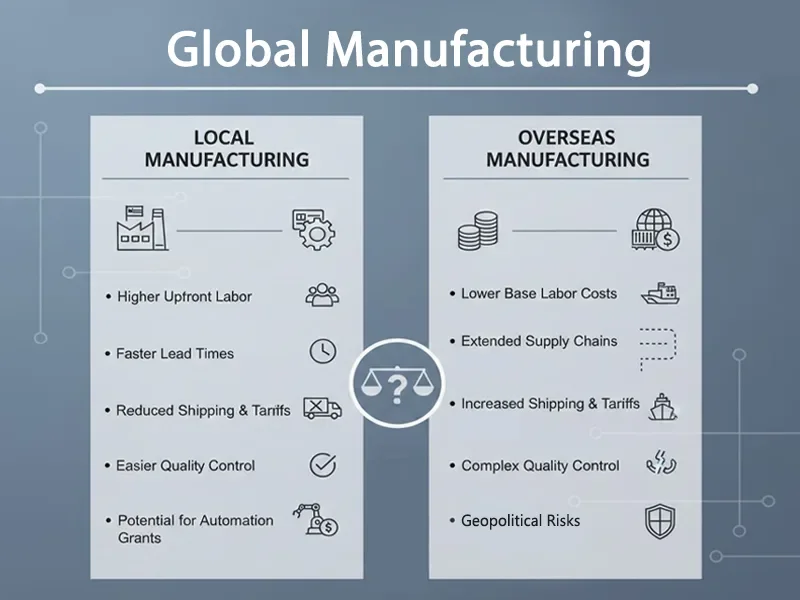
Choosing where to make products is now a hard problem in global manufacturing. The total cost of ownership is more than just the price of each item. Making things at home can look expensive. But when companies count all the hidden costs, like labor, building, and utilities, it can be better to make things locally.
For example, workers in the U.S. get paid about $36.38 each hour. This is much more than in China or Vietnam. Companies like Stanley Black & Decker and Apple had problems when they moved work back to the U.S. They faced higher costs, and things did not run smoothly. Strategic sourcing is now very important. It helps find these hidden costs and helps companies make better choices.
Key Takeaways
- Total Cost of Ownership (TCO) means all costs count. It is not just the price you pay for items. You must think about buying, using, and getting rid of things.
- Local manufacturing can look pricey at first. But overseas production has hidden costs. These can make it more expensive over time.
- Strategic sourcing helps companies find hidden costs. It helps them choose where to make their goods.
- Problems with quality and talking to suppliers can add hidden costs. You should always think about these when picking suppliers.
- Using data-driven ways helps companies track costs and how suppliers perform. This leads to better choices for sourcing.
- Companies should check sourcing plans often. This helps them keep up with market changes and stop surprise costs.
- Local sourcing helps the economy. It can also mean faster delivery and better control of quality.
- Automation in manufacturing can lower costs. It can make work faster and better. This makes it a smart choice for companies.
Table of Contents
Understanding Total Cost of Ownership
What Is TCO?
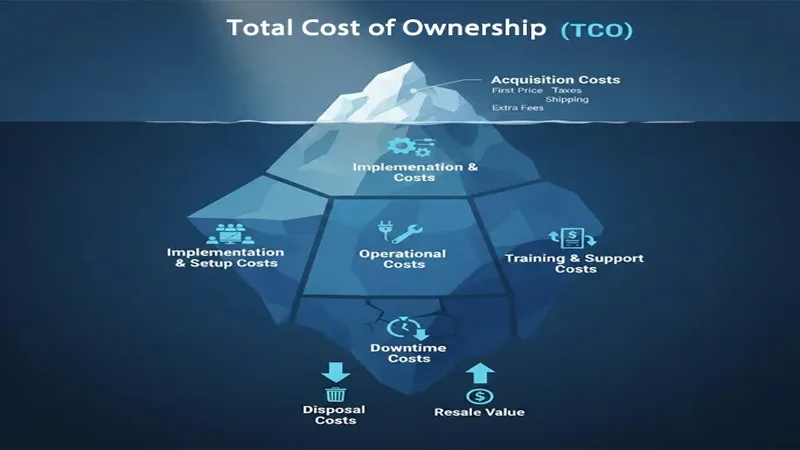
Total cost of ownership helps companies see all costs. It is not just about the price. In the context of precision metal parts manufacturing, TCO is a rigorous financial estimate intended to help buyers and owners determine the direct and indirect costs of a product or system. Companies must think about every step. This means buying materials and removing old equipment.
To formalize this for engineering applications, TCO can be expressed through the following mathematical model:
TCO = Cacq + Csetup + Cops + Cdowntime + Ceol + Crisk
Where:
- Cacq represents acquisition costs.
- Csetup represents implementation and setup costs.
- Cops represent operational costs.
- Cdowntime represents the cost of machine or supply chain downtime.
- Ceol represents end-of-life or disposal costs.
- Crisk represents the quantified cost of geopolitical, quality, and IP risks.
The main parts of the total cost of ownership are:
- Acquisition costs: This means the first price, taxes, shipping, and extra fees.
- Implementation and setup costs: These are costs for putting in or changing equipment. In CNC machining, this includes fixture design, CAM programming, and initial first-article inspection (FAI).
- Training and support costs: Companies pay to teach workers and help them use new tools.
- Operational costs: These are daily costs like energy and fixing things. For metal processing, CNC drilling cost, tooling wear, and coolant consumption are prime examples.
- Downtime costs: If machines stop, companies lose time and money.
- Disposal costs or resale value: This is the cost to remove old things or the money from selling them.
This way, companies see the real cost of making products around the world.
Why TCO Matters in Global Manufacturing
In the last ten years, the total cost of ownership has become more important. Many companies thought that making things overseas was always cheaper. Now, they know this is not always true. When procuring highly toleranced mechanical parts, the raw unit price heavily obscures the engineering overhead required to maintain quality. Shipping, tariffs, and quality problems can cost a lot. Risks to ideas and late deliveries can hurt profits.
Rules for the environment and people are stricter now. This can make costs go up. Strategic sourcing companies help businesses look at all these things. They help companies bring work back home. This helps companies avoid hidden costs and make better choices. Strategic sourcing companies help manufacturers see all costs, not just the price.
Expanding TCO Beyond Price
Many people think the lowest price is always best. This is not true. For product design engineers, selecting a CNC machining partner based solely on piece-price often results in costly redesigns and sub-optimal design for manufacturability (DFM) outcomes. Manufacturers look at more than just the price. They check costs for fixing, energy, training, support, downtime, and getting rid of things.
Some car makers have cut their long-term TCO by 25% by looking at these costs. Sourcing programs using total cost of ownership can save up to 30% in three years. This shows it is good to think about the future. Strategic sourcing companies help businesses avoid mistakes. They help companies not treat quality as the last step. They show that more technology does not fix every problem. They help companies manage risks and make better choices for the future.
Traditional vs. Modern Global Sourcing
Old Cost Drivers
In the past, global sourcing was about saving money. Companies made products in places with lower wages. This way was simple and focused on price. Businesses wanted cheap labor and materials. They did not think much about other things.
The main cost drivers in traditional global sourcing were:
- Lower labor costs in overseas markets.
- Reduced expenses for raw materials.
- Basic shipping fees.
- Simple supplier contracts.
This plan worked for some time. Many companies thought cheap labor meant more profit. But the market changed over time. Companies learned that cost was not the only thing to watch. They had to care about quality, supplier ties, and strong supply chains.
Limitations of Simple Comparisons
Comparing costs between local and overseas factories can miss key details. A simple quote for a turned shaft does not reflect the statistical process control (SPC) capabilities of the vendor. Many hidden costs can make overseas production cost more. Some of these hidden costs are:
- Shipping and customs duties.
- Rework or replacements for quality issues.
- Currency exchange fluctuations.
- Import taxes or compliance fees.
These costs can add up fast. They can make a cheap choice risky and costly. Companies also deal with delays and talking problems. Managing faraway suppliers is hard. Strategic sourcing companies help find these hidden costs. They help companies look past price and see the full effect on their work. Simple price checks do not show the real cost of global sourcing. Companies need to look at everything to make smart choices.
The Shift in Global Sourcing
Today, global sourcing is different. Companies use a big-picture approach now. They look at the total cost of ownership, not just the price per item. This means checking logistics, tariffs, inventory, and supplier skills. Teams from finance, legal, and product groups work together to study the supply chain.
Modern global sourcing includes:
- Working with strategic sourcing companies to check all costs.
- Using scenario planning for tariff changes and new rules.
- Financial modeling to track inventory and currency risks.
- Building supply chain strength by checking vendor reliability and logistics costs.
- Nearshoring to lower risks from far suppliers.
- Using technology and automation to make supply chains faster and more flexible.
Global manufacturing is not just about the lowest price now. Companies must build strong and flexible supply chains. Strategic sourcing companies are important in this change. They help businesses make better choices and keep up in a fast-changing world.
Direct and Hidden Costs in Global Manufacturing

Labor and Materials
Labor and materials are the highest costs in global manufacturing. Companies usually look at these costs first when picking a place to make things. Labor costs are different in each country. Material prices also change based on where they come from and how much is needed.
The proportion of total costs for direct materials is 50-70%. The proportion of total costs for direct labor is 10-30%.
Most money in manufacturing goes to materials and paying workers. However, the cost of raw alloys (like 6061-T6 aluminum or 316 stainless steel) fluctuates globally. Companies need to find the lowest real cost per part. They should not just pick the cheapest labor or materials. If they only look at price, they might miss hidden costs that hurt profits later. Good supply chain management helps companies balance cost, quality, and reliability.
Logistics and Supply Chain Costs
Logistics and supply chain costs can be very different based on where things are made. Shipping goods from other countries can add many extra costs. These costs include shipping, storing, and handling products. Local sources may cost more but can lower risks and delays. Logistics and supply chain costs are different for local and overseas manufacturing.
Local options usually cost more. Changing supply chains can raise capital and operating costs. Shipping costs can go up fast if fuel prices rise or if there are shipping problems. Companies also need to think about how moving goods far affects the environment. Good risk management in supply chains helps avoid surprises and keeps production steady.
Tariffs and Trade Barriers
Tariffs and trade barriers can add high costs for companies buying from other countries. These extra fees can make things overseas less appealing.
- Tariffs raise import costs.
- Supply chain disruption leads to more logistics costs and delays.
- Strategic sourcing adjustments lead to higher total production costs.
Companies that sell a lot in the U.S. face more risks from tariffs. Profits can change a lot, with EBITDA margins going from -6% to almost 14% depending on the industry and supply chain. It is important to check all costs. This means looking at tariffs, shipping, inventory costs, and supply chain risks. Companies that do this can make better choices and avoid problems in production.
Quality and IP Risks
Quality problems and IP risks can cost companies a lot. In precision machining, a deviation of a few microns can render a part useless. Making products overseas often means extra steps to keep the quality good. These steps take more time and money.
To mathematically assess the Cost of Poor Quality (COPQ), quality inspection personnel use:
COPQ = Cinternal_failure + Cexternal_failure + Cappraisal + Cprevention
Hidden costs from quality problems include:
- Third-party inspection services: Needed to check product quality from far away.
- Increased documentation and compliance requirements: More paperwork is needed to follow the rules.
- Training and continuous communication about quality expectations: Suppliers need training and reminders about quality.
Companies pay for inspections to make sure products are right. They also do more paperwork to meet the rules in each country. Training suppliers and talking about quality takes time and money. If products are not good enough, companies must fix or replace them. This can slow down shipping and make customers unhappy.
IP risks are bigger with suppliers in other countries. It is harder to keep company secrets safe. Designs and trade secrets can get copied or used the wrong way. These problems can make companies lose sales and hurt their reputation. It is harder to keep secrets with suppliers in other countries. There is a big risk of designs being copied or used incorrectly. Quality and IP risks do not always show in the first price. They can cause big problems later. Companies need to think about these risks when picking where to make things.
Communication and Coordination
Good communication and teamwork are very important in global manufacturing. When discussing GD&T (Geometric Dimensioning and Tolerancing), clarity is non-negotiable. Teams in different countries and time zones can have misunderstandings. These problems can slow down work and cost more money.
Main costs from communication and teamwork problems include:
- Volatile commodity pricing: Makes buying materials cost more and harder to plan.
- Geopolitical instability: Can make suppliers hard to find and cause delays.
- Resource shortages: Make labor cost more and raise project costs.
- Regulatory changes: Bring new rules and surprise costs for projects.
- Market uncertainty: Makes it hard to plan money and spending.
- Coordination among stakeholders: Needed to control costs and stop arguments or delays.
- Financial volatility and inflation: Make costs change fast, so companies need good planning.
Teams must work together to handle these risks. They need to share news fast and fix problems quickly. Bad teamwork can mean missed deadlines, higher shipping costs, and even legal trouble. Companies spend money on better tools and training to help teams talk well. Good teamwork keeps projects moving and lowers hidden costs. Having regular meetings and clear jobs helps teams avoid mistakes and save money in global manufacturing.
Local vs. Imported Sourcing Analysis

Comparing Local and Imported Raw Materials
Companies must pick between local and imported materials. Each choice has good and bad sides.
The main differences in cost and impact are:
- Production Costs: Local sourcing has higher labor costs, smaller economies of scale; imported has lower costs from large-scale production and lower wages.
- Transportation & Lead Time: Local has lower cost, faster delivery times; imported has higher shipping costs, longer delivery, and customs delays.
- Quality Control: Local is easier to oversee, better consistency; imported is harder to monitor, quality may vary.
- Supply Chain Risk: Local is lower and more stable, fewer global shocks; imported is higher exposure to geopolitical and logistical disruptions.
- Environmental Impact: Local has reduced carbon footprint, shorter transportation; imported has higher emissions from long-distance shipping.
- Local Economic Impact: Local supports domestic jobs, strengthens the local economy; imported has limited benefit to local job creation.
- Brand & Consumer Value: Local appeals to ethical consumers, builds national brand identity; imported products may lack local relevance for sustainability-minded buyers.
Local sourcing helps companies control quality and delivery. Imported sourcing can save money, but it brings more risk and less control.
Supply Chain Risks and Resilience
Supply chain strength is very important in global sourcing. Local sourcing makes supply chains steadier and less likely to break. Here are some key points:
- Local sourcing makes supply chains stronger and safer.
- Imported sourcing brings more risks, like shipping delays and politics.
- Local suppliers often cost more for labor and overhead.
- Local suppliers may not make products as fast as overseas ones.
- Shipping from other countries takes longer and can cause problems.
- Every country has its own import and export rules.
- Bad weather and world events can stop shipping routes.
Good planning helps companies deal with these problems. Companies using local sourcing often fix issues faster and keep things running.
Business Impact of Sourcing Choices
Sourcing choices change how businesses operate in global markets. Companies using local sourcing build stronger brands and help their own economy. Companies using imported sourcing may save money and grow fast, but face more risks.
Real examples of how sourcing choices change business results:
- Importantly, saved money and kept production steady for many materials.
- Whiskey Towers: Entered the market faster and saved thousands by smart sourcing.
- Frawgs: Got better profits and worked faster by talking with suppliers and checking quality.
- 420seven: Grew quickly and led the market by improving sourcing and prototyping.
Global sourcing helps companies grow without limits. Using many suppliers lets companies make more products fast. Having different suppliers also lowers risks and keeps supply chains strong. Companies that use both local and imported sourcing often do best in managing risks and growing their business. Companies should check their sourcing plans often to keep up with new risks and market changes.
Strategic Sourcing and TCO Decision-Making
Role of Strategic Sourcing Companies
Strategic sourcing companies help manufacturers make smart choices. They do more than look at the price of materials or labor. These experts use a careful plan to see all costs.
Strategic sourcing companies:
- Gather information from different teams, like buying, making, and fixing things.
- Study costs that are not just the price, like shipping, storing, and checking quality.
- Help companies spot risks, such as late shipments or supplier problems.
- Try to save money over time, not just on one order.
With these steps, strategic sourcing companies help build strong supplier networks. They make sure companies do not miss hidden costs when choosing suppliers. Their help leads to better buying plans and stronger business results.
Reshoring Driven by TCO
Reshoring means bringing factories back to the home country. This is happening more because companies now look at every cost, not just the lowest price. Many companies used to think that buying from other countries was always cheaper. But studies show only 30% of companies check all costs before picking suppliers. This means they often guess wrong and miss 20% to 30% of the real costs.
A good cost plan can help bring back up to $200 billion in factory work. For example, Morey Corporation saw that even though U.S. circuit boards cost more, the total cost was less than buying from overseas. This helped them win a $60 million deal. Another company, Miles, saved 17% by making products in the U.S. instead of sending work abroad. These stories show that reshoring can make companies stronger and help them compete.
Partnering with Domestic Suppliers
Working with local suppliers gives many good things to manufacturers. Local sourcing means parts come in days, not weeks. Teams talk better because they share the same time zone and language. Local sourcing also makes supply chains stronger and less likely to break. Companies can check quality more easily by visiting nearby suppliers.
The main benefits of local sourcing:
- Reduced Lead Times: Faster delivery of parts and materials.
- Better Communication: Fewer mistakes and faster problem-solving.
- Stronger Supply Chains: Less risk of delays or disruptions.
- Easier Quality Checks: Direct visits and audits are possible.
- Lower Overall Costs: Savings from fewer delays and better quality.
Local sourcing may cost more for each part, but it often saves money in the end. Companies that use local suppliers build better relationships and can react fast to market changes. This helps manufacturers stay ahead and keep their business strong.
Technology and TCO Optimization
Digital Tools for TCO
Manufacturers use digital tools to see all costs. These tools show more than just material prices. They help companies compare choices in global sourcing.
Tools for total cost of ownership analysis:
- Should-Cost Modeling: Estimates fair pricing based on cost breakdowns.
- Activity-Based Costing (ABC): Assigns indirect costs based on usage.
- Value Stream Mapping (VSM): Identifies waste and inefficiencies across production.
- Lifecycle Cost Analysis (LCCA): Evaluates total costs from start to end-of-life.
These tools help companies spot hidden costs and make smart choices. They also help teams share clear information and work together.
Data-Driven Sourcing Decisions
Data-driven decisions change how companies buy things. Companies use real-time data to check suppliers and track spending. This helps them fix supply chains and lower costs.
Ways data-driven sourcing helps manufacturers:
- Real-time supply chain data shows how suppliers are doing.
- Looking at the total cost of ownership saves money at each step.
- Teams work better with open processes and digital bids.
Companies also use data to:
- List every cost, not just the price per item.
- Compare how suppliers do in different places.
- Find hidden costs in contracts and bad plans.
- Use real facts instead of guessing.
With these steps, companies can cut extra vendors by 20%, spend 30% less off-contract, and save up to 12% each year. Data-driven sourcing makes global sourcing safer and helps companies avoid problems. Using data helps companies choose the best suppliers and keep costs low.
Automation in Global Manufacturing
Automation changes how factories work everywhere. Inprecision machining, CNC robotics, and pallet pools represent a massive shift in OEE (Overall Equipment Effectiveness). Machines and robots do jobs people did before. This lowers labor costs and makes factories run better. Automation also cuts waste and stops machines from breaking down, which saves money.
Automated systems usually cost less over time than manual work. They can grow with the company without needing more workers. This helps companies avoid extra costs later.
- Automation lowers labor costs.
- It cuts waste and stops downtime.
- Automated systems cost less over time.
- Companies can grow without hiring more people.
Automation helps companies stay strong in global sourcing. It lets them make products faster and with fewer mistakes.
Building a Holistic TCO Framework
Steps for TCO Evaluation
A good framework helps companies see every cost. Leaders in manufacturing use a step-by-step process to check costs from start to finish.
The main steps for a full evaluation:
- Define Scope & Objectives: Set the goal for the review. Decide what choice you need to make. Think about how long it will last. Pick which costs to look at.
- Gather Direct Costs: Collect all costs you can see right away. These are things like buying price, fees, setup, and training.
- Capture Indirect Costs: Find costs that are not easy to see. These can be lost time, less work done, risks, and missed chances.
- Choose the Right Metrics: Use tools like Net Present Value (NPV), Return on Investment (ROI), and payback period to measure value.
- Visualize Data Effectively: Show the data in charts or tables. This makes it easier to spot important findings and share them with others.
Clear data helps teams make better choices and avoid costly mistakes.
Cross-Functional Teams
A full approach needs help from many experts. Cross-functional teams bring people from different jobs together. Each person adds something special to the cost review.
- Design and manufacturing engineers: Give important data for cost details, like CAD files and process steps.
- Procurement cost specialists: Share what they know about suppliers and prices for better cost guesses.
- Finance and controllers: Check the total cost of ownership and make sure it matches budgets and goals.
- Product managers and operations leads: Match cost goals with product plans and market needs.
These teams look at the whole money story. They think about shipping, customs, and how easy it is to fix products. Working together helps companies see value over time, not just the first price. Teams that work together make smarter decisions. They help companies avoid surprises and plan for the future.
Scenario Planning
Scenario planning gets companies ready for change. Leaders use this tool to test how choices affect costs. They ask, “What if shipping costs go up?” or “What if new rules change things?” Teams build models to see how each scenario changes the outcome.
Scenario planning helps companies spot risks early. It shows how costs change if something unexpected happens. Teams can adjust plans before problems grow. Regular scenario planning keeps companies ready for new challenges in global manufacturing. A full framework gives companies a clear view of all costs. It helps them stay strong, flexible, and ready for the future.
Actionable Guidance for Manufacturers
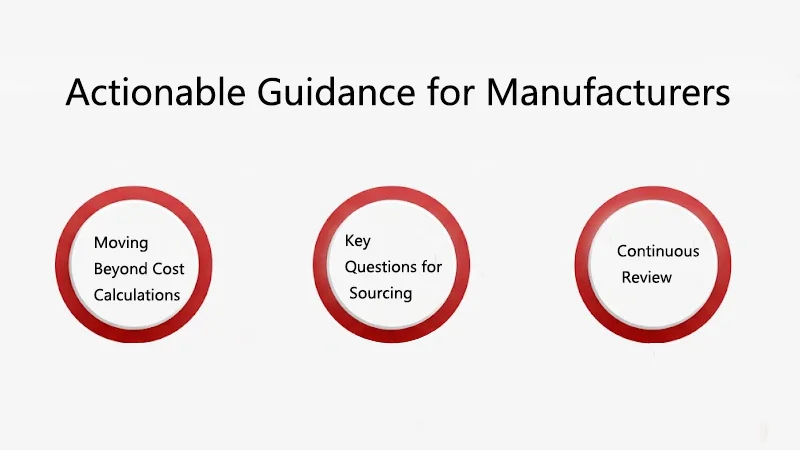
Moving Beyond Cost Calculations
Manufacturers should look at more than just cost. A good procurement strategy uses data, teamwork, and better processes. Teams need to think about more than price. They should also look at quality, risk, and long-term value.
Make a team with people from engineering, finance, and operations. This helps find new ways to source locally or from other countries. Focus on the most expensive parts of your best-selling products. Use design for manufacturing to make things simpler and cheaper. Build and test samples before making lots of products. This makes sure things work well, and customers are happy.
A strong procurement plan also has these steps:
- Collect and organize all your spending records.
- Study the market and list possible suppliers for local sourcing.
- Make a model to compare all costs, not just the price.
- Use data to ask suppliers the same questions and compare answers.
- Set clear goals, check progress, and keep improving.
Local sourcing can cut shipping costs, help teams talk better, and lower risks.
Key Questions for Sourcing
Manufacturers should ask important questions before picking suppliers. These questions help find hidden costs and risks. They also help plan better for local sourcing and reshoring.
- Over ten to twenty years, how do costs split between capital, energy, maintenance, labor, and downtime?
- How does the vendor show costs? Do they use real examples and life cycle plans, or just give one price?
- What parts wear out or get used up, and how often?
- How long does it take to do maintenance?
- Can you fix things without special tools?
- What is the vendor’s service network like?
- How fast can they help, and are parts easy to get?
These questions help companies compare local and imported sourcing. They also show why working with nearby suppliers can be better.
Continuous Review
Checking sourcing choices often is important for long-term success. Companies that review their choices can handle market changes. This helps keep supply chains strong and supports local sourcing and reshoring.
Regular checks help plan budgets and use resources better. They help find new ways to save money over time. Knowing real costs and risks helps companies get better deals with suppliers. Reviewing often makes work smoother and raises profits. It helps companies make smart choices and stay ahead. Local sourcing also helps the environment and supports local communities.
Manufacturers who follow these steps can build a strong and flexible procurement plan. They can react fast to changes and keep their business healthy. Total cost of ownership helps companies make better choices in global manufacturing. Companies now know that price is not the only thing that matters.
Some recent stories show how things are changing:
- A food-and-beverage company had trouble because of hidden system costs.
- Pump B costs more at first, but it saved 30% over five years. This happened because it used less energy and needed fewer repairs.
Manufacturers should use a full TCO framework and strategic sourcing. This way, they can avoid surprises and do well for a long time.
FAQ
TCO lets companies see every cost, not just price. This helps them make smarter choices and earn more money. It also stops surprises from the costs they did not expect.
TCO shows the true cost for each choice. Companies can look at risks, quality, and how fast things arrive. This helps them choose the best supplier for what they need.
Yes, hidden costs matter a lot. Things like shipping delays, tariffs, and bad quality can add up quickly. If companies ignore these, they can lose money and slow down work.
Yes, small companies can use TCO too. They can use easy tools and checklists. This helps them avoid mistakes and save money, even if they have less to spend.
Automation usually makes TCO lower. Machines help cut labor costs, waste, and make better products. This means making things is faster and more dependable
Companies should check TCO at least once every year. Checking often helps find new problems and keeps costs from getting too high.