
Introduction
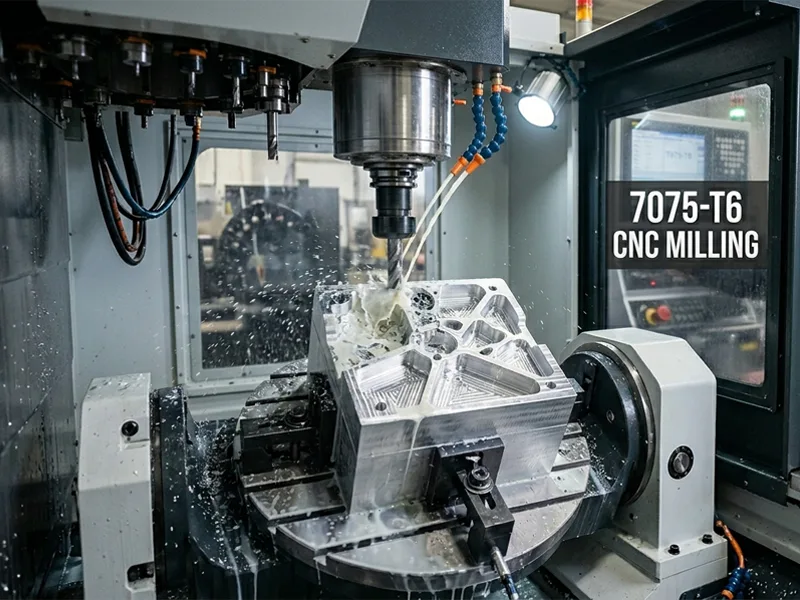
This guide is for aerospace engineers and procurement teams running (or sourcing) 7075-T6 CNC milling programs—especially when the part has thin walls, deep pockets, or tight GD&T that must survive finishing and FAI.
You’ll learn how to set practical parameter windows, control part movement, plan finishing allowances, and build inspection evidence that holds up in an AS9102 package.
Use it as a checklist to define process windows on the traveler, quote more accurately, and plan builds that are FAI-ready on the first attempt. The focus throughout is repeatability, inspection evidence, and total cost—not hero machining.
Table of Contents
7075-T6 behavior and DFM
Engineers often pick 7075-T6 for stiffness and strength, but the machining plan has to account for stress relief, thin-wall deflection, and finishing stack-ups—otherwise the part can meet size “in the vise” and miss it on the bench.
Machinability and residual stress
7075-T6 is strong for its weight, but that same strength usually comes with residual stress in the starting stock (especially plate). As you remove material, the stress field rebalances, and the part can “move” between setups, between rough and finish, or even after it’s unclamped.
In practice, distortion shows up as:
- Flatness/parallelism drifting after final unclamp
- Pocket floors “oil-canning” and walls tapering
- Datums shifting, causing a GD&T cascade even when individual features look acceptable
Treat residual stress as a process variable, not a one-time surprise. Your process plan should explicitly control when stress is released (sequencing), and your inspection plan should prove that the part is stable at the point you measure it.
Thin-wall and pocketed geometries
Thin walls and large pocketed regions amplify deflection and vibration. Thin-wall milling research on a 7xxx-series aerospace alloy shows deformation sensitivity rises quickly as wall thickness drops; in that study context, walls below about 1.5 mm were much more prone to post-machining deformation under deep axial engagement, while thicker walls were more stable (see the thin-wall milling analysis in thin-wall milling research (PMC)).
Practical implications for aerospace housings, frames, and structural brackets:
- Long, unsupported walls are a chatter risk and a dimensional-risk multiplier.
- Deep pockets drive long tool overhang, which increases tool deflection and worsens surface finish.
- Thin ribs create local thermal gradients—parts can spring open after finishing passes.
DFM adjustments for stability
A few small drawing-level choices can materially reduce total cost and rework risk:
- Minimum wall guidance: Where design allows, avoid ultra-thin walls in long spans. If a thin wall is unavoidable, define which faces are functional and which can float.
- Corner radii in pockets: Larger internal radii allow stronger tools (less deflection) and reduce stress concentration in the part.
- Datum strategy that matches fixturing reality: Make sure primary/secondary datums can be repeated across setups without fragile contact points.
- Explicit finishing notes: Call out whether final dimensions are pre-finish or post-finish (especially for anodize), and where masking is required.
Key Takeaway: For 7075-T6, the easiest way to “buy” tolerance capability is to reduce instability (residual stress + deflection), not to demand tighter machine numbers.
Tooling, parameters, and chip control
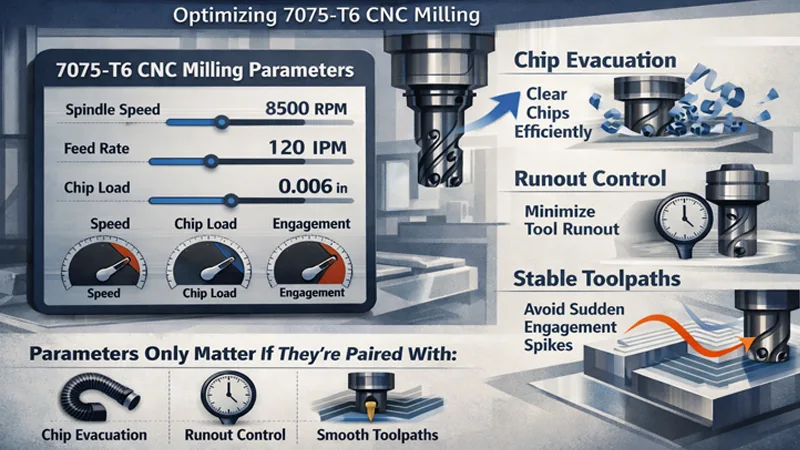
This section includes an initial 7075-T6 CNC milling parameter window you can tune during prove-out (speed, chip load, engagement) and the control levers that keep it repeatable.
In 7075-T6 CNC milling, parameter recommendations only matter if they’re paired with chip evacuation, runout control, and a toolpath that avoids sudden engagement spikes.
Flute count, geometry, and coatings
For 7075-T6, chip evacuation and edge condition tend to decide whether a run is stable.
A practical starting point:
- Flute count: 2–3 flutes are common in aluminum; too many flutes can restrict chip space at high RPM. Harvey Performance notes that higher flute counts can make chip evacuation difficult at aluminum cutting speeds, while 2-flute tools are traditional and 3-flute tools often perform well for finishing and can also rough with the right conditions (Harvey Performance aluminum machining guide, 2018).
- Helix and vibration control: Variable helix / variable pitch is often worth it when thin walls and long reach are involved.
- Coatings: Coatings like ZrN and TiB2 are commonly used in aluminum applications, depending on chip-welding risk and desired tool life (per the same Harvey guidance).
Keep the goal simple: stable cutting with predictable chip evacuation. If chips recut, everything downstream gets harder—surface finish, size control, and tool life.
Speeds/feeds windows for 7075-T6
This section gives the initial 7075-T6 machining parameters you can tune during prove-out. Always validate against machine limits, toolmaker recommendations, and your specific geometry risk.
A defensible way to set an initial window is to start broad and tighten based on your machine rigidity, tool reach, and geometry risk.
Harvey Performance’s guidance for wrought aluminum alloys (including 7075) recommends 800–1500 SFM as a surface-speed window (Harvey Performance aluminum machining guide, 2018). Use that range as a starting band—not a promise.
For quoting and process planning, a practical way to communicate this is to specify a 7075-T6 machining parameter window on the traveler (speed range + target chip load band + engagement limits) rather than locking a single feed/speed number on day one.
Then constrain further by:
- tool diameter and stick-out
- corner engagement (pockets, blends)
- thin-wall proximity (finish walls last, with light radial engagement)
- machine spindle power and dynamic stability
High-speed strategies and runout
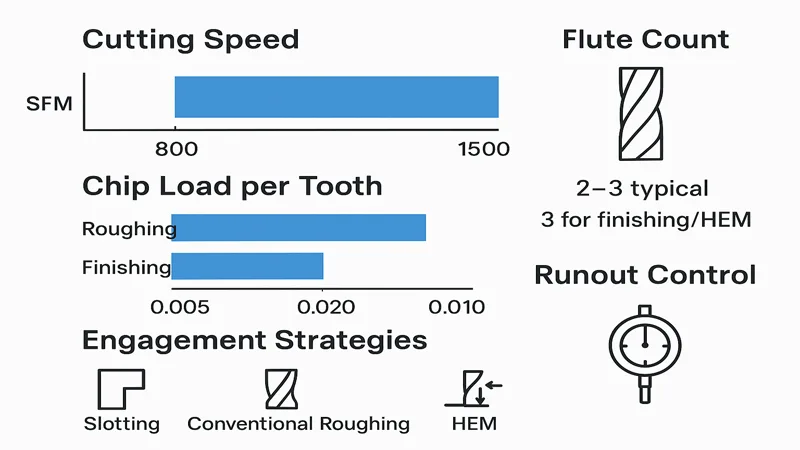
High-speed and HEM-style toolpaths can stabilize 7075-T6 milling when they keep chip thickness consistent.
Key control levers:
- Engagement control: Prefer low radial engagement with higher axial engagement where geometry permits (HEM concept).
- Runout discipline: Treat runout as a first-order variable. Excess runout increases peak chip load on one flute, driving chatter and uneven wear.
- Chip evacuation: Don’t rely on “more RPM” to solve chip problems. Clear chips with an air/coolant strategy and tool geometry first.
Fixturing, distortion, and sequencing
Workholding and support methods
For aerospace housings and pocketed parts, workholding is often the “hidden process” that determines whether the final CMM report is boring (good) or painful.
Common approaches, chosen by geometry:
- Soft jaws/custom nests to spread clamping load and avoid point-contact deformation
- Sacrificial plates and perimeter support to keep pocket floors stable during roughing
- Vacuum or adhesive fixturing for thin plates when mechanical clamping distorts features
- Fill/support (wax, low-melt alloy, polymer) when machining thin ribs that otherwise ring or deflect
Pick a strategy that makes your datums repeatable between setups and avoids re-clamping distortion.
Thin-wall milling techniques
A few practices reduce wall movement without adding a lot of cost:
- Leave finishing stock intentionally on thin walls and finish them late, after the part is mostly balanced.
- Control tool reach: minimize stick-out; use a larger diameter tool where the corner radius allows.
- Avoid full-width slotting near final walls; if slotting is unavoidable, reduce engagement and give chips a way out.
Thin-wall studies also point to the value of sequencing and stress release: literature cited in thin-wall milling research describes removing the part from the clamp after roughing to release residual stress, then re-clamping for finishing.
Rough–stress-relieve–finish
A repeatable pattern for 7075-T6 aerospace parts is:
- Rough to near-net while maintaining symmetric material removal.
- Stress-relieve / stabilize (time, temperature cycle when applicable, or at least a controlled dwell) before the final critical cuts.
- Finish critical datums/features in a stable state with controlled engagement.
AFI Industrial Co., Ltd. (AFI Parts) typically controls process windows with setup-specific parameters, supports AS9102-ready inspection packs, and coordinates Type II/III anodize suppliers so machining allowances and masking are planned before FAI.
Tolerances, GD&T, and AS9102
Aerospace tolerance targets
Aerospace tolerance expectations vary by function and interface, but two patterns show up repeatedly:
- Tight positional tolerances on hole patterns that define assembly alignment
- Flatness/parallelism on sealing faces or bearing seats
To keep quotes realistic, separate:
- geometry-driven capability (thin walls, long reach, pocket density)
- metrology-driven requirements (how you’ll verify, at what temperature, with what datum simulation)
In-process probing, SPC, CMM
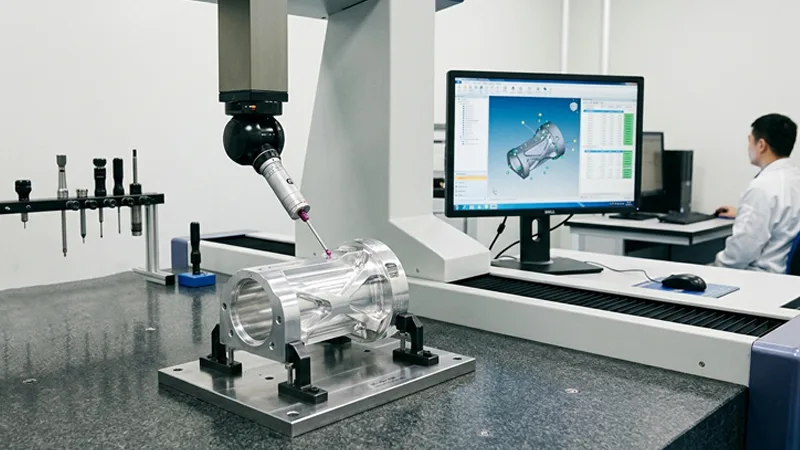
If you want repeatability, you need evidence that the process is stable—not just a final pass/fail.
A practical control stack:
- In-process probing to detect drift between operations and protect critical datums
- SPC on key characteristics (e.g., positional tolerance, bore size, flatness surrogate checks)
- CMM validation for final characteristics, with clear datum alignment notes
This is also where procurement gets real leverage: require a supplier to state what they’ll probe in-process versus what they’ll only measure at final inspection.
AS9102 FAI documentation
AS9102 isn’t just a formality; it’s a traceability structure.
A commonly used breakdown (per 1factory’s AS9102 FAI guide) is:
- Form 1: Part number accountability (what configuration was built)
- Form 2: Material and special processes + functional testing (what the part is made from and what processes were applied)
- Form 3: Characteristic accountability tied to a ballooned drawing (what was measured, how, and what the results were)
To avoid a late-stage scramble, align early on:
- ballooning rules (what gets bubbled: notes, surface finish, plating/anodize callouts)
- gage strategy and calibration traceability
- How special processes (anodize, chem film) will be certified and attached
Pro Tip: If anodizing is required, treat it as part of the FAI plan—not “post-processing.” Many AS9102 delays come from missing process certifications or unclear post-finish dimensions.
Surface finish and anodizing allowances
Ra targets and finish levers
Surface finish is driven by both tool mechanics and chip behavior.
Common finish levers:
- Reduce radial engagement on finishing passes
- Use a stable finishing tool (short stick-out, sharp edge condition)
- control vibration (variable helix, toolpath smoothing)
- keep chips out of the cut (air blast/coolant and effective evacuation)
When Ra is critical on functional faces, explicitly define:
- measurement direction and sampling length
- whether anodizing is applied (and whether post-anodize Ra is inspected)
Type II/III growth and planning
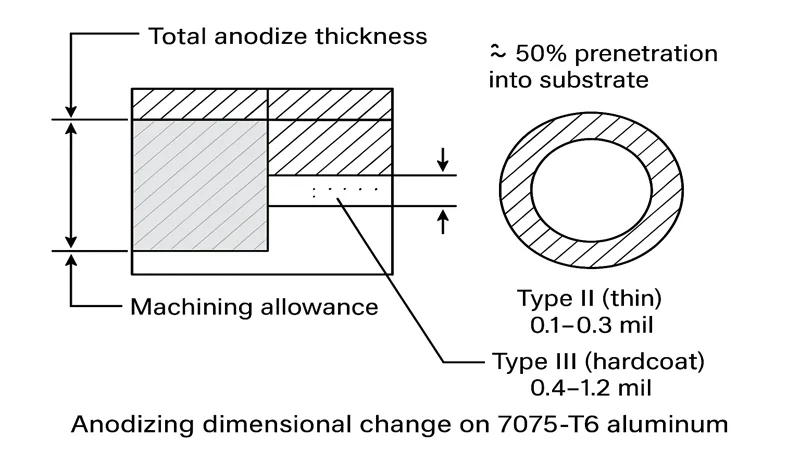
Anodizing changes dimensions. If you don’t plan it, you’ll “lose” tolerance during finishing.
One common rule of thumb is that roughly 50% of anodize thickness builds outward and 50% penetrates the substrate, so total coating thickness doesn’t translate 1:1 into size change on every surface. A practical explanation and examples are summarized in Okdor’s note on the Type III anodizing dimensional-change rule (2025).
The key is to decide upfront:
- Which dimensions are controlled pre-finish vs post-finish
- whether masking is required on fits, threads, and electrical contacts
- whether any surfaces will be machined after anodizing (rare, but sometimes necessary)
Masking and fit strategies
Masking is a technical choice with cost and lead-time consequences. Use it where it protects function, not as a blanket fix.
Common masking candidates:
- threads
- press-fit bores
- bearing seats
- grounding features
For fits, treat anodize as part of the tolerance stack. If two mating parts are both anodized, your clearance shrinks on both sides.
Key takeaways
- 7075-T6 milling success is usually determined by stability controls (stress release, fixturing support, runout, chip evacuation), not by chasing a single “perfect” feed/speed.
- Treat speeds/feeds as a window tied to engagement and tool reach; lock the window with inspection evidence during prove-out.
- If the part is thin-wall or deeply pocketed, plan sequencing (rough → stabilize → finish) before you quote.
- Plan finishing early: Type II/III anodize can change dimensions and may require masking or pre-size allowances.
- AS9102 readiness is easier when probing/SPC and special-process certificates are planned as part of the traveler.
Conclusion
Stable 7075-T6 CNC milling for aerospace comes down to disciplined control of variables that are easy to ignore: residual stress release, chip evacuation, runout, and inspection traceability.
- Key takeaways: stable parameters, chip control, fixturing, and inspection discipline
- Set a defensible parameter window (speed/engagement) and tighten it by geometry risk.
- Engineer chip evacuation and runout control early; they drive surface finish and tool stability.
- Sequence for stability: balance roughing, allow stress to relax, then finish critical features.
- Build inspection evidence as you go (probing + SPC), then formalize it into an AS9102 package.
- Next actions: align tolerances/FAI scope, confirm finishing allowances, and pilot a 7075-T6 run
- Confirm which dimensions are post-finish, how anodize thickness will be specified, and what gets masked.
- Define the AS9102 scope (forms, ballooning rules, special-process certificates) before you cut metal.
- Run a pilot build to validate the process window and produce an inspection pack that procurement can reuse across programs.
If you’re evaluating suppliers for a 7075-T6 program, start by reviewing their CNC milling scope and documentation approach, then align on the evidence you’ll need at FAI: AFI Parts CNC milling and AFI Parts’ certification/documentation context.
FAQ
This is primarily due to residual stress rebalancing. 7075-T6 plate stock contains internal stresses that are released as material is removed. To maintain flatness and parallelism, the process must include a “Rough–Stabilize–Finish” sequence, allowing the part to move and relax before the final critical cuts are made.
Stability is key. You should:
- Leave intentional finishing stock and finish thin walls late in the cycle.
- Minimize tool stick-out to reduce deflection.
- Use light radial engagement with higher axial engagement (HEM) to reduce lateral pressure that causes “spring-back.”
A defensible starting window is 800–1500 SFM (Surface Feet per Minute). However, this should be treated as a “parameter window” rather than a fixed number. Actual rates must be tuned based on tool diameter, reach, and machine rigidity to avoid chatter and ensure repeatable FAI results.
In 7075-T6, recutting chips is a leading cause of poor surface finish (Ra) and tool wear. Using 2–3 flute tools provides more space for chips to escape. Combined with high-pressure coolant or air blast, effective evacuation prevents “chip welding” and ensures the part meets aerospace Ra requirements.
You must plan for the “50/50 Growth Rule.” Roughly 50% of the anodize coating builds outward, while 50% penetrates the substrate. It is critical to define upfront whether drawing dimensions apply pre-finish or post-finish, and to use masking for critical fits, threads, or electrical grounding points.
Beyond meeting dimensions, an AS9102-compliant package requires a complete evidence chain:
- Form 1: Part accountability.
- Form 2: Material certs and special process (Anodize) certs.
- Form 3: Characteristic accountability tied to a ballooned drawing. Integrating in-process probing and SPC (Statistical Process Control) into the traveler provides the necessary data for a seamless FAI.
Small changes can drastically reduce cost and risk:
- Larger corner radii: Allows for shorter, more rigid tools.
- Standardized Datums: Ensuring primary/secondary datums are accessible across all setups to prevent “datum shift.”
- Wall Thickness: Avoiding ultra-thin walls on long spans where design allows, which reduces the need for expensive specialized fixturing like wax or polymers.