
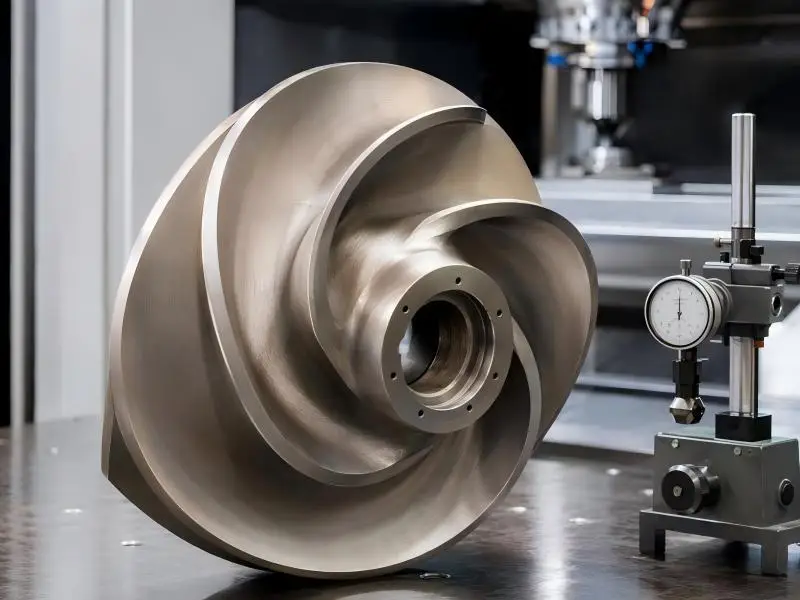
When it comes to duplex 2205 pump impellers casting, you are not making a simple commodity buy. It is a critical-to-quality process for a rotating part where the material grade, casting route, heat treatment, machining stock, balancing, and inspection documentation all have to line up before you compare price. On paper, 2205 looks like a simple upgrade from 316, but the metallurgy and machining behave differently, and the supplier who understands that difference is the one worth awarding.
This guide walks through what to specify, what to ask a foundry-and-machine-shop partner for, and how to separate a qualified supplier from one that just quotes stainless. If you are preparing an RFQ for custom 2205 pump impellers, this is your evaluation framework.
Key Takeaway: Treat a custom 2205 impeller as an engineered casting + machining program, not a commodity. Lock the grade, casting route, heat treatment, inspection scope, and acceptance criteria in the RFQ before discussing price.
Table of Contents
Why 2205 for Pump Impellers
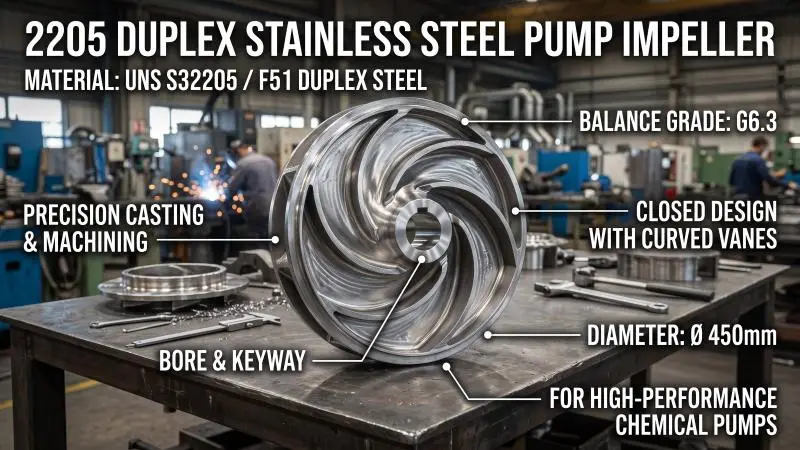
Duplex 2205, also written as UNS S32205 (with S31803 as the earlier designation), has a near 50/50 austenite–ferrite microstructure. That dual structure gives it roughly twice the yield strength of 316L, together with strong resistance to chloride stress-corrosion cracking. Rolled Alloys’ 2205 specification lists the governing ASTM forms and the A923 microstructural check for duplex. For pump service in seawater, chlorinated process streams, or fluids carrying moderate solids, 2205 often outlasts the standard austenitic grades and can beat bronze or cast iron on replacement frequency.
The practical trade-off worth weighing is cost and manufacturability versus corrosion and strength. 2205 is generally more expensive than 316 and harder to machine, so it is not the right default for every pump. It earns its place when the duty cycle involves chlorides, higher strength, or erosion–corrosion where a cheaper impeller would fail and drive up downtime. If the environment is mild, a less expensive grade is often the smarter call, which is why the needs assessment comes first.
Pro Tip: Before shortlisting suppliers, write down the actual service conditions — chloride level, temperature, solids loading, and duty cycle. A supplier that asks about these before quoting is a better partner than one that quotes 316 and lets you discover the difference later.
Casting Route Decisions
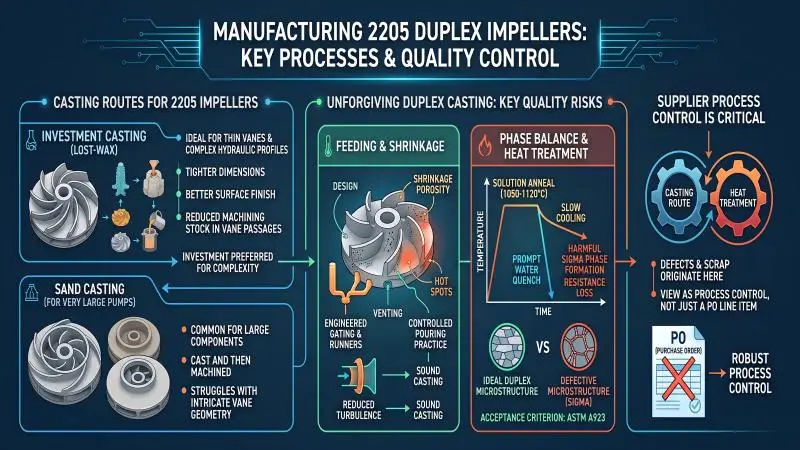
Most impeller vanes are thin, and the flow passages are complex, which is why investment casting (lost-wax) is the common route for 2205 impellers. Investment casting holds tighter dimensions and better surface finish on intricate hydraulic profiles than sand casting, so it typically reduces machining stock on the vane passages. For very large pumps, cast construction is common too — the impeller and diffuser are cast and then machined.
Whatever the route, duplex casting is unforgiving about solidification and heat treatment. Two things drive most of the quality risk:
- Feeding and shrinkage. Impellers are prone to shrinkage porosity and hot spots. Gating, runner length, venting, and pour practice have to be designed to reduce turbulence and feeding problems, not improvised on the floor. Investment casting is a common choice specifically because it holds the intricate vane geometry that sand casting struggles to reproduce, a point Metaltek’s sand-versus-investment comparison for impellers develops in full.
- Phase balance and heat treatment. Cast 2205 must be solution annealed in the range of roughly 1050–1120 °C and then water quenched promptly. Slow cooling through the critical range can form harmful sigma phase and destroy corrosion resistance. A good acceptance criterion is ASTM A923, which checks that the duplex microstructure is free of damaging intermetallic phases. The solution-anneal-and-quench requirement is spelled out in ForceBeyond’s duplex casting guidance.
Because the casting route and heat treatment are where defects and scrap originate, you should see them as part of the supplier’s process control — not just as a line item on the PO.
Key Considerations for Duplex 2205 Pump Impellers Casting
2205 is harder to machine than 304 or 316, and the machining setup has to respect that. Cutting forces run higher than austenitic grades, the material work-hardens quickly, and poor thermal conductivity keeps heat at the cut. The guidance from material producers is consistent: use rigid machines and fixtures, keep tools sharp and overhang short, run conservative speeds, and use coolant generously.
In practical terms, expect machining strategy to matter more than with ordinary stainless. Several sources recommend cutting speeds roughly 40% lower for roughing and about 20% lower for finishing compared with austenitic grades when using carbide tooling, and carbide grades such as M20–M25 or P20–P25 are common recommendations for turning. Outokumpu’s 2205 machining guideline covers the rigid-setup and tooling requirements in detail. The point of all this discipline is not just tool life. If the shop plows through 2205 like it is 316, you get chatter, poor surface finish on seal faces and bores, and work-hardened surfaces that hurt the next pass.
The impeller machining sequence matters too. It is usually better to machine after heat treatment, because quenching can move dimensions and distort the vane and bore geometry. Critical-to-quality features — the bore, the seal faces, datum surfaces, and the locations that determine dynamic balance — need controlled machining stock rather than relying on as-cast tolerance, and they need finishing passes that cut below any work-hardened layer.
Here is a short example of what proper impeller machining looks like on the shop floor:
Dynamic balancing closes the loop. A high-speed rotating part with uneven mass distribution causes vibration and shortens bearing and seal life, so the finished impeller is typically balanced to ISO 1940-1 grades such as G2.5 or G6.3 before shipment, as Global Metal Casting’s 2BV impeller page documents. Confirm the balance grade in the drawing, because it affects machining and fixtures.
Because machining and casting connect so tightly — casting defects limit machining stock, and machining reveals them — consider working with a supplier that handles both sides of the transition rather than juggling a foundry and a machine shop separately. Even where casting and machining are separate, the handoff (machining allowance, datum strategy, inspection) has to be explicit. A supplier with in-house casting and custom CNC machining services can close that gap and reduce handoff risk.
What to Request in the RFQ
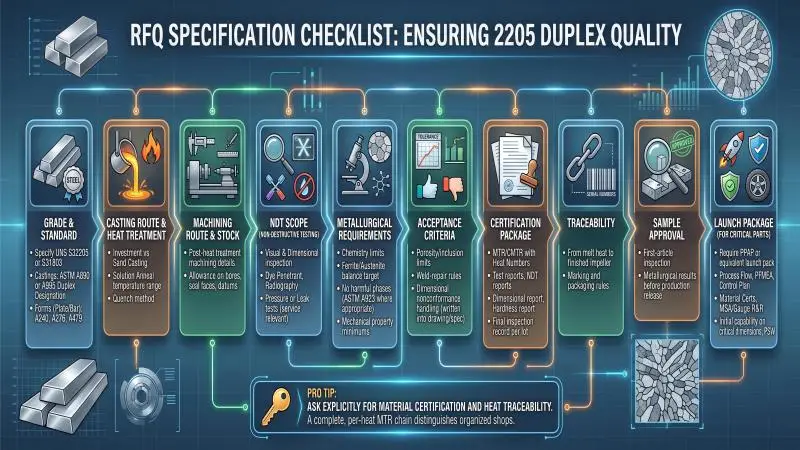
The RFQ is where you decide the outcome. A vague “quote this print in 2205” invites a wide spread of quality. Lock these items down:
- Grade and standard. Specify UNS S32205 (or S31803) and the governing standard — for castings, an ASTM A890 or A995 duplex designation; for plate/bar forms, A240, A276, or A479.
- Casting route and heat treatment. Investment versus sand, solution anneal temperature range, and quench method.
- Machining route and stock. What gets machined after heat treatment, and the machining allowance on bores, seal faces, and datums.
- NDT scope. Visual, dimensional, dye penetrant, radiography, and any pressure or leak test relevant to service.
- Metallurgical requirements. Chemistry, ferrite/austenite balance target, freedom from harmful phases (ASTM A923 where appropriate), and mechanical property minimums.
- Acceptance criteria. Porosity/inclusion limits, weld-repair rules, and dimensional nonconformance handling written into the drawing or purchase spec.
- Certification package. MTR/CMTR with heat numbers, test reports, dimensional report, NDT reports, hardness report, and final inspection record per lot.
- Traceability. From melt heat to finished impeller, with marking and packaging rules.
- Sample approval. First-article and metallurgical results before production release.
- Launch package. If this is automotive-linked or safety-critical, require a PPAP or equivalent launch pack: process flow, PFMEA, control plan, dimensional results, material certs, MSA/gauge R&R, initial capability on critical dimensions, and a part submission warrant.
Pro Tip: Ask for material certification and heat traceability explicitly. A complete, per-heat MTR chain is one of the fastest ways to tell an organized shop from one that cannot defend its material.
Supplier Qualification and Red Flags
Price matters, but on an engineered component the qualification criteria matter more. Build your shortlist around these:
- Track record casting and machining duplex, not just austenitic stainless. Duplex behaves differently and experience shows.
- Documented control of duplex metallurgy, including solution anneal and phase-balance control.
- Valid quality system certification — ISO 9001 at minimum, IATF 16949 if your business requires automotive-grade control.
- Full heat traceability and robust MTRs.
- Dimensional capability on impellers or similar hydraulic components, with process capability (Cpk) on critical dimensions.
- NDT competence and acceptance discipline.
- Clear handling of nonconforming material and rework — not silent fixes.
- Willingness to share sample and first-article reports before award.
- On-time delivery and communication that survive cross-time-zone changes and engineering revisions.
Watch for red flags: a quote with no engineering questions about your service conditions, no proposed inspection plan, no heat-treat or phase-balance detail, vague claims of “we do stainless” without duplex evidence, reluctance to share sample reports, or silence on traceability. Any of these is a reason to keep looking.
On delivery and communication — legitimate concerns many buyers raise about sourcing cast and machined parts from overseas — the answer is to paper it down. Confirm lead times (tooling, first article, then production), expedite options, monthly capacity, and how engineering changes and rework are handled before you commit. IP and drawing security should also be an explicit part of the agreement, with clear rules on data handling and confidentiality.
One approach is to consolidate. Rather than managing a foundry, a machine shop, and a finishing vendor as separate interfaces, many automotive buyers prefer a single audited partner offering one-stop custom metal parts across casting, CNC machining, and finishing. It reduces interface risk, keeps traceability under one roof, and simplifies the audit trail you need for PPAP.
FAQ
How much longer does a 2205 impeller last than 316 in seawater?
In chloride-laden service, the gap is large. Field and supplier data cited by MW Alloys put 316L impellers pitting within one to three years in seawater, while equivalent 2205 parts commonly run eight to fifteen years before balancing or replacement is needed. That longevity is the real economic argument for duplex — the payback comes from avoided downtime, not the sticker price.
Why is 2205 so much harder to machine than 316?
Because duplex is roughly twice the yield strength and work-hardens aggressively. Cutting forces run 20–40% higher than austenitic grades, poor thermal conductivity keeps heat at the cut, and the chip is tough and abrasive on the tool. In practice this means slower cutting speeds, sharp tools with short overhang, rigid fixtures, and generous coolant — machining 2205 like it is 316 invites chatter, poor finish on seal faces and bores, and work-hardened surfaces that hurt the next pass.
What heat treatment does a cast 2205 impeller require?
The casting must be solution annealed in the roughly 1050–1120 °C range and then water quenched promptly. Slow cooling through the critical band lets harmful sigma phase form and destroys corrosion resistance. A sound acceptance check is ASTM A923, which confirms the duplex microstructure is free of damaging intermetallic phases. Buyers should treat solution anneal and quench as part of the supplier’s process control, not just a line item on the purchase order.
Should I choose 2205 or 2507 for a pump impeller?
It depends on how aggressive the service is. 2507 (super duplex) delivers higher strength and better pitting resistance, but it costs more and is even harder to cast and machine. For most seawater, chloride, and moderate-solids duty, 2205 is the economical sweet spot. Reserve 2507 for high-chloride, high-temperature, or severe offshore service where 2205 would be pushed to its limit.
What defects are common in cast duplex impellers and how are they prevented?
The usual culprits are shrinkage porosity, hot spots, misruns, and gas inclusions in the thin vanes, plus sigma phase from improper heat treatment. Prevention starts with gating, runner, and venting design that limits turbulence and feeding problems rather than improvised pour practice. That is why investment casting is the common route — it holds the intricate vane geometry and feeding behavior that sand casting struggles to reproduce.
What dynamic balance grade should a custom impeller be specified to?
For high-speed rotating parts, machining to ISO 1940-1 grades such as G2.5 or G6.3 before shipment is standard practice, and the finished impeller is typically verified against that target. Confirm the balance grade on the drawing. It matters because it drives the machining strategy and fixtures — a grade that is too loose shows up later as vibration that shortens bearing and seal life.
Next steps
A custom 2205 duplex impeller is a decision you can make with confidence once you have the grade, casting route, heat treatment, inspection scope, and supplier qualification criteria pinned down. Start with the needs assessment, then run every shortlisted supplier through the RFQ checklist, and award only after first-article, dimensional, NDT, and metallurgical results meet spec.
When you are evaluating partners, put the capability to the test: ask how they control duplex phase balance, how they handle heat treatment, what their inspection and traceability look like, and whether casting and machining live under one roof. A supplier that answers with process detail rather than a price sheet is the one to shortlist.
If you are about to issue an RFQ for custom 2205 pump impellers, sending your drawing for a free DFM and engineering review is a low-risk way to see how a shop thinks about the casting, machining, and balancing challenges before you commit. That review usually tells you more than the quote does.