

Custom metal stamping services are usually bought on unit price, and that is where the evaluation goes wrong. The lever is not the part, it is the supply chain built around it: how many suppliers touch it, how long it takes to quote and requalify, and what each rejected lot costs to contain.
This guide covers the six areas that decide total cost of ownership (TCO, the fully loaded cost of a purchased part across ordering, quality, inventory and change) for a stamped component. It sets out the metrics to collect, the KPI targets worth writing into a supplier agreement, and how to apply them at each stage, from NPI (new product introduction) through production tooling. Design for manufacturing (DFM) appears where it changes cost, not as a separate checklist.
Key Takeaways
- Unit price is a small share of what a stamped part costs; transaction, quality and inventory overhead decide the rest.
- One benchmark puts the average purchase order transaction at $22.55, against $6.01 for leading procurement organizations (Hackett Group benchmark, cited by ConvergentIS).
- Cost per accepted part, not cost per part, is the number to score suppliers on.
- Lead time, documentation and tooling terms are negotiated at the same time as price, because they are what you live with afterwards.
AFI Industrial Co., Ltd. works in this space, so the sections below use its DFM review and tooling quote process as a working example of the evaluation steps, not as a recommendation.
This article is published by AFI Industrial Co., Ltd. (AFI Parts), a metal parts manufacturer headquartered in China with over 20 years of industry experience. Its in-house capabilities include metal stamping and tube bending, alongside engineering support and drawing reviews, and its work spans rapid prototyping through mass production for global manufacturing customers. That direct involvement in custom metal stamping is the basis for the guidance given here.
Table of Contents
Introduction
Custom metal stamping services are usually bought on unit price, and that is the wrong lever. The cost that matters is the total cost of ownership (TCO) of the stamped part, meaning every dollar the supply chain spends from quote to accepted shipment: procurement admin, expedite freight, inspection, scrap, tooling amortization, and inventory carrying cost.
A Hackett Group benchmark cited by ConvergentIS puts the average transaction at $22.55 per purchase order, receipt, and invoice combined, against $6.01 for leading organizations. That gap is the scale of the administrative layer alone, before a single part is made.
This guide covers the KPIs, design for manufacturing (DFM) rules, tooling strategies, and inventory models that decide whether a stamping supplier lowers that number or adds to it. Use it as a scorecard when you evaluate a new metal stamping supplier, and as a checklist when you plan a new product introduction (NPI).
Key Takeaways
- Unit price is one line of TCO; procurement admin, freight, inspection, scrap, tooling, and carrying cost are the others.
- The Hackett Group benchmark cited by ConvergentIS puts an average transaction at $22.55, versus $6.01 for leading organizations.
- Lead time, quality documentation, and inventory programs are supplier-selection criteria, not afterthoughts.
- DFM feedback and tooling terms set the ceiling on both cost and scalability.
TCO Beyond Unit Price
Metal stamping supplier selection starts with a quote comparison, and the quote is where most of the money hides. Unit price is the only line item that arrives in a tidy number, so it becomes the only line item anyone weighs. The costs that decide whether a program is profitable- expedite freight, sorting labor, engineering changes, and administrative load, arrive later and land on separate budgets, which is exactly why they escape review.
Hidden Cost Drivers to Quantify
Premium freight is the clearest example. Top-performing supply chains spend roughly 3% of their freight budget on expediting, while bottom performers spend about 10% (Fleetrabbit’s premium freight root-cause analysis, retrieved 2026-08-20). That gap is not a freight problem. It is a supplier capability problem that gets billed to logistics. Build the comparison around cost per accepted part: unit price plus freight, sorting, scrap, rework, and the engineering hours your team spends chasing status. A quote that is 8% cheaper but generates one sort per quarter rarely survives that arithmetic.
Cost per Accepted Part and Scorecard Weighting
Weight the scorecard to the program’s risk profile rather than to habit. One published model puts balanced production at 40% quality, 25% delivery, 20% responsiveness and NCR closure, and 15% cost, shifting to 50/20/20/10 for quality-critical work and 35/25/25/15 for launch-sensitive programs (YCU Metal’s supplier scorecard guide, retrieved 2026-07-12). Note what the model does: cost is never the heaviest category, even on a launch-sensitive program.
Pro Tip: Pick the weighting before you open the quotes. Choosing it afterward lets the cheapest bid set the criteria.
Supplier Consolidation and Admin Overhead
Every additional stamping vendor adds a purchase order, an approval cycle, a quality record, and a reconciliation. Consolidation cuts that load, but only when the surviving supplier can hold the tolerance and capacity across the full part family. The failure mode is consolidating on price and discovering mid-program that the remaining vendor cannot run the tightest part, which sends you back to a second source with no leverage left. If you are evaluating custom metal stamping services, ask what the consolidation actually removes from your process, not just from your vendor list.
Lead Time Compression
Total lead time in custom metal stamping services is not one clock. It is four, and they run in sequence: quote-to-PO, tool build, first article inspection (FAI), and engineering change notice (ECN) response. Buyers who contract on a single “lead time” number usually discover the distinction after the first change request.
Quote-to-PO and NPI Cadence
Where time is actually lost is rarely the press. It is the new product introduction (NPI) cadence: how long a supplier takes to return a quote, how many clarification rounds that quote needs, and how quickly a purchase order converts into a scheduled tool build. A quote that arrives in three days but requires four engineering exchanges costs more calendar time than one that arrives in ten days and is buildable as written. Ask for the quote turnaround and the NPI milestone schedule as separate commitments, because they fail independently.
Tool Build Timelines and FAI Readiness
Tool build is the longest single block, and it is the one buyers most often leave unpriced in time terms. Die maintenance intervals shape it: about 50,000 to 100,000 strokes is the commonly reported baseline for full preventive maintenance and inspection, with planning figures widening to 150,000 to 250,000 hits between sharpenings for low-carbon steel and 50,000 to 80,000 for stainless (die-maintenance tracking guidance, retrieved 2026-09-19). Treat those as planning figures, not measured benchmarks for a specific die.
FAI readiness depends on the submission level agreed up front. Level 3, the usual default for a new stamped part, requires a part submission warrant plus samples plus complete supporting data (AIAG PPAP submission levels, retrieved 2026-07-01). A supplier planning for Level 1 will miss the FAI date.
ECN Response and Change Management
ECN response is the clock that restarts all the others. A revision to hole spacing or material can invalidate the tool build, the FAI package, or both. Contract for a stated ECN acknowledgement window and a stated re-validation path, and confirm in writing whether a given change triggers a new PPAP submission. The failure mode is a supplier who acknowledges the change quickly and then re-quotes the tool, which returns the program to the start of the queue.
Key Takeaway: Contract for three separate clocks, not one: quote-to-PO turnaround, tool build through FAI at the agreed PPAP level, and ECN acknowledgement plus re-validation.
Quality and Documentation
A stamping supplier’s quality system is only as good as the records you can pull from it. The audit question is not whether a certificate hangs on the wall, but whether the data behind a production lot is retrievable, complete, and tied to the drawing revision you approved.
ISO/PPAP Systems and Traceability
Production Part Approval Process (PPAP) is the AIAG submission framework that documents a part from design record through process capability. For a new stamped part, buyers typically audit dimensional results tied to balloted drawing characteristics, material mill certificates with heat and batch traceability, PFMEA, a control plan with inspection frequency and reaction plan, MSA/gage R&R, and initial process capability studies (Quality-One PPAP submission levels). Aerospace work shifts the emphasis toward traceability and long retention; a ten-year minimum records-retention practice is common in defense and aerospace supply chains, though the specific figure comes from supplier guidance rather than a cited standard.
The failure mode is a supplier certified to ISO 9001 whose lot file cannot produce a mill certificate for the coil that ran last Tuesday. Ask for a sample lot packet before you place the first order.
Warning: A capability study without the sampling plan and reaction plan behind it is a number, not a control. Request both documents together.
SPC/Cpk Targets and Sampling Plans
Statistical Process Control (SPC) is the practice of monitoring a process with measured data rather than inspecting output after the fact. Cpk expresses how well a centered process fits inside its specification limits. Most customers want Cpk of at least 1.33, while a customer-designated critical characteristic is commonly quoted at Cpk 1.67 (Jennison, statistical process control in metal stamping). The same source illustrates the risk of treating capability as static: a process running at Cp = Cpk = 1.67 drifted to Cpk 0.67 after tool wear shifted the mean, and began producing scrap.
That drift is why you specify the sampling frequency and the reaction plan, not just the target. A Cpk figure quoted at PPAP describes one moment in the tool’s life.
PPM/FPY Metrics and Containment
Parts Per Million (PPM) measures defect rate against total shipped volume; First Pass Yield (FPY) measures the share of parts that pass inspection without rework. Neither figure appears in the verified record for stamping benchmarks, so treat any supplier’s quoted number as a claim to test against their own lot data rather than an industry standard.
Containment is the practical layer: when a defect escapes, the supplier quarantines suspect stock, sorts it, and documents the disposition. Ask what triggers containment, who pays for the sort, and how fast the supplier notifies you.
DFM for Stamping
Design for manufacturing stamping is the review that happens before a drawing is released, and it is the cheapest place to remove cost from a stamped part. The rules below are the ones a supplier checks first. Where a rule cannot be held, the honest answer is a secondary operation or a different process, not a tolerance that quietly fails at volume.
Bend Radii, Hole Spacing, and Springback
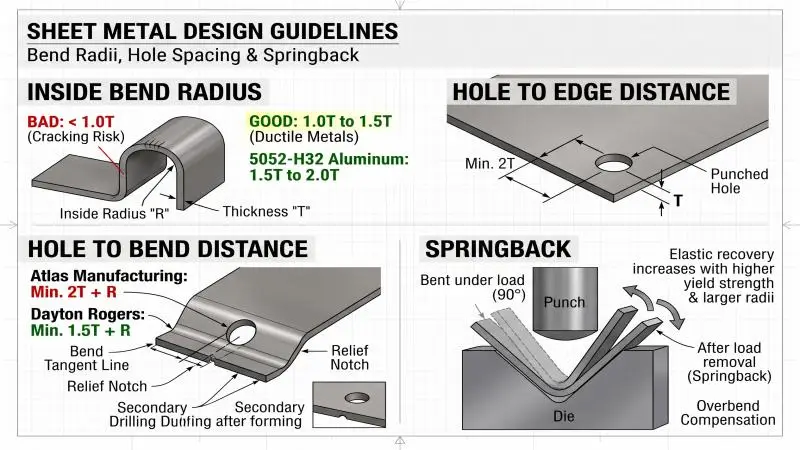
Keep the inside bend radius at 1.0T to 1.5T for ductile metals; below 1.0T the material is stressed and risks cracking and tool fatigue, with 5052-H32 aluminum needing roughly 1.5T to 2T (Fictiv metal stamping guide).
Punched holes should sit at least 2T from an edge, and hole-to-bend distance needs 2T plus the radius (Atlas Manufacturing DFM minimums). Dayton Rogers puts the minimum hole-to-bend at 1.5T plus the radius, and where that cannot be held, the part needs secondary drilling after forming or a relief notch (Dayton Rogers Red Book).
Springback, the elastic recovery that opens a bend after load removal, grows with higher yield strength and larger radii, so specify the most generous radius the design allows and expect overbend compensation (Jiga stamping guide).
Progressive vs Transfer vs Single-Hit Selection
Progressive dies suit high-volume parts with multiple features that can stay on a carrier strip; transfer suits large or deep-drawn parts that cannot ride a strip but still justify dedicated tooling; single-hit suits simple parts and short runs (Keats Manufacturing). Fictiv puts stamping above roughly 20,000 units per year, with pilot tooling covering 500 to 5,000 units (Fictiv).
Material Choice, Grain Direction, and Burr Control
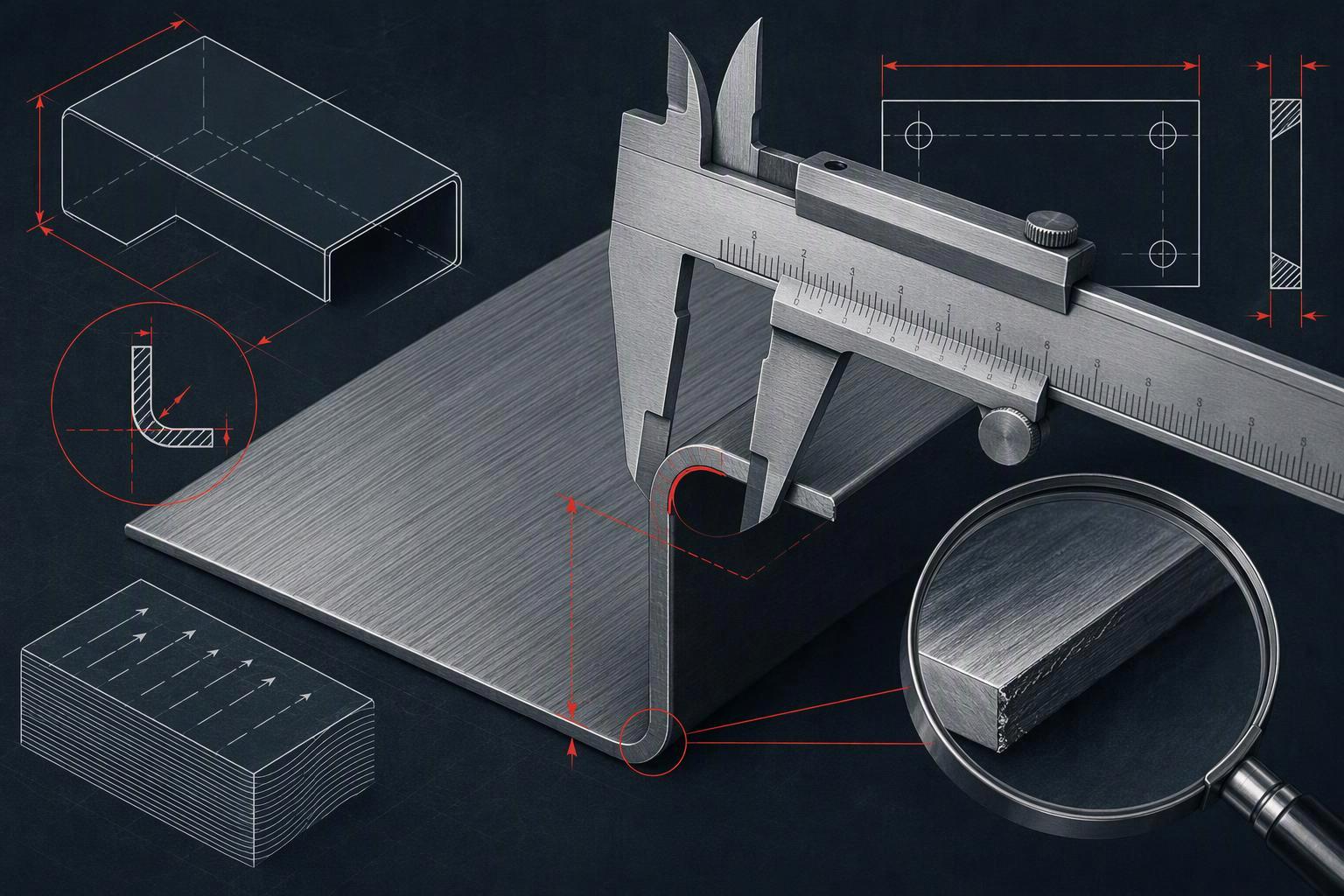
Burr side on the outside of a bend raises fracture risk, so orient the strip accordingly (Dayton Rogers Red Book). AFI Industrial Co., Ltd. reviews drawings for bend radii, hole spacing, springback and process selection before quoting.
Inventory Programs
Vendor-managed inventory Kanban programs change who carries the risk of holding stock, not whether that risk exists. Three models dominate B2B stamping supply: VMI, where the supplier watches the buyer’s stock and replenishes to agreed levels (Slimstock, 2024); consignment, where title stays with the supplier until parts are consumed (NetSuite); and JIT, where the buyer pulls small lots against near-term demand. Each shifts cost, data obligations and stockout exposure differently.
VMI Setup and Service-Level Terms
VMI requires the buyer to share demand data the buyer may not be ready to give. Setup means agreeing on replenishment triggers, min/max levels, and a service-level target with a defined measurement window. The failure mode is a service-level clause with no consumption visibility behind it: the supplier commits to a fill rate it cannot see coming.
Kanban Sizing and Electronic Replenishment
Kanban quantity is derived from demand rate, replenishment lead time, safety stock and container quantity, with replenishment triggered by consumption signals that can be manual cards or electronic, such as an EDI signal or an advance shipping notice (ASN) (Slimstock, 2024). Sizing on average demand alone understates the buffer; the failure mode is a card count that works in a steady month and empties in a spike.
JIT Trade-offs and Risk Buffers
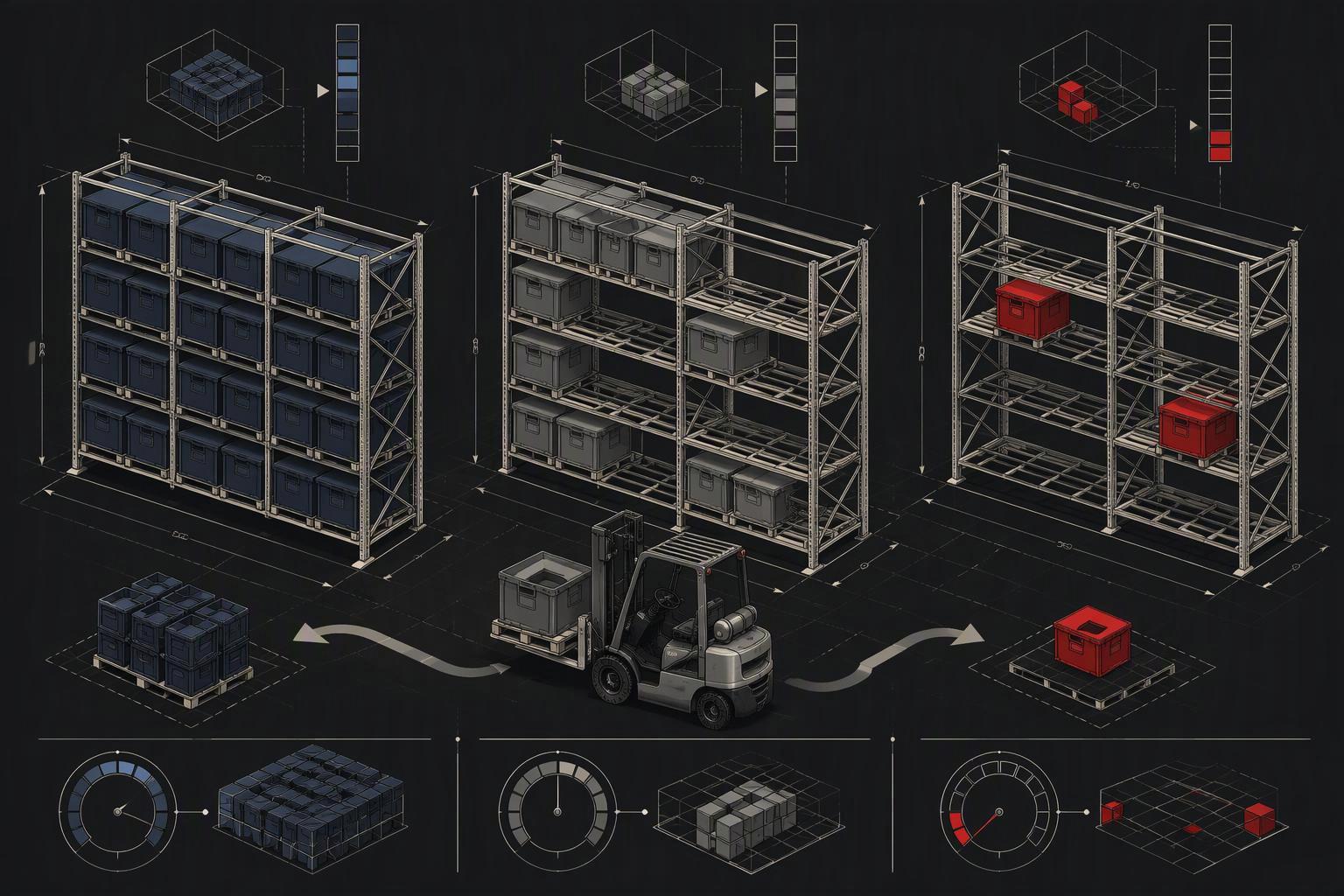
JIT cuts carrying cost and removes the buffer that absorbs lead-time variance. The trade-off is direct: less stock on the floor means less tolerance for a late coil, a tool repair, or a freight delay. Size the risk buffer against your own lead-time variance and MOQ, not a rule of thumb.
Tooling Strategy and Scalability
Tooling strategy and amortization decide whether a stamped part stays economical as volumes grow. The three tooling classes are not interchangeable, and choosing one class too low is the most expensive mistake in the sequence.
Prototype, Bridge, and Production Tooling
Prototype tooling proves geometry and fit, usually in soft or low-cost tool steel, and it is not built to hold tolerance across a long run. Bridge tooling sits between prototype and production: it carries a program through early builds and low-rate launch volumes while the production die is still being cut. Production tooling is built for the full program life, with the hardening, guiding, and strip handling that sustained volume requires.
The failure mode is treating prototype tooling as good enough to scale. It works until volume rises, then it wears, drifts on tolerance, and forces an unplanned tool rebuild in the middle of a launch. Fictiv’s guidance on pilot tooling puts the cost of that intermediate class in a defined range rather than leaving it as an open question (Fictiv, retrieved 2026-06-11).
Die Maintenance, Sensorization, and Uptime
Die maintenance is a stroke-count decision, not a calendar one. Shops schedule service against accumulated hits, and the interval depends on material, coating, and die design. OEE is the standard way to express how much of scheduled press time actually produced good parts, and 85 percent OEE is the customary world-class reference point (OEE.com, retrieved 2026-06-11). That figure is a general manufacturing benchmark, not a stamping average, so treat it as a target to reason against rather than a number your press will hit by default.
Sensorization changes the maintenance conversation. In-die sensors for strip position, tonnage, and misfeed let a shop stop on a deviation instead of discovering it in a bin of scrap. The tradeoff is real: sensors add cost and setup complexity, and they pay back only where the part value or the scrap cost justifies them.
Ownership, Storage, and Amortization Terms
Who owns the die, who stores it, and what happens to the amortization if the program ends are contract terms, and they should be settled before the PO, not after. The questions worth putting in writing: does the tooling strategy and amortization sit with the buyer or the supplier, is the amortization a one-time charge or spread across piece price, and who pays for storage and maintenance once the program slows.
The exit clause matters most. If the program ends or moves, the buyer needs a clear path to take possession of the die, and the supplier needs a clear term for releasing it. A tooling agreement that is silent on storage, maintenance responsibility, and transfer is the one that turns a routine sourcing change into a dispute.
Conclusion
The framework only pays off once it lives in your documents, not in this article. Four moves convert it into program discipline.
Define the KPIs before the next quote round. Cost per accepted part, quote-to-PO and FAI clocks, and a Cpk floor belong in the RFQ itself, so every supplier responds to the same scorecard instead of its own preferred metric.
Set DFM checkpoints at fixed gates. Review bend radii, hole spacing, and springback before tooling release, not after first article. The 2T spacing rule and grain direction decisions are cheapest to change at drawing review and most expensive to change at tryout.
Establish inventory governance. Write the service-level terms, Kanban sizing logic, and replenishment triggers into the agreement, and name who owns the buffer when demand moves.
Settle tooling terms up front. Ownership, storage, maintenance responsibility, and amortization belong in the contract, because they decide who pays when the program scales or moves.
Then evaluate custom metal stamping services against those four criteria, and shortlist suppliers on program continuity rather than unit price alone. AFI Industrial Co., Ltd. reviews drawings at that stage and returns a DFM review with an itemized tooling quote, which is enough to compare against your scorecard before you commit.
Ready to benchmark your next program? Send your drawings for a DFM review and an itemized tooling quote at afiparts.com.
FAQ
What is the minimum order quantity for custom metal stamping?
It depends on the tooling route, not on a single house number. Parts run on an existing die often start around 100 to 1,000 pieces, because only a material buy increment and a press setup are added (MOQ negotiation guide, 2026). A new die pushes the floor up, with progressive tooling commonly quoted at 5,000 to 10,000+ pieces because the die build has to amortize over volume (Custom Metal Parts MOQ & Lead Time, 2026). When a supplier quotes an MOQ, ask which cost it is recovering; that answer tells you how much room there is to negotiate for a pilot run.
How long does it take from quote to first article?
Plan on roughly 5 to 12 weeks when new tooling is required, with many programs landing in the 6 to 8 week window (OEM stamping workflow). The clock breaks into three parts: quote turnaround of a few days to two weeks, tool build of 4 to 12 weeks depending on die complexity, and FAI of 1 to 2 weeks after the tool is cut. If you transfer an existing tool, the timeline collapses dramatically, which is why the tooling ownership and transfer terms covered above matter as much as the price.
How much does stamping tooling cost for a new part?
The honest range is wide, and it tracks die type. Simple single-stage dies land around $2,000 to $10,000, compound dies run roughly $5,000 to $30,000, and progressive dies commonly fall between $20,000 and $100,000+, with complex transfer dies going higher (Metal Stamping Tooling Cost Guide). Most moderate-complexity projects sit in the $15,000 to $50,000 band (Jennison, sheet metal stamping costs). Treat these as planning figures. The itemized quote from your supplier is the one that matters, and it should break out design, die steel, machining, tryout, and finishing rather than a single lump sum.