
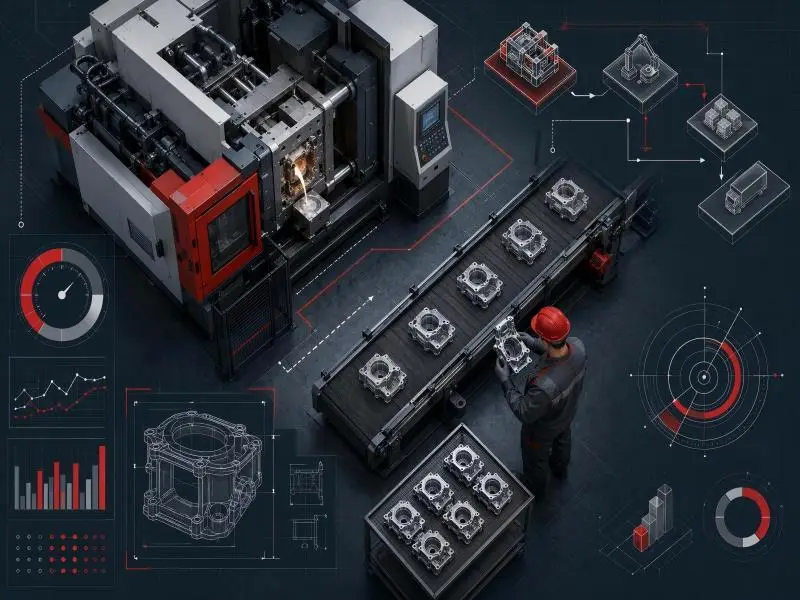
Custom die casting services are usually evaluated on piece price. The more useful question is where they sit in your supply chain: how many handoffs a part passes through, who owns the tool, and what documentation follows the part from design freeze to mass production. That is the frame for die casting supplier selection, and it is where integration actually shows up in the numbers.
Multi-vendor sourcing adds administrative and transport latency on top of fabrication time, and Walker Manufacturing’s analysis of manufacturing lead times puts that overhead at 25–40% more time than the active work alone. Consolidating stages removes handoff lag; it does not remove tool build, sampling, or approval. This guide works through what integration compresses, what it cannot, and how to compare suppliers on total cost of ownership for die casting rather than unit price, using a die caster’s published NPI gate table as the reference timeline.
AFI Industrial Co., Ltd. is a metal parts manufacturer headquartered in China with over 20 years of industry experience in custom metal parts production, including die casting. Its work covers the full manufacturing process from rapid prototyping to mass production, along with drawing reviews, material and tolerance selection, and logistics from packaging to global shipping. That direct involvement in custom die casting and supply chain execution is the basis for the guidance in this article.
Introduction
Custom die casting services matter to OEM supply chains for one reason that survives scrutiny: they remove handoffs. A single qualified supplier that owns tooling, casting, machining, and inspection compresses the administrative and transport latency that stacks up when parts travel between vendors, the same handoff lag that adds 25–40% to elapsed time over active fabrication alone. That is handoff lag, not machine speed, and it is the part of a launch schedule you can actually design away.
This guide is built for evaluation, not persuasion. It covers where integration genuinely shortens a program and where it does not, how to read total cost of ownership die casting beyond piece price, and what to demand during die casting supplier selection. Every timing figure comes from a named source, including a die caster’s published NPI gate table, and where the public record is thin, that gets said plainly.
Key Takeaways
- Integration compresses handoffs and scheduling latency; it does not compress physics, cooling, or tool steel.
- Total cost of ownership die casting is tooling plus material plus process plus freight plus scrap, not the quoted unit price.
- Supplier selection is a documentation question as much as a price question, and APQP PPAP die casting readiness is the fastest way to tell the two apart.
Table of Contents
Integrated Impact
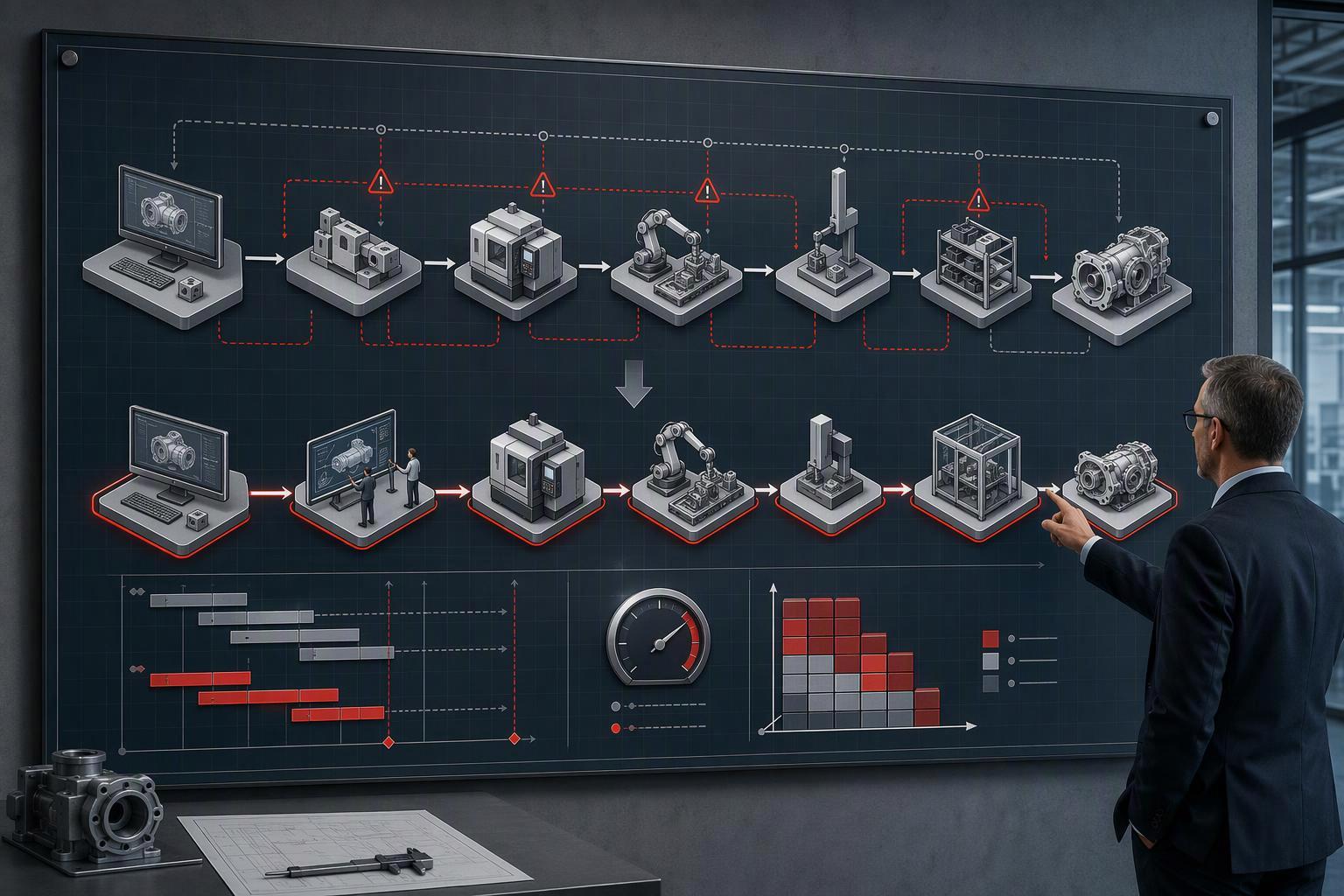
Integration changes the schedule before it changes the invoice. When design for manufacturing (DFM), tooling, casting, machining, and finishing sit inside one supplier, the work moves through fewer queues and fewer approval handoffs. That is the whole mechanism: the supplier is not fabricating faster; it is waiting less.
Key Takeaway: Integrated suppliers remove scheduling latency between steps, not fabrication time. Expect shorter calendars, not faster machines.
Lead Time Compression
Most of the calendar time in a die casting program is handoff lag, not cutting time. A part that moves between a tool shop, a caster and a machine shop accumulates quoting cycles, shipping days, and re-inspection at every boundary. Consolidating those steps removes the boundaries themselves, which is why the same part can finish weeks earlier on an identical press.
Quality Continuity with APQP/PPAP
The distinction that matters is simple: APQP plans, PPAP proves. Advanced Product Quality Planning is the framework that structures a launch, and the Production Part Approval Process is the evidence package submitted to show the process can repeatedly produce conforming parts before OEM approval (Fictiv, Production Part Approval Process Explained, 2025).
That continuity is where single-source programs earn their keep. A die-casting PPAP submission package typically includes the process flow, PFMEA and control plan, dimensional results with MSA/Gage R&R, material certification by spectroscopy, and an IMDS submission (PSAES, PPAP for Die Casting, 2025). When one supplier owns tooling, casting, and machining, those records trace to a single process rather than being reconstructed across three vendors after a tooling change or a capacity move.
Certification is the other half of the question. ISO 9001:2015 is the baseline and does not mandate casting parameters, equipment or inspection frequency, while IATF 16949:2016 adds the five core tools: APQP, PFMEA, control plans, MSA/Gage & R&R, and SPC. That is the certification difference that matters for automotive programs (Kast Die Casting quality standards overview, 2026).
Pro Tip: Ask for the control plan revision history, not just the current control plan. The revision trail shows whether quality documentation actually followed the last tooling change.
Scalable Capacity and Press Fit
Press tonnage is clamp force, not part weight, and that misreading causes more capacity mismatches than any other single error. The practical sanity check is clamping force in tonnes at or above projected area in cm² multiplied by an injection pressure factor of 3 to 5 for aluminum (Kast Die Casting supplier selection guide, 2026). Run that arithmetic against a supplier’s machine list before assuming a housing can move from an 800T cell to a 1,600T cell as volumes grow. A press that cannot clamp the projected area cannot run the part, regardless of its rated capacity.
Economics and TCO

Piece price is the only line most buyers can compare across quotes, and it is the line that predicts the least. A die cast part’s cost is spread across tooling, material, process and energy, and the split shifts with volume, so two quotes for the same drawing can be built on completely different assumptions. That is why a 100,000-part program and a 5,000-part program see the same die differently: one amortizes it into cents, the other into dollars.
TCO Beyond Piece Price
Tooling amortization is the clearest example. A $100,000 die with a 500,000-part life costs $0.20 per part, while the same die over 5,000 parts costs $20 per part (casting-china.org, “Aluminum Die Casting Cost Analysis”, 2026-03-17). Neither number is wrong; they answer different questions, and a quote that hides which one applies is not comparable.
The freight and scrap lines that land after the quote behave the same way. A pallet traveling 8,000 km can add 5–12% to landed cost once export clearance, duties, and inland drayage are counted, and material waste in die casting commonly runs 8–10%, with porosity, cold shuts, and misruns driving rework, impregnation, or rejection (Ferr Casting, “An Overview of Die-Casting Cost Analysis”, 2026-02-09). Across die life, tooling accounts for 10–25% of total cost, material 30–50%, production process 15–25%, and energy 5–10% (casting-china.org, 2026-03-17). Build the comparison on those lines, not on the unit rate alone.
⚠️ Warning: A quote without tooling ownership terms is not comparable to one with them. If the die’s ownership, transfer conditions and amortization basis are not stated, the piece price cannot be evaluated.
Realistic NPI Week Ranges
A die caster’s published NPI gate table gives a usable planning baseline: DFM and tooling approval 1–2 weeks, tool build 4–8 weeks, T0 1 week, correction 1–3 weeks, T1 1 week, FAI 1–2 weeks, pilot 1–2 weeks, and release after approval (Kast Die Casting, “Die Casting Sample to Production”, 2026-08-16). Complex tools, leak-tight parts, cosmetic surfaces, or PPAP requirements extend the timeline beyond the table (same source, 2026-08-16).
Note what the record does not give you: PPAP timing is folded into sampling and approval, not published separately, so no standalone PPAP week range exists to plan against (same source, 2026-08-16). Treat that as a range to negotiate with your supplier, not a number to assume.
Avoiding Hidden Costs and Delays
The delays that get blamed on the die caster usually start earlier, with design changes made after tooling approval. DFM before the first cut of steel is the cheapest correction available: a geometry or draft change caught on the model costs engineering hours, while the same change caught in the tool costs rework of a die that already exists.
Two habits keep that cost visible. Ask for the tooling ownership and amortization basis in writing before award, and ask for the NPI gate dates as dates rather than durations, so slippage shows up at the gate instead of at SOP.
Supplier Selection Framework
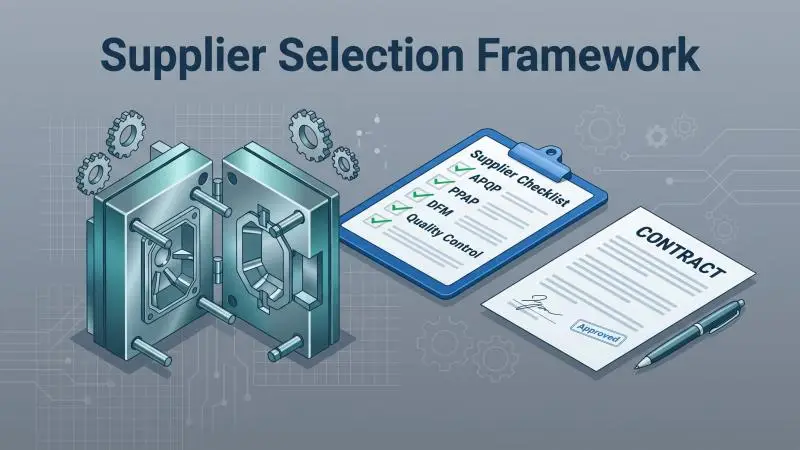
Comparing die casting suppliers on piece price alone hides the three variables that decide whether a program stays on schedule: who controls the tool, how the quality record is built, and what happens at the end of the contract. Treat each as a scored line item rather than a conversation topic.
Capability and Tooling Strategy Fit
The first question is not which supplier is cheapest but which tool the program actually needs on day one. A production tool makes sense when volumes are committed, and the design is frozen. Before that, rapid tooling for validation volumes in the roughly 100 to 500 part range lets you prove the design without paying for a full production die, and a bridge tool carries you from validation into early production while the final tool is built.
Match press capacity to the part, not to the supplier’s largest machine. If a housing requires a move from 800T to 1,600T, confirm the supplier runs that tonnage rather than assuming it. Ask which alloy the die is cut for: production aluminum dies should be H13, with P20 adequate for prototype work (KastDieCast, 2026-07-24). Outsourced tooling also costs you visibility into die quality, lead time, and maintenance history, so ask directly who machines the die and where.
Quality Systems and Documentation
Ask for the PPAP level before you ask for the price. PPAP Level 1 is a Part Submission Warrant only, suited to low-risk parts with a consistent quality history (Fictiv, 2025-05-19). PPAP Level 3, the most commonly required level, adds full documentation (drawings, process flow, capability studies, test results) plus sample parts, and Level 3 dimensional results use a 100-piece layout (KastMfg, 2026-08-16). Levels 4 and 5 are customer-defined and on-site-reviewed, respectively.
The die-casting PPAP submission package runs to 18 elements, with X-ray to ASTM E505 for internal porosity, leak testing for liquid-tight housings, and salt spray for coatings (PSAES, 2025-02-25). Check the capability targets your customer will check: Cpk ≥ 1.67 for critical characteristics, ≥ 1.33 for standard ones, and below 1.0 means the process is not capable (Yuhui Die Casting, 2026-08-10). General die casting tolerance sits around ±0.05 mm, with post-machining for functional surfaces (Norck). Suppliers such as AFI Industrial Co., Ltd. support PPAP and FAI documentation and inspection reporting, which is one way to keep that APQP PPAP die casting record traceable without adding a separate documentation vendor.
Commercial Transparency and Risk Resilience
Settle who holds title to the die in writing. Buyer-paid NRE means you own the tool, held on consignment by the supplier; supplier-owned means the piece price carries amortization and you stay locked in until break-even; a vesting tool transfers title after a volume or spend threshold, commonly 50 to 100% of forecast. Silence defaults to supplier-owned in many jurisdictions (Alumcasting, 2026-08-06).
Expect a split on intellectual property: you own part geometry and drawings, the supplier owns die engineering (gating, cooling, ejector layout) and licenses the tool design back to you (Alumcasting, 2026-08-06). One honest limit: consolidating with a single integrated supplier does not remove the need for a specialist where a process falls outside that supplier’s in-house scope.
Conclusion
The evaluation work is the same whether you are qualifying a first die casting supplier or re-competing an incumbent: compress lead time, hold quality continuity through APQP and PPAP, and confirm that press capacity actually fits the parts you are buying. Custom die casting services earn their place in a B2B supply chain when those three hold together, not when any one of them looks strong in isolation.
What changes on Monday is the order of the questions you ask. Start with the RFQ checklist: part and alloy, annual volume and call-off pattern, tolerance and GD&T requirements, secondary machining and finishing scope, and tooling ownership terms stated in writing. Then test PPAP readiness by asking which documents the supplier controls in-house and how deviations are dispositioned. Finally, validate capacity against your peak month, not your average, and ask what happens when press tonnage has to step up for a larger housing.
AFI Industrial Co., Ltd. publishes its alloy range, machine tonnage spread, and in-house machining scope, which is the kind of detail that makes the first pass of that checklist faster to run.
Talk to an expert about your next program. Request an RFQ review, and we will validate capacity, tooling strategy, and documentation readiness against your drawings before you commit to a tool.
FAQ
What is the typical lead time for custom die casting from design freeze to production?
Plan around the gates, not one number. A die caster’s published NPI table runs DFM and tooling approval 1–2 weeks, tool build 4–8 weeks, T0 1 week, correction 1–3 weeks, T1 1 week, FAI 1–2 weeks, pilot 1–2 weeks, and release after approval (Kast Die Casting, “Die Casting Sample to Production”, 2026-08-16). Complex tools, leak-tight parts, cosmetic surfaces or PPAP requirements push the timeline out. PPAP timing is folded into sampling and approval rather than published separately, so negotiate that as a range with your supplier instead of assuming a fixed figure.
How much does die casting tooling cost?
Tooling is the largest upfront line and scales with complexity, not part count. A single-cavity production die for a small to medium aluminum part typically lands between $3,000 and $12,000, larger housings and two-cavity tools with slides run $12,000 to $25,000, and complex multi-slide tools climb well above that (CharMax, “Aluminum Die Casting Tooling Cost”, 2026-08-28). Cost drivers are part size, cavity count, side actions, steel grade, tolerance, and surface finish. Just as important as the number is who owns the die and how it amortizes.
Is die casting cheaper than other casting processes for high volumes?
Piece price favors die casting above roughly 10,000 units a year, but the honest comparison is total cost, not unit rate. Die casting carries high upfront tooling and low per-part cost, while sand casting has cheap tooling and higher per-part cost, so the crossover depends on your annual volume and die life (FabDigit, “Metal Casting Cost Guide”, 2026). Across die life, tooling is 10–25% of total cost, material 30–50%, production process 15–25%, and energy 5–10% (casting-china.org, 2026-03-17). Run the arithmetic on your own volumes before assuming die casting wins.
What tolerances can die casting hold, and when do you need post-machining?
As-cast die casting general tolerance sits around ±0.05 mm, with tighter functional surfaces handled by post-machining (Norck). The rule of thumb is to keep as-cast tolerances where the drawing allows and reserve machining for sealing faces, bearing bores, and any feature with a Cpk-driven requirement. Capability targets typically run Cpk ≥ 1.67 for critical characteristics and ≥ 1.33 for standard ones, so specify which dimensions fall into which bucket at the RFQ stage (Yuhui Die Casting, 2026-08-10).
What should I include in an RFQ for die casting parts?
Send the part and alloy, annual volume and call-off pattern, tolerance and GD&T requirements, secondary machining and finishing scope, plus tooling ownership terms in writing. Buyers who also state inspection standards and the launch schedule up front get comparable quotes, because the same drawing can be priced on completely different assumptions about cavity count, die life, and freight. If a quote omits tooling ownership, transfer conditions, and amortization basis, treat the piece price as unverifiable until those lines are added.