
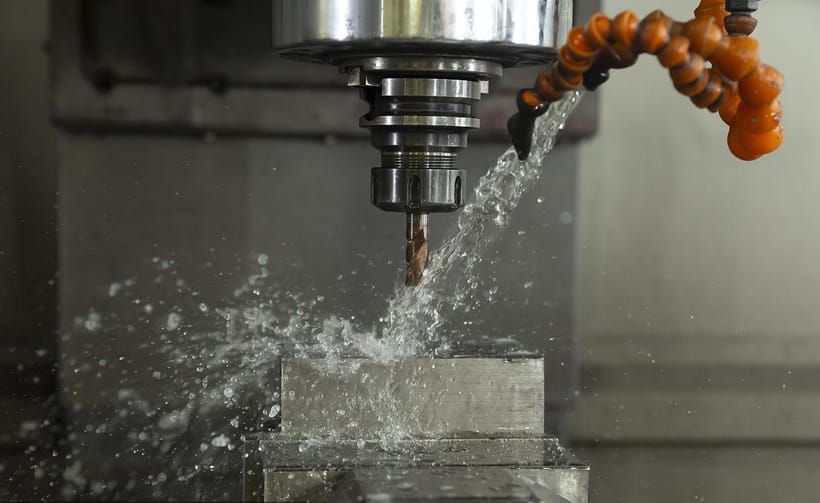
Custom CNC milling services are a supply-chain lever, not just a fabrication step. Unplanned downtime already costs 83% of decision makers at least $10,000 per hour, climbing to $500,000 per hour for larger facilities, according to Component Solutions Group’s analysis of supplier consolidation (2025). That figure is the publisher’s own framing rather than an independent benchmark, but the direction is hard to argue with: every week of slippage compounds.
This guide is an evaluation framework for buyers, not a supplier pitch. It covers CNC milling lead time, design for manufacturability (DFM) as a quote gate, documentation and traceability, prototype to production continuity, supplier consolidation, and total cost of ownership. The process basis comes from AFI Parts’ CNC milling capabilities, where quote and DFM analysis turnaround is usually within 24 hours, prototypes typically run 3 to 7 business days, and production usually takes 1 to 3 weeks.
Key Takeaways
- Compress lead time by front-loading DFM review, not by chasing faster machining.
- Demand documentation and traceability as quote-stage deliverables, not post-award promises.
- Hold process continuity from prototype to production so qualification does not restart at scale.
- Manage total cost of ownership, including admin, logistics and risk premiums, rather than piece price alone.
AFI Industrial Co., Ltd. is a metal parts manufacturer headquartered in China with over 20 years of industry experience in custom metal parts production. Its in-house capabilities include CNC turning and milling, 5-axis machining, and engineering support for design optimization, and it handles projects from rapid prototyping through mass production. This article draws on that manufacturing background to explain how custom CNC milling services fit into a B2B supply chain.
Table of Contents
Introduction
Supply chain volatility is a given. What separates programs that ship on schedule from those that slip is how tightly a manufacturer controls the interval between a released drawing and a qualified part. Custom CNC milling services matter here less as a machining capability than as a scheduling and documentation system: quote speed, DFM feedback, inspection records, and capacity continuity all determine whether a new product introduction (NPI) lands on time.
That framing is the point of this guide. It walks through the six levers a buyer can actually evaluate: CNC milling lead time from RFQ to quote and through production, design for manufacturability (DFM) as a gate rather than a courtesy, the quality and traceability records worth demanding, how prototype to production continuity is held, when supplier consolidation pays, and how total cost of ownership behaves once piece price stops being the deciding number.
The process basis for the lead-time figures below comes from AFI Parts’ published CNC milling capabilities, which state quote and DFM turnaround usually within 24 hours, prototypes typically in 3 to 7 business days, and production runs usually in 1 to 3 weeks (AFI Parts, read 2026). Treat those as one supplier’s stated windows, not an industry benchmark.
Key Takeaways
- Front-loading DFM compresses lead time more reliably than expediting a job already in the queue.
- Ask for the documentation and traceability records before you place the order, not after a deviation.
- Continuity from prototype to production depends on locking processes and assumptions, not on goodwill.
- Piece price is the smallest part of total cost of ownership once admin, logistics and risk are counted.
Lead Time Compression
That interval between drawing release and qualified part starts with the variables you control before the first chip is cut. CNC milling lead time is driven by four of them: part complexity, tolerance class, material availability, and inspection level. Published lead-time ranges by part complexity show simple aluminum prototypes at standard tolerance running 1 to 3 working days, moderate complexity at 3 to 5 days, and complex geometry on 5-axis with tight tolerances at 5 to 10 working days, with standard prototypes shipping overall in 2 to 7 working days (RivCut, CNC Lead Times: 3 Days to 6 Weeks Explained, 2026-03-13). Those bands are the baseline. Everything below is about where they stretch.
From RFQ to Quote
Quote turnaround is the first compressible step, and it is usually the cheapest to fix. A supplier that runs DFM review as part of quoting returns manufacturability feedback with the price rather than after the order, which removes a second review loop once the PO is issued. For comparison, AFI Parts states that quote and DFM analysis turnaround is usually within 24 hours on its CNC milling capabilities page, one option among several rather than a benchmark. The practical test when you evaluate suppliers: ask what happens to the quote if the DFM review finds a tolerance stack that cannot be held, and whether that answer arrives before or after you commit.
Pro Tip: Front-load DFM review before you issue the RFQ, not after. A drawing that reaches the shop already cleared for tool access and tolerance stack turns the quote into a price confirmation instead of the start of an engineering exchange.
Prototype Turnaround Windows
Prototype timing splits into machining time and everything around it. Machining alone runs 1 to 3 days for simple prototypes, while finishing and inspection add 1 to 7 days on top (RivCut, 2026-03-13). That gap is where most schedule surprises live, because a 2-day machining window with a 5-day anodizing and CMM queue is a 7-day part. Ask for the finishing and inspection lead time as a separate line item on the quote.
Production Scheduling Levers
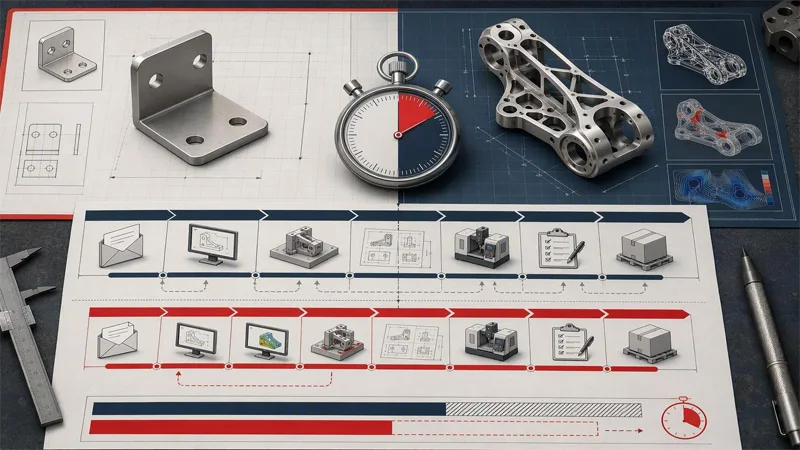
Production-run lead-time tiers scale predictably with volume and qualification scope. Anodized aluminum at 200 to 500 pieces runs 15 to 20 working days on a first run and 10 to 15 on a repeat; multi-material volumes of 500 to 2,000 pieces run 20 to 30 days first run and 12 to 18 on repeat; and 2,000+ piece programs in regulated industries requiring FAI and PPAP run 25 to 40 working days first run and 15 to 20 on repeat (RivCut, 2026-03-13). The repeat-run column is the one to negotiate against: it tells you what the supplier believes it can hold once tooling, fixtures, and inspection plans are settled.
DFM as a Quote Gate
Those lead-time bands only hold if manufacturability is settled before the order, which is why design for manufacturability (DFM) review belongs before the quote, not after. When a supplier returns a price with no engineering commentary, the buyer absorbs every assumption the shop made about tool access, fixturing, and tolerance intent. AFI Parts’ DFM review step places drawing and manufacturability review first in its workflow, describing it as “technical review of drawings and manufacturing requirements before production.” That ordering is the point: manufacturability findings should change the drawing, not the delivery date.
A DFM gate only works if the supplier has enough to review. The RFQ package a buyer should supply includes a 3D model in STEP or IGES plus a 2D drawing with GD&T per ASME Y14.5-2018, material specification with alloy, temper, and heat treatment, critical tolerances called out on the drawing rather than only in the model, surface finish Ra per ISO 21920-2, quantity and expected annual usage, required delivery date, and inspection and documentation requirements.
Critical-to-Quality Features
Critical-to-quality features are the dimensions where a miss stops the build, and they should be flagged on the drawing before quoting. A supplier reviewing a part without that flagging has to guess which tolerances carry functional weight, and guessing usually produces either an inflated price or a rejected lot. The practical test is whether the quote response names those features back to you. If it does not, the review was a price calculation, not a manufacturability review.
Tolerance Stacks and Tool Access
Tight individual tolerances are affordable; tight tolerances that stack across a feature chain are not. How tolerance stacking drives cost, and scrap explains the mechanism: variation accumulates across mating features, so a stack that leaves insufficient clearance forces tighter per-feature limits, more inspection, and higher scrap. Tool access compounds it. A feature a cutter cannot reach without a long-reach tool or a second setup adds cost that no piece price line item explains.
Concrete capability figures help here. AFI Parts’ example part tolerances list a precision aluminum housing at ±0.02 mm on length, ±0.05 mm on diameter and ±0.03 mm on position, and a stainless steel part at ±0.02 mm overall with ±0.005 mm hole diameter. Use published examples like these to test whether a shop’s stated range matches your drawing, not as a substitute for reviewing your own stack.
Automating Manufacturability Review
Automated DFM checks catch geometry and thickness problems quickly, but they do not resolve tolerance intent or datum strategy. Treat software output as the first pass and require a named engineer’s written response on the features automation cannot judge. Ask for the review in writing with the quote, so the assumptions are auditable when the first article arrives.
Key Takeaway: A DFM review before quoting is the highest-leverage gate for reducing redesign and rework, because it moves manufacturability findings into the drawing instead of the production schedule.
Quality and Traceability
Once the drawing is settled, quality on a production milling program becomes a documentation problem before it is a machining problem. The shop either hands you inspection data that ties each lot to its material heat and its approved revision, or you are trusting a certificate that says nothing about the parts in the box.
Documentation You Should Expect
For production machined parts, the documentation a buyer should require is a defined package, not a favor: a Certificate of Conformance; material certifications (MTRs) traceable to the mill heat number; a dimensional inspection report, CMM or manual; surface finish readings wherever Ra is called out; a First Article Inspection report with CMM data on every GD&T callout; and the shop’s quality manual or quality system overview (MakerStage, 2026).
| Document | What it proves | Ask for it when |
|---|---|---|
| Certificate of Conformance | The lot was built to the approved drawing and spec | Every shipment |
| Material certifications (MTRs) | Alloy and condition, traceable to mill heat number | Every lot, or on material-critical parts |
| Dimensional inspection report | Actual measured values, CMM or manual | Every lot on toleranced features |
| Surface finish readings | Ra where the drawing calls it out | Sealing, bearing, or wear surfaces |
| First Article Inspection report | Every GD&T callout measured with CMM data | New part, new revision, new process |
| Quality manual/system overview | How the QMS handles nonconformance and corrective action | Supplier qualification |
Warning: ISO 9001 alone does not prove dimensional accuracy. What ISO 9001 does and does not prove is a documented QMS covering process control, nonconformance handling, corrective action and management review, and it is the minimum for any shop quoting production work. It says nothing about whether the last 500 parts held tolerance. Demand the inspection data.
Metrology and Calibration Control
Ask which instruments measure your critical features, and when they were last calibrated. A CMM report is only as good as the calibration record behind the machine. Where a shop publishes capability, treat it as a claim to test against your own first article: AFI Parts’ stated tolerances list positional tolerance to 0.001 mm, repeatability of ±0.002 mm, flatness and parallelism of 0.005 to 0.008 mm, and surface roughness down to Ra 0.2 µm. Those are the numbers to reproduce on your print, not to accept on a web page.
Change Control and CAPA Discipline
Change-control expectations for a machining supplier start with identification: the currently approved drawing revision, CAD model revision, material spec, surface treatment spec, CNC program, process route, fixture and tooling configuration, inspection plan, and packaging spec. Changes to material source, manufacturing route, critical tooling, external processing, or inspection method need internal review and your approval, and ISO 10007 covers configuration identification, change control, status accounting, and audit (AZP CNC, 2026).
Nonconformance response should cover affected lot identification, containment, review of shipped, in-process, and stored inventory, customer communication, root cause, corrective action, effectiveness verification, and updates to process and inspection controls. A supplier that cannot show that loop is a supplier whose next escape you will find yourself.
Worth noting honestly: AFI Parts’ published order process runs: send drawings, process discussion and quotation, sample, volume production, shipment and payment, and that page lists ISO 9001:2015 only. ISO 13485, IATF 16949, and AS9100D are not mentioned there. If your program needs medical, automotive, or aerospace certification, confirm it directly rather than assuming it from a general capability page.
Prototype-to-Production Continuity
That documentation package is what makes the next step auditable, because prototype-to-production continuity means the part you qualify at low volume is made by the same locked process at high volume. The failure mode is subtle: a supplier machines ten good prototypes, then re-quotes tooling, fixtures, or outside processing for the production run, and the qualification you paid for no longer applies. For buyers of custom CNC milling services, continuity is a contract term, not a hope.
Locking Processes and Assumptions
A first article inspection rests on one assumption: every subsequent part follows the identical manufacturing process. 1factory’s guide to first article inspection notes that FAI typically evaluates one part, sometimes three to five, and treats that sample as representative of the whole run. That assumption only holds if the process route is frozen.
Freeze the route in writing at prototype: machine and setup, fixture design, material source and condition, inspection method, and every outside process. Finishing is where routes drift most, because it is usually subcontracted. AFI Parts, for example, lists anodizing, plating, passivation, powder coating, heat treatment, polishing, and bead blasting among its finishing options, and each one is a separate vendor with its own process controls. Name the finishing house in the route, not just the finish.
FAIR/PPAP When to Trigger
Trigger a new first article inspection whenever the “same process” assumption breaks. 1factory lists the events: new product introduction, design change (new part number or revision), manufacturing process change, outside-processing vendor change, factory move, or resuming production after a long gap. Verisurf adds that FAI is required for new parts, after major design or process changes, and when production shifts suppliers, and that aerospace and automotive subcontracts mandate it.
The paperwork differs by sector. An AS9102 first article inspection report carries the three forms in an AS9102 FAIR: Form 1 for part number accountability, Form 2 for product accountability covering materials, special processes, and functional testing, and Form 3 for characteristic accountability and verification. An automotive submission instead follows the 18 elements of an AIAG PPAP submission, and without a signed Part Submission Warrant, the supplier may not ship in volume.
Key Takeaway: Lock the process route and its assumptions at prototype, or expect to re-qualify the part at scale.
Scaling Capacity Without Re-Qual
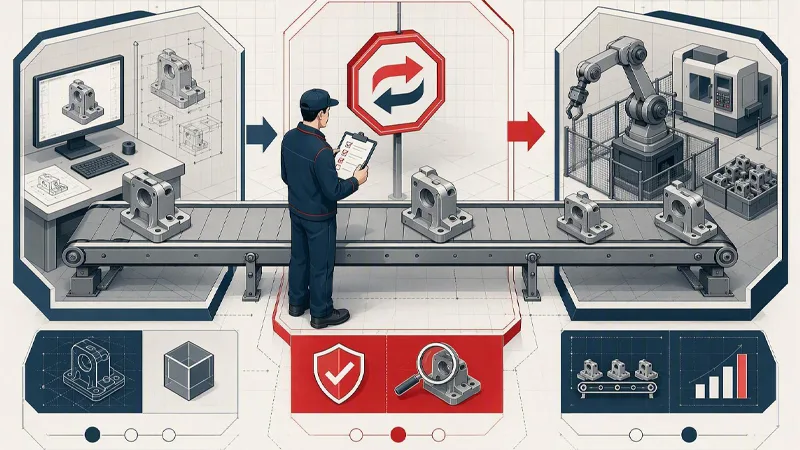
PPAP validates the production process, not a sample. QA Report’s PPAP guide describes the scope as design adherence, material conformance, process capability, measurement system reliability, control plan adequacy, and packaging, with triggers that include new or modified tooling and significant process changes such as new equipment or a new facility.
That list is your scaling checklist. Adding a second machine, a second shift, or a second plant is a process change, so plan the ramp before the volume arrives: qualify the duplicate cell in parallel, keep the control plan identical, and route CAD revisions through the same change-control gate. Capacity added this way needs no new submission; capacity added ad hoc does.
Supplier Consolidation
Continuity is easier to hold when fewer parties touch the part, which is the case for consolidating a fragmented vendor base into fewer accountable partners to cut administrative load and handoff risk. Component Solutions Group reported in 2025 that processing a single PO for ten items is significantly cheaper than ten separate POs across ten vendors, with the savings accumulating across production cycles. That is the administrative cost of a fragmented supplier base stated plainly: it is not the piece price you pay; it is the purchasing labor, the follow-up, and the reconciliation behind every separate order.
One Accountable Partner Model
MES describes supplier consolidation as reducing the number of vendors a buyer manages so that fewer relationships carry more of the scope. In practice, that means one partner owns the drawing review, the machining, the finishing, and the inspection record, and one conversation resolves a deviation instead of a chain of forwards across time zones.
The counterargument is real: a single partner concentrates risk, and a buyer who consolidates without auditing capacity has traded admin overhead for delivery exposure. The honest version of the model is not “fewer vendors, always better.” It is fewer vendors, each one qualified against the criteria in the scorecard below.
Integrating Finishing and Logistics
A three-vendor chain multiplies handoffs rather than adding capability. Boldx’s 2026 analysis of multi-vendor sourcing frames the hidden cost of a three-vendor chain as three shipments, three receiving inspections, three first-article packages, and three corrective-action loops when something drifts. None of those steps improve the part; they only move it.
AFI Industrial Co., Ltd. holds ISO 9001:2015, and its brand profile lists ISO 13485, IATF 16949:2016, and AS9100D alongside 20+ years in operation and 1,200+ global clients. AFI Parts’ published order process lists ISO 9001:2015 only, so treat the wider certification set as a profile claim to confirm during supplier qualification rather than a page-level fact. What the AFI Parts order process does show is engineering support at the quote stage, including DFM feedback on materials and processes, and documented inspection reporting.
Scorecarding Service Levels
Score the consolidated partner on the same axes you would have used across the vendor chain, so consolidation does not hide a weakness.
| Criterion | What to check | Why it matters |
|---|---|---|
| Lead-time reliability | Quoted vs. actual on-time rate | Protects your build schedule |
| Documentation completeness | FAI, material certs, inspection reports | Supports audit and traceability |
| Change-control discipline | Written approval before process change | Prevents silent drift |
| Finishing integration | In-house vs. subcontracted steps | Fewer handoffs, clearer accountability |
| Logistics | Shipping terms, consolidation options | Controls landed cost |
| Communication | Named contact, response window | Resolves deviations fast |
Consolidation lowers overhead only when the remaining partner clears every row. The next section covers how those rows feed into total cost of ownership.
Total Cost of Ownership
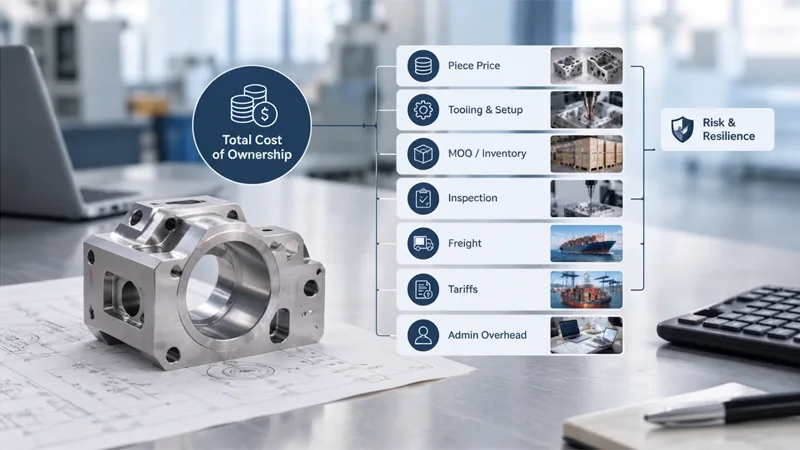
Those scorecard rows are cost lines in disguise, because total cost of ownership (TCO) for a milled part is everything you pay between raising the requisition and accepting the goods: piece price, tooling, minimum order quantities, inspection, freight, tariffs, and the administrative load of managing the order. Piece price is the most visible line and usually the smallest share of the difference between two suppliers.
Beyond Piece Price Factors
Tooling and setup are quoted separately by some shops and absorbed into piece price by others, which makes two quotes look comparable when they are not. Minimum order quantities matter more than they appear: a low piece price on a 5,000-unit MOQ is expensive if you need 400 parts this quarter, because the balance becomes inventory you finance and store. Tight tolerances carry their own cost.
Harvey Performance Company’s explanation of how tolerance stacking drives cost and scrap (2018) sets out why stacked tolerances force more conservative machining strategies, slower cycle times, and higher scrap rates, so a drawing that tightens a non-functional dimension buys cost without buying function. On finishing, AFI Parts’ finishing options include anodizing, electroplating, spraying, brushing, sandblasting, and polishing under one scope, removing a separate purchase order and freight leg without changing the piece price.
Admin and Logistics Overhead
The administrative cost of a fragmented supplier base is real and rarely itemized. Component Solutions Group’s 2025 analysis of consolidated purchasing compares one purchase order against ten, counting the requisitions, approvals, receiving transactions, invoice reconciliations, and supplier follow-ups each additional vendor adds. Freight adds a second layer: freight transit times from China run in weeks rather than days, so an overseas award converts into pipeline inventory, a larger safety stock, and expedited air freight when a schedule slips. Neither cost appears on the quote.
Risk and Resilience Premiums
The last TCO line is what you pay to absorb a failure. A single-source overseas award concentrates schedule risk in one transit lane and one production calendar, and the mitigation (buffer stock, dual sourcing, air freight) is a real cost even in a year when nothing goes wrong. This cuts both ways, and honesty requires saying so: milling is not always the right process. A part with generous tolerances, high volume, and a shape that suits casting or forming is often cheaper cast or formed than milled, and a supplier who tells you that early is worth more than one who quotes it anyway.
Pro Tip: Ask for itemized quotes that separate piece price from tooling, finishing, inspection, and freight. A supplier who will not break those out is either absorbing a cost you cannot see or hiding one you will.
| TCO line | What to request | Why it changes the comparison |
|---|---|---|
| Piece price | Unit price at your actual annual volume | Volume breaks rarely match your demand pattern |
| Tooling and setup | One-time charge, stated separately | Absorbed tooling hides the true per-part cost |
| MOQ and inventory | Minimum lot size and balance terms | Unsold balance becomes financed inventory |
| Expedited freight | Trigger conditions and rate basis | Air freight can exceed the piece-price delta |
| Tariffs and duties | Landed-cost basis and HS code | Duty applies to freight and insurance too |
| Admin | POs, invoices and suppliers per order | Consolidation removes transactions, not just price |
| Inspection | Report type and sampling plan | Full inspection adds cost and lead time |
| Risk premium | Buffer stock and dual-source cost | The mitigation is a cost even when unused |
Conclusion
The strongest lever in a custom CNC milling services program is not piece price. It is the time and rework you remove before metal is cut: front-loaded design for manufacturability (DFM), a documented quote, and a supplier who stays accountable from first article to steady state.
Recap the chain you now have criteria for. CNC milling lead time compresses when RFQ data is complete, and tolerances are challenged at quote stage, not after. Prototype to production continuity depends on locking processes, assumptions, and inspection methods before volume starts. Supplier consolidation trades a longer list of vendors for fewer handoffs, and total cost of ownership should be scored on admin load, logistics and risk, not unit cost alone.
Three next steps de-risk a program: run pilot parts against your real tolerance stack, write service levels for quote turnaround and change notification, and agree the documentation and change-control package up front.
No supporting articles exist yet for this cluster; deeper pieces on DFM review, FAIR/PPAP triggers, and supplier scorecards are planned.
Ready to test a supplier against your own drawings? Send drawings for a quote and get manufacturability feedback on materials, tolerances and lead time before you commit to a program. Request a DFM review.
FAQ
How long does custom CNC milling take from quote to delivery?
It depends on three clocks running at once: quote and DFM turnaround, machining time, and finishing plus inspection. Quote and DFM analysis usually returns within 24 hours, prototypes typically run 3 to 7 business days, and production usually takes 1 to 3 weeks (AFI Parts, read 2026). The window that catches buyers out is the last one—machining alone is 1 to 3 days on a simple prototype, but anodizing and CMM inspection can add 1 to 7 days on top, so a “7-day part” is often a 3-day machine and a 4-day queue. Ask for finishing and inspection as separate lead-time lines on the quote, not folded into a single delivery date.
What should a DFM review cover before I place an order?
A real manufacturability review checks the things automation can’t judge: which dimensions are functional versus cosmetic, whether tolerance stacks leave sufficient clearance across mating features, and whether a cutter can actually reach every feature without a long-reach tool or a second setup. It should come back in writing with the price, naming your critical-to-quality features and any tolerance that cannot be held. The RFQ package that makes this possible includes a 3D model in STEP or IGES, a 2D drawing with GD&T per ASME Y14.5-2018, material spec with alloy and heat treatment, surface finish Ra per ISO 21920-2, quantity, delivery date, and inspection requirements. If a quote arrives with no engineering commentary, the shop made assumptions you’re now paying for.
How do I compare quotes when piece price is misleading?
Build a landed comparison, not a unit-price comparison. Separate piece price from tooling, setup, minimum order quantities, inspection, freight, tariffs, and the admin cost of managing the order—because absorbed tooling or a 5,000-unit MOQ can make a cheap quote look identical to an expensive one. Then add the continuity question: a low prototype price is worthless if the supplier re-quotes fixtures and outside processing at volume and your qualification no longer applies. Ask both suppliers what stays fixed from prototype to production run, and score them on the same six axes: lead-time reliability, documentation, change control, finishing integration, logistics, and a named contact with a response window.