
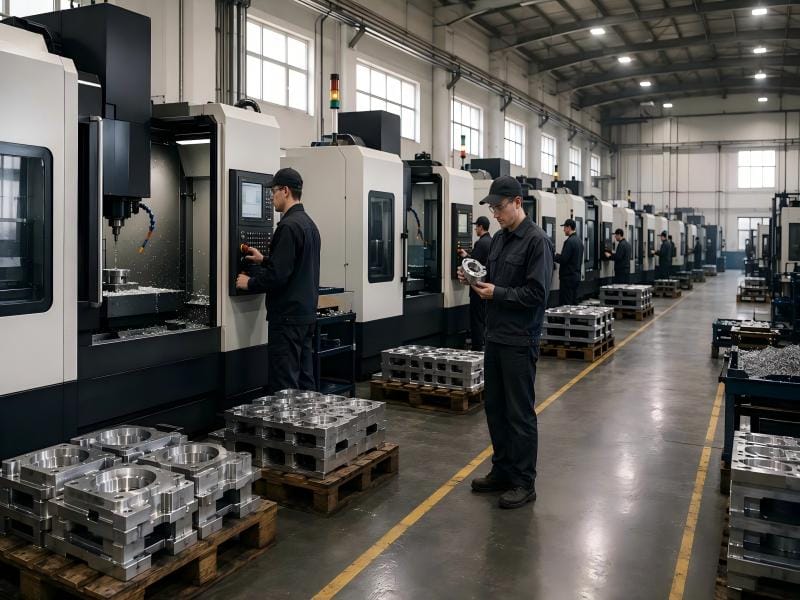
Selecting the right OEM CNC milling manufacturer for high-volume production comes down to evidence you can audit before committing to tooling: capability, capacity, traceability, cost transparency, and governance. This guide provides the scorecard to run that evaluation, shifting the decision from a basic price comparison to a structured risk assessment.
Key Takeaways
- Ask for Cp/Cpk on the actual feature and material, not a shop-wide claim; a stable high-volume process typically holds Cpk ≥ 1.33, with 1.67 for safety-critical features.
- Require MSA evidence: %GR&R under 10% is acceptable, 10–30% is conditional, above 30% means the measurement system cannot support the tolerance.
- A dedicated high-volume cell should show OEE in the 75–85% band; below that, ask which of availability, performance or quality is losing the hours.
- Budget 4–8 weeks for qualification, and 8–16 weeks for regulated or complex programs, with 20–40 engineering hours of your own team’s time.
Table of Contents
A week-by-week supplier qualification timeline helps here: pre-screening and the capability questionnaire in Weeks 1–2, NDA, quote and quality-system document review in Weeks 2–3, a trial order in Weeks 3–5, FAI review and corrective actions in Weeks 5–7, then the decision and onboarding in Weeks 7–8 (MakerStage, 2026-02-21). Regulated or complex programs commonly run 8–16 weeks, and buyers should expect to invest 20–40 engineering hours in the process.
What you request at that first screen sets the ceiling on everything you can verify later. A pre-qualification screen should cover process capability match (equipment list with make, model, axis count and work envelope), tolerance capability stated as the supplier’s standard band rather than a heroic one-off, material and finish capability with two or three example parts in your material, capacity utilization and shift patterns, inspection equipment (CMM for GD&T per ASME Y14.5, profilometer for finish, calibration every 6–12 months per ISO 10012), and communication fit measured by quoting-phase response time (MakerStage, 2026-02-21). Everything that follows in this guide tests one of those answers.
AFI Industrial Co., Ltd. is a metal parts manufacturer headquartered in China with over 20 years of industry experience in custom metal parts production. Its in-house capabilities include CNC turning and milling, 5-axis machining, and engineering support for design optimization, and it has completed more than 200,000 custom projects from rapid prototyping to mass production. This article draws on that production experience to explain what buyers should evaluate in an OEM CNC milling manufacturer for high-volume work.
Introduction
Choosing an OEM CNC milling manufacturer for high-volume production is a high-volume CNC milling supplier selection problem before it is a price problem. Four measurable fronts separate suppliers that hold up under volume from those that merely quote low: process capability (Cp/Cpk), process control evidence (SPC and MSA), on-time delivery (OTD), and traceability.
Qualification typically runs 4 to 8 weeks, or 8 to 16 weeks for regulated or complex programs, and costs the buyer roughly 20 to 40 engineering hours (MakerStage, 2026-02-21). Spend that budget against a defined standard. A pre-qualification screen should cover equipment list with make, model, axis count and work envelope; the supplier’s standard tolerance band rather than a heroic one-off; material and finish capability shown on two or three example parts in your material; capacity utilization and shift patterns; inspection equipment such as a CMM for GD&T per ASME Y14.5 and a profilometer for finish, calibrated every 6 to 12 months per ISO 10012; and quoting-phase response time as a proxy for communication fit (MakerStage, 2026-02-21).
Use the scorecard and RFQ checklist in this guide as your own instrument, and ask every candidate for the same artifacts: recent production-run capability data, control plans, and PPAP or FAI packages.
Key Takeaways
- Set Cp/Cpk thresholds before you request data, so capability claims are measured against your target, not the supplier’s.
- Require SPC and MSA evidence: a gauge R&R above roughly 30% makes the capability number unreliable.
- Treat OEE, backlog and surge planning as capacity proof, and decompose lead time queue by queue.
- Budget 4 to 8 weeks for qualification (8 to 16 for regulated programs) and 20 to 40 engineering hours.
Capability and Quality Metrics
Capability and quality metrics are where a high-volume CNC milling supplier selection is won or lost, and the place to start is Cp/Cpk and SPC requirements for CNC machining suppliers. Ask for the process capability indices, the study that produced them, and the measurement system behind the study. A number without those three things tells you nothing about whether the next 50,000 parts will hold tolerance.
Set Cp/Cpk Thresholds
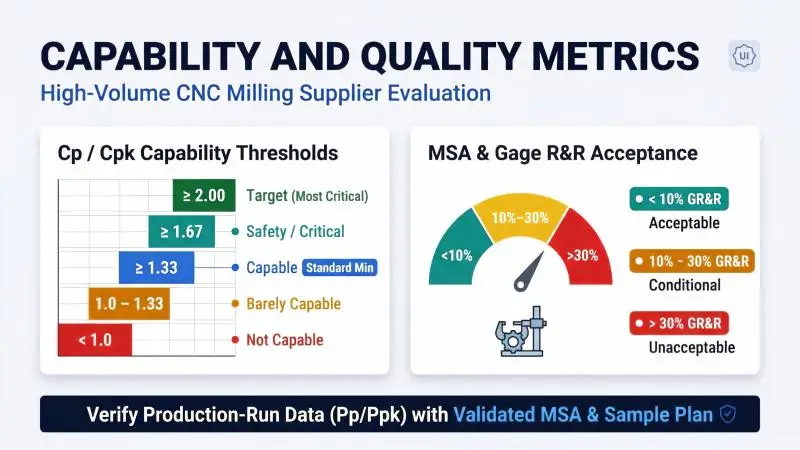
Cp measures whether the process spread is narrower than the specification width, while Cpk adds centering; both use short-term variation to predict what the process can do, whereas Pp and Ppk use overall variation to evaluate what it actually did, as set out in a practical walkthrough of the Cp, Cpk, Pp and Ppk indices. The bands are conventional: below 1.0 is not capable, 1.0 to 1.33 is barely capable, and above 1.33 is capable, with 2.00 as a target where the part allows it.
For production submissions, how capability thresholds map to PPAP submissions records 1.33 as the standard minimum for most automotive processes, 1.67 for safety-related or critical characteristics, and 2.0 for the most critical. Confirm which band your customer-specific requirements actually name before you write it into a purchase order.
| Cpk band | Interpretation | Typical PPAP expectation |
|---|---|---|
| Below 1.0 | Not capable | Not acceptable for production |
| 1.0 to 1.33 | Barely capable | Improvement plan usually required |
| Above 1.33 | Capable | Standard minimum for most processes |
| 1.67 and above | Safety or critical characteristics | Required where the characteristic is critical |
| 2.00 | Most critical characteristics | Target where the part allows |
Verify SPC and MSA Evidence
A capability figure is only as good as the measurement system that produced it. A measurement system is not just the gauge: it includes the method, the operators, the fixtures, the software, the procedures, the environment, and calibration, which is what a measurement system actually includes.
The most common study is Gage R&R, which separates variation from the gauge itself (repeatability) from variation between operators (reproducibility), as explained in how a Gage R&R study separates the two variation sources. The acceptance bands are a TS16949-derived convention: under 10% is generally acceptable, 10 to 30% is acceptable depending on criticality and the cost of measurement error, and above 30% is generally unacceptable, per the TS16949-derived acceptance bands for a Gage R&R study.
Pro Tip: Never accept a Cpk figure on its own. Ask for the sample plan that produced it and the %GR&R of the gauge that measured it. A Cpk of 1.5 measured with a 35% GR&R system is not a capability statement.
Demand Production-Run Capability Data
First article inspection proves the setup, not the process. Ask for capability studies from actual production runs, at the same speeds, feeds, and fixtures the volume order will use, and covering the full run rather than a hand-picked sample. The distinction matters because capability predicts and performance evaluates, which is the difference between predicting capability and evaluating performance: a Pp/Ppk calculated from production data tells you what the supplier has already achieved, while Cp/Cpk tells you what it could achieve under unchanged conditions.
Treat any Cpk as conditional. It is meaningful only with a defined sample plan and a validated measurement system, so put both in the RFQ and require them with every capability submission.
Capacity and Lead Time
Capacity is the first thing a quote cannot show you: a supplier can hold tolerance on ten parts and still have no room for your monthly volume. A CNC machining lead time and capacity assessment answers two questions before you commit: whether the shop has capacity for your volume and whether the quoted lead time is built from real queue data or from a best case.
Map Machines and Shifts
Ask for the machine list that would run your part, not the plant total: machine type, spindle hours available per week, and the shift pattern behind those hours. A cell running two shifts on one VMC has roughly half the weekly spindle hours of the same cell running three, and that difference decides whether your volume fits.
Track OEE, Backlog, Surge Plan
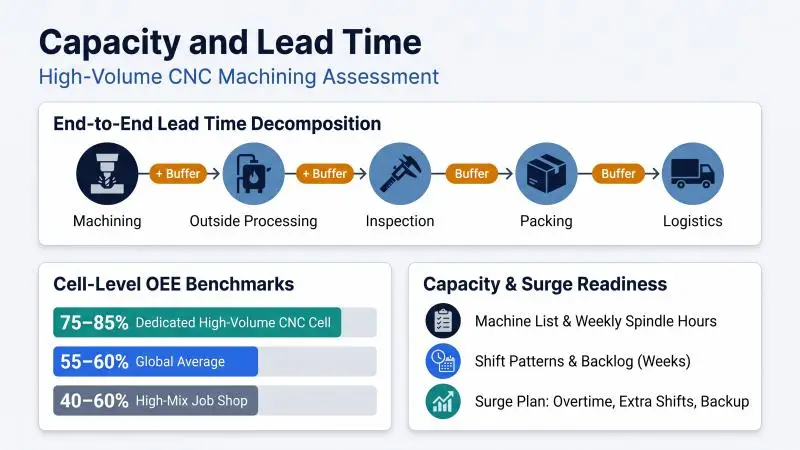
Read OEE per cell type, not plant-wide, because a single average hides the cell that will run your part (Harmoni, retrieved 2026-07-14). Dedicated high-volume CNC cells typically run 75–85% OEE, while high-mix job shops sit at 40–60%, and availability is usually the largest CNC loss, ahead of slow feeds or scrap. Where most manufacturers actually sit against the 85% benchmark is well below it: 70–84% counts as good, 55–69% as average, the global average is roughly 55–60%, and only 3–6% of manufacturers sustain 85% or better (oxmaint, retrieved 2026-01-26). The component benchmarks behind an OEE figure are similarly specific: CNC machining performance 88–92%, high-volume discrete availability 88–92%, make-to-order availability 78–85% (oxmaint, retrieved 2026-01-26).
⚠️ Warning: A plant-wide OEE average hides the cell that will run your part. Ask for the figure per cell, with the measurement window.
Then ask for current backlog in weeks, and the surge plan: overtime, added shifts, or a second source.
Decompose End-To-End Lead Time
Break the quoted CNC machining lead time and capacity assessment into its queues: machining, outside processing such as heat treat or plating, inspection, packing, and logistics. Ask for days per queue and the buffer held at each. A 15-day quote is often 6 days of machining and 9 days of queue and transit, and only the queue portion can be compressed.
Traceability and Control
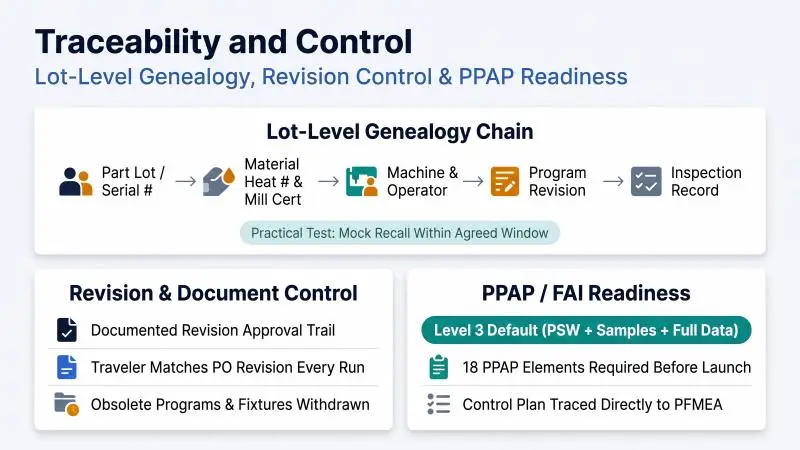
PPAP and traceability requirements for CNC milling come down to one test: can the supplier show, from a finished part, which lot of material, which machine, which program revision, and which inspection record produced it? If the answer takes more than a shift to assemble, containment is guesswork. Treat these three checks as must-haves in your scorecard.
Lot-Level Genealogy and Records
Ask for a sample genealogy record and read the fields, not the cover page. A usable record ties a part serial or lot number to the material heat number and mill certificate, the machine and operator, the program revision, the inspection results, and the date. Confirm retention period and whether records survive a supplier system migration. The practical test is a mock recall: pick a lot number and ask the supplier to return the full chain within an agreed window.
Revision and Document Control
Drawing revision control is where most escapes start. Require a documented change process that names who approves a revision, how the shop floor learns of it, and how obsolete programs and fixtures are withdrawn. Verify that the revision on the traveler matches the revision on your purchase order, every run. Ask to see a recent change record with its approval trail.
PPAP/FAI Readiness
PPAP is the production part approval submission used to demonstrate that a supplier can meet requirements at the quoted rate; it has five submission levels, and Level 3, the PSW with samples and complete supporting data, is the most common default (Quality Training Portal, 2025-11-18). Request the full PPAP element package a supplier owes you before launch, not the week of it, and confirm which level applies to your program.
The element list runs to 18 items, from the design record and authorized engineering change documents through DFMEA, process flow, PFMEA, control plan, MSA, dimensional results, initial process studies, and the Part Submission Warrant, which serves as the cover document. Ask your supplier to walk you through what each PPAP element is for and flag which are customer-specific. The control plan is the one to read closely: it names the process and product characteristics, test methods, specifications, sampling intervals and reaction plans, and it should trace directly to the PFMEA severity, occurrence, and detection ratings that triggered each control (Quality Training Portal, 2025-11-18). Where a control plan and PFMEA disagree, the package is incomplete.
AFI Industrial Co., Ltd. supports this with drawing-level engineering reviews and documentation readiness; see AFI’s high-volume milling capability and DFM review.
Key Takeaway: Traceability completeness is a must-have, not a nice-to-have. A supplier who cannot produce a full lot genealogy on request cannot contain a defect, and an incomplete PPAP package is a launch risk you inherit.
Cost and RFQ Transparency
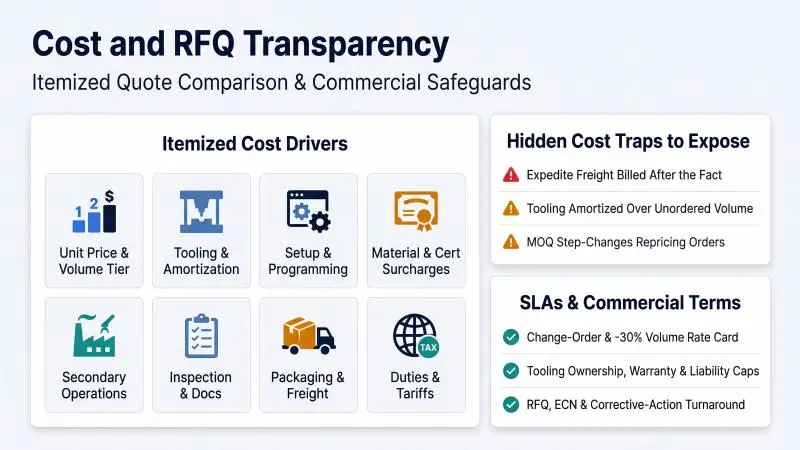
A quote is only comparable if you can see what is inside it. Two suppliers can return the same unit price for the same drawing and still be thousands of dollars apart once tooling, minimum order quantities, expedited freight, tariffs, and secondary operations are priced in. The fix is structural: require every quote in the same itemized format, so the comparison happens on cost drivers rather than on a headline number.
Itemize all Cost Drivers
Ask for a line-item breakdown covering, at minimum: unit price at your stated annual volume, tooling and fixture cost with an amortization schedule, setup and programming charges, material grade and certification surcharges, secondary operations (anodizing, heat treat, plating, assembly), inspection and documentation fees, packaging, freight, and duty or tariff treatment. Require the pricing basis to be stated explicitly: what volume tier the unit price assumes, what material index it was quoted against, and how long the quote holds. A quote that names its assumptions can be re-run when your forecast changes; one that does not has to be renegotiated from scratch.
⚠️ Warning: The three most common hidden traps are expedite freight billed after the fact, tooling amortization spread across volumes you may never order, and MOQ step-changes that reprice the whole order when you drop below a threshold. Get each one in writing before you award.
Expose Hidden Cost Traps
Structure the RFQ so the traps surface during quoting rather than during production. Ask what happens to unit price if volume falls 30 percent, who owns the tooling and fixtures at the end of program, whether NRE is charged once or per revision, and how scrap and rework are billed when the cause is disputed. Ask for the change-order rate card up front: engineering changes, drawing revisions, and schedule pulls all carry a price, and the suppliers who publish that rate card are usually the ones who do not need to invent charges later.
Define SLAs and Terms
Cost transparency and commercial terms belong in the same document. Specify payment terms and milestone triggers, liability caps for late delivery and nonconforming parts, warranty period and remedy, tooling ownership and transfer rights, and the notice period for price adjustments on material. Tie response commitments to the quoting phase as well: a stated turnaround for RFQs, engineering change quotes, and corrective-action responses tells you how the supplier will behave once the program is running. These terms feed directly into your own approval workflow, so procurement, quality, and finance are signing off on the same numbers rather than reconciling three versions later.
Risk and Governance
Risk and governance turn the earlier criteria into standing mechanisms: how you split volume, who answers when something fails, and how you keep score. A supplier that scores well on capability and capacity can still leave you exposed if these three controls are missing.
Dual-Sourcing and Backups
Single-source exposure is the most common structural risk in high-volume CNC milling supplier selection. Buyers typically split volume using a 50/50, 70/30, or 80/20 allocation, with the 80/20 and 70/30 patterns used to keep a backup shop “warm” while preserving primary-supplier efficiency (dual-sourcing for CNC parts, 2026-05-20). The same source is clear that dual-sourcing should be limited to parts that justify it, since splitting volume adds setup, inspection, and documentation overhead on both sides.
Pro Tip: Keep the backup supplier genuinely warm with a small recurring volume rather than a dormant second source. A shop that has not run your part in eighteen months will not hold tolerance or lead time on short notice.
Escalation and Response SLAs
Write the escalation path into the contract: named contacts, response windows, and the containment step for nonconforming lots. Agree what happens when a shipment fails at your incoming inspection, not after it reaches your line.
Scorecards and Audits
Keep the scorecard to roughly 5 to 10 KPIs grouped into quality, delivery, cost, responsiveness, compliance, and capacity or flexibility, scored 1 to 5 or as a weighted percentage, with bands for preferred, acceptable, improvement-plan, and replacement (Leonhardt Manufacturing, 2026-01-13). That is a one-page scorecard you can actually fill in each quarter.
Conclusion
The evaluation criteria you have assembled are the deliverable: a capability floor of Cpk ≥ 1.33 for critical characteristics and ≥ 1.67 for safety-related ones, a %GR&R under 10% for the measurement system behind each, an OEE band and an on-time delivery rate you agree in writing, and lot-level traceability complete enough to reconstruct any shipment. No single number proves a supplier will hold those limits across a year of production, which is why the evidence matters more than the claim.
Monday’s sequence is short. Shortlist two or three OEM CNC milling manufacturers for high-volume production, issue the same RFQ to each with your cost drivers itemized, then run a pilot batch before committing volume. During onboarding, agree on the dashboard set, the audit cadence, and the continuous-improvement review that keeps the thresholds from drifting.
If you want to test the process against a real quote, request a capability package or start a pilot batch and compare the results with your own scorecard.
FAQ
What Cpk should a high-volume CNC milling supplier prove?
Aim for Cpk ≥ 1.33 on critical dimensions, and Cpk ≥ 1.67 for safety-critical or highly regulated features. Anything below 1.00 means the process isn’t capable and needs corrective action first. Always ask for the production-run study and the gauge’s %GR&R behind the number, not a shop-wide claim.
How long does it take to qualify a high-volume CNC milling manufacturer?
Budget 4–8 weeks for standard parts, from the capability screen and NDA through trial order and FAI review. Complex, regulated, or aerospace programs commonly run 8–16 weeks. Expect to invest 20–40 of your own engineering hours along the way.
How do I compare quotes from different CNC milling suppliers fairly?
Require every supplier to quote in the same itemized format: unit price at your stated annual volume, tooling with its amortization, setup and programming, secondary operations, inspection and documentation, freight, and tariff treatment. Naming the pricing assumptions, such as volume tier, material index, and quote validity, is what makes two quotes truly comparable instead of just two headline numbers.