
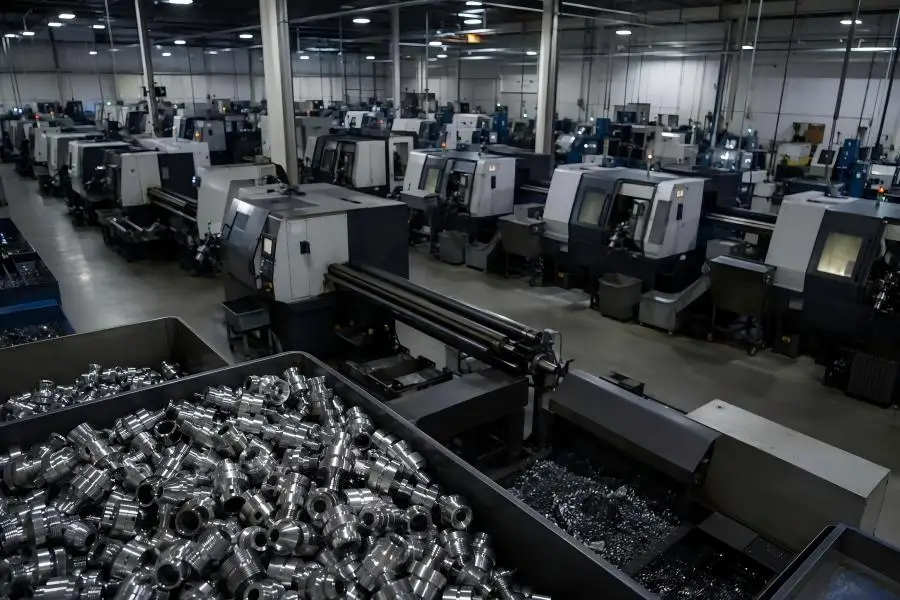
Every quote for a high-volume turning program looks the same on paper, which is why the shortlist should be built from artifacts, not adjectives. Choosing the right OEM CNC turning manufacturer for high-volume production comes down to what a supplier can put in front of you: process capability studies, first article inspection reports, PPAP submissions, capacity data, and inspection records. This guide follows the shape of that decision.
It starts with a needs assessment that pins down your part family, tolerances, materials, and certifications, then turns those requirements into evaluation criteria across quality systems, scalability, lead time, and landed cost. From there, it flags the red flags that should end a conversation early, and finishes with a supplier scorecard you can take into the next round of quotes.
Key Takeaways
- Build the shortlist from requestable artifacts, not from price and machine count.
- Define your own requirements first: part family, volumes, tolerances, finishes, materials, and certification scope.
- Evaluate quality systems, automation signals, lead time, and total cost with the same scorecard for every supplier.
- Treat the scorecard as the deliverable, and trace every supplier claim back to a document you can review.
The measurable part of that evaluation is not a matter of opinion. PPAP’s 18 elements and five submission levels (Quality-One) give buyers a defined package to request and audit, which is why the sections that follow keep returning to documents rather than assurances.
AFI Industrial Co., Ltd. is a metal parts manufacturer headquartered in China with over 20 years of industry experience, and CNC turning and milling is one of its core services. Its work spans drawing reviews, material and tolerance selection, and precision monitoring from prototyping through mass production, which is the ground on which this article’s topic sits.
Introduction
Every quote for high-volume turned parts looks the same on paper, so the choice of an OEM CNC turning manufacturer for high-volume production has to be made on evidence rather than price alone. The suppliers that hold up after award are the ones whose capability, quality system, and capacity can be inspected before the purchase order is issued: documented process capability, metrology records, automation that keeps spindles running unattended, and a total cost model that survives freight and duty.
Key Takeaways
- Build the decision around a scorecard, not a quote comparison: capability, quality, capacity, and total cost of ownership each get their own fields.
- Every claim a supplier makes should map to an artifact you can request, from a first article inspection report to PPAP’s 18 elements and five submission levels (Quality-One).
- Define your own part family, tolerance band, and annual volume first, because those three inputs decide which suppliers are even eligible.
This guide works through that sequence: define fit and capabilities, test the quality system and metrology, read the scalability and automation signals, then weigh lead time, logistics, and total cost before scoring candidates side by side.
Table of Contents
Define Fit and Capabilities

Choosing an OEM CNC turning manufacturer for high-volume production starts with your own part, not with a supplier list. Fit is a set of measurable requirements: the part family and annual volume, the tolerance and finish the drawing actually demands, and the material and certification the end program requires. Write those three down before you send an RFQ, and supplier selection becomes a comparison against a fixed standard instead of a sales conversation.
Part Family and Volumes
Volume is the first filter because it decides which machine class a supplier should quote. A turned part under roughly 25 mm in diameter with a length-to-diameter ratio above 3 usually belongs on a Swiss-type lathe with bar feeder, where the guide bushing supports the work and the machine can run unattended. Larger diameters, interrupted cuts, or secondary milling move the part toward a turning center with live tooling. State your annual volume, your expected monthly release, and whether demand is steady or spiky. A shop that quotes a 250,000-piece program off a single-spindle lathe and a manual load will not hold the cycle time or the price.
Tolerances and Finishes
Tolerance drives cost faster than any other variable. As a reference point, the turning tolerance band commonly quoted across the industry runs from ±0.001″ to ±0.005″, and a supplier should tell you which end of that band it can hold on your specific feature, at your volume, with a documented capability figure rather than a verbal assurance. Finish matters just as much: as-machined, bead blast, anodized, and powder coat each add a process step, a lead-time increment, and a handling risk. List the critical dimensions and the finish callout separately, and mark which tolerances are functional and which are simply drawn.
Materials and Certifications
Material availability and certification scope are separate questions, and buyers conflate them. Common turned materials include aluminium, brass and bronze, copper, plastics, steel, titanium, and zinc; each carries its own machinability, tool wear, and lead-time profile, and titanium or high-nickel work narrows the supplier field quickly. Certification is the second question: ISO 9001 covers a quality management system, while IATF 16949 applies to automotive production and carries additional requirements. Match the certificate to your program, not to the supplier’s marketing page.
This distinction also frames the evidence you will ask for later: FAI checks the part, PPAP checks the process (Goscpm, 2026). Define which of the two your program needs before you start high-volume CNC turning supplier selection.
Quality Systems and Metrology
Quality systems are where a supplier’s volume claims get tested. A shop can hit a first article and still drift once the process runs unattended, so the useful question is not whether a certificate exists but which standard it covers, which artifacts the supplier will hand over, and how it proves the process stays centered. PPAP and SPC requirements for CNC turned parts are the practical gate here, and they are requestable documents, not assurances.
ISO 9001 vs IATF 16949 Scope
ISO 9001 is the general quality management standard and the parent of IATF 16949; IATF 16949 is automotive-sector specific and cannot be certified on its own (DQS’s explainer on what IATF 16949 adds to ISO 9001, retrieved 2026). The distinction matters because the two are often used interchangeably in supplier marketing. IATF 16949:2016 was published on 3 October 2016 and replaced ISO/TS 16949, and it couples with applicable customer-specific requirements to define QMS requirements for automotive production, service, and accessory parts (AIAG’s IATF 16949:2016 standard page, published 2016-10-03).
If your part is not automotive, ISO 9001 scope is usually the right baseline, and IATF is not a must-have. If it is automotive, ask for the certificate scope and the customer-specific requirements the supplier is registered against.
PPAP, FAI, and Documentation
A first article inspection confirms the process produced one conforming part; PPAP confirms the process is defined, measured, and repeatable. The Production Part Approval Process runs to 18 elements: design documentation, engineering change documentation, customer engineering approval, DFMEA, process flow diagram, PFMEA, control plan, MSA studies, dimensional results, material and performance test records, initial process studies, qualified laboratory documentation, appearance approval report, sample production parts, master sample, checking aids, customer-specific requirements, and the PSW (Quality-One’s breakdown of the PPAP process).
Ask which levels the supplier has actually submitted before, not which it can produce in principle. As one neutral example, AFI Industrial Co., Ltd. supports drawing and DFM reviews before quoting and prepares PPAP documentation within its ISO 9001 scope, with turning tolerances stated at ±0.001″ to ±0.005″ and Swiss-type capacity sourced through its partner network across aluminium, brass, copper, plastics, steel, titanium and zinc.
SPC/Cpk Targets and Gage R&R
Statistical process control only holds if the measurement system underneath it is sound. Gage R&R under 10% of study variation is adequate, 10–30% may be acceptable for some applications, and over 30% is unacceptable, though threshold criteria alone are not an acceptable basis for accepting a measurement system (SPC for Excel on AIAG gage R&R acceptance criteria, citing AIAG Measurement Systems Analysis, 4th ed., p.78). That last clause is the one buyers skip. A supplier reporting Cpk of 1.67 on a feature measured by a gage at 28% R&R has reported a number about its measurement system, not its process. Ask for the gage R&R study alongside the capability study, and set your Cpk target before the RFQ, not after.
Scalability and Automation Signals
CNC turning scalability and lights-out automation are the two claims buyers hear most often and can verify least often. A supplier’s machine count tells you what exists on the floor, not what is available for your part. What separates a shop that can absorb a volume ramp from one that cannot is the automation chain behind the spindles and the records that prove it runs.
Machine Mix and Unattended Runs
Start with the machine mix against your part family. Swiss-type lathes suit long, slender parts with tight diameter tolerances; fixed-head turning centers suit shorter, larger-diameter work and heavier stock removal. A shop whose mix is mostly one type will quote your part either reluctantly or at a premium.
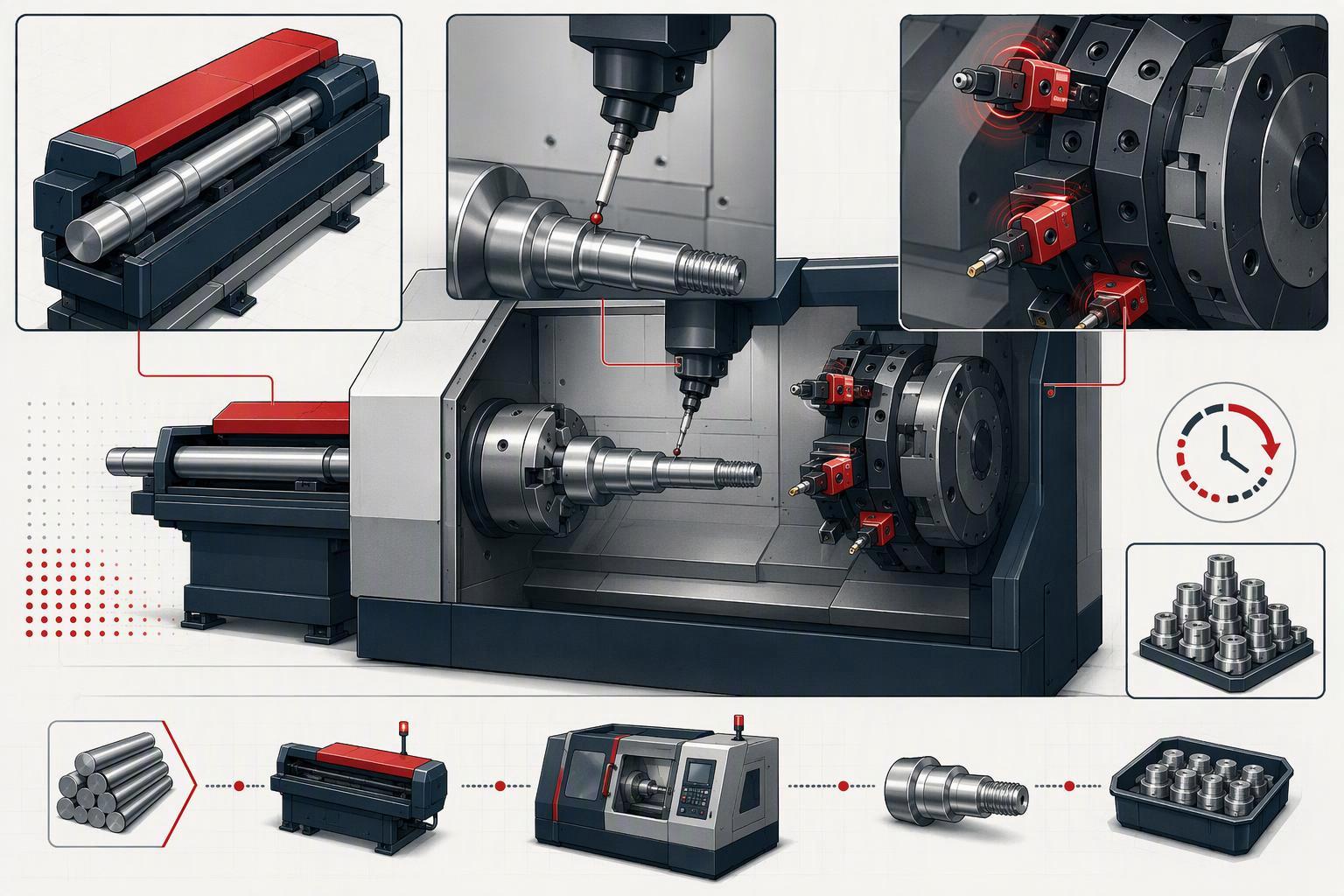
Unattended running is where scalability actually lives. A bar feeder lets the machine keep cutting after the operator leaves; a magazine or pallet system does the same for chucked work. Ask how many unattended hours per week the shop runs on a comparable part family, and on which machines. A plant average is not an answer: lights-out hours on a family with different cycle times, tool life and chip control tell you nothing about your program.
Probing, Tool Monitoring, Offsets
Automation only scales when the machine can correct itself. The chain runs from bar feeder to in-process probing to tool monitoring to automatic offsets. In-process probing measures the part on the machine and feeds the deviation back; tool monitoring watches load or vibration and flags wear before it becomes scrap; automatic offsets apply the correction without an operator touching the control.
Each element buys a specific thing. Probing holds a dimension between manual checks. Tool monitoring prevents the slow drift that turns a good run into a rejected lot at final inspection. Automatic offsets keep a lights-out shift producing parts that pass, not parts that need sorting.
Pro Tip: Ask for OEE and FPY records plus unattended-run hours for a comparable part family, not for the plant average. A shop that can pull them for your part type is a shop that measures them.
OEE, FPY, Uptime Evidence
Set-up verification and total productive maintenance sit underneath all of it. What IATF 16949 adds to ISO 9001 is the discipline layer: control plans, tooling and gauge management, set-up verification and TPM layered onto the ISO 9001 clause structure (DQS, IATF 16949 explained, retrieved 2026). A shop running unattended shifts without documented set-up verification and planned maintenance is running on luck.
Treat an OEE figure with no definition as a red flag. OEE depends on how availability, performance, and quality are each defined, and a number quoted without those definitions cannot be compared to anything. Ask for the calculation method, the measurement period, and the part family it covers. If the supplier cannot produce FPY data at all, assume the process is monitored by final inspection, which is the most expensive place to find a defect.
Lead Times, Packaging, Inventory
Lead time, packaging, and inventory terms are where a competitive piece price quietly turns into an expensive program. They belong in the evaluation, not in the purchase order fine print, because each one is negotiable and each one moves cost and continuity risk.
NPI to PPAP Timing
The PPAP submission level you specify sets the timeline before the supplier quotes a single piece. Under the five PPAP submission levels documented by Quality-One, Level 1 requires only a Part Submission Warrant, Level 2 adds samples and limited supporting data, Level 3 adds samples and complete supporting data, Level 4 follows whatever the customer defines, and Level 5 is reviewed at the supplier’s site. Each step up adds documentation the supplier must produce and you must review, so the level is a schedule decision as much as a quality one.
Most new part submissions run at Level 3 as the default PPAP submission, the PSW with samples and complete supporting data, unless the customer specifies otherwise. Ask for the level in writing at the RFQ stage and ask what the supplier’s historical NPI-to-PPAP duration has been at that level. A supplier that cannot state a duration for a comparable part family is telling you the timeline will be discovered, not managed.
Packaging, Labeling, Corrosion Control
Packaging is a cost line and a quality control. Specify the returnable or expendable container, the dunnage that keeps turned surfaces from contacting each other, the label format and barcode standard your receiving system reads, and the corrosion protection required for the material and transit time. Aluminium and brass parts shipped in humid conditions need a defined barrier or VCI specification, not a generic “protected packaging” note. Get the packaging specification into the PPAP documentation so a packaging change cannot arrive unannounced.
VMI, Kanban, Buffer Stock
Inventory terms decide who carries the working capital and who absorbs demand swings. Vendor-managed inventory, Kanban replenishment, and agreed buffer stock each shift that balance, and each has a cost the supplier will price back into the part. Define the trigger, the replenishment window, the minimum and maximum levels, and what happens when your forecast is wrong. A buffer-stock commitment without a stated replenishment window is not a supply guarantee; it is a hope with a purchase order number.
Logistics and Total Cost
The lowest unit price on a quote is rarely the lowest total cost of ownership for CNC turned parts sourcing. Freight, duty, inventory carrying cost, and the probability of a quality escape all sit on top of the piece price, and the Incoterm on the quote decides which of them the supplier has already priced in. Comparing two quotes that use different terms compares two different scopes of work.
Incoterms, Modes, Duties
Incoterms 2020 defines 11 trade terms: seven for any transport mode (EXW, FCA, CPT, CIP, DAP, DPU, DDP) and four for sea and inland waterway (FAS, FOB, CFR, CIF), each specifying when risk passes and which party contracts for carriage and insurance, per the US Commercial Service’s Incoterms explainer. The risk point is not the same as the freight point. Under FOB and CIF, risk transfers when the goods are on board the vessel, and under CIF the seller pays freight to destination while risk has already passed at the port of shipment, as UPS’s table of where risk transfers under each Incoterm sets out.
Duty is the layer buyers most often leave out. Chinese-origin turned parts carry Section 301 additional duty by list: 25% on Lists 1, 2 and 3, 7.5% on List 4A, with List 4B suspended, and four-year-review increases of 25% to 100% phased from 27 September 2024 through 1 January 2026, according to China Briefing’s tracker of current US-China tariff rates. A further 12.5% forced-labour tariff on all Chinese-origin goods took effect on 24 July 2026, presumed to stack with other Section 301 tariffs, per the 12.5% forced-labour tariff effective 24 July 2026.
⚠️ Warning: Do not compare quotes issued under different Incoterms. Risk and cost transfer at different points, so the unit price is not comparable until both quotes are restated on the same term.
TCO Model Components
Build the model on landed cost, not piece price. For containerised industrial parts, the common ocean terms are FOB, CFR and CIF, and the common multimodal terms are FCA, CPT, CIP, DAP and DDP, per which Incoterms are common for containerised industrial parts. Incoterms 2020 gathers all costs for each rule into articles A9 and B9, which makes the cost split explicit rather than negotiated line by line, as ICC’s Incoterms 2020 rules page explains. Stack the total cost of ownership for CNC turned parts sourcing in these layers:
- Piece price and setup or tooling amortisation
- Freight, insurance, and brokerage
- Duty and tariff exposure by origin
- Inventory carrying cost and safety stock
- Quality cost: inspection, sorting, and containment
- Risk cost: expedite freight and line-down exposure
Risk and Variability Costs
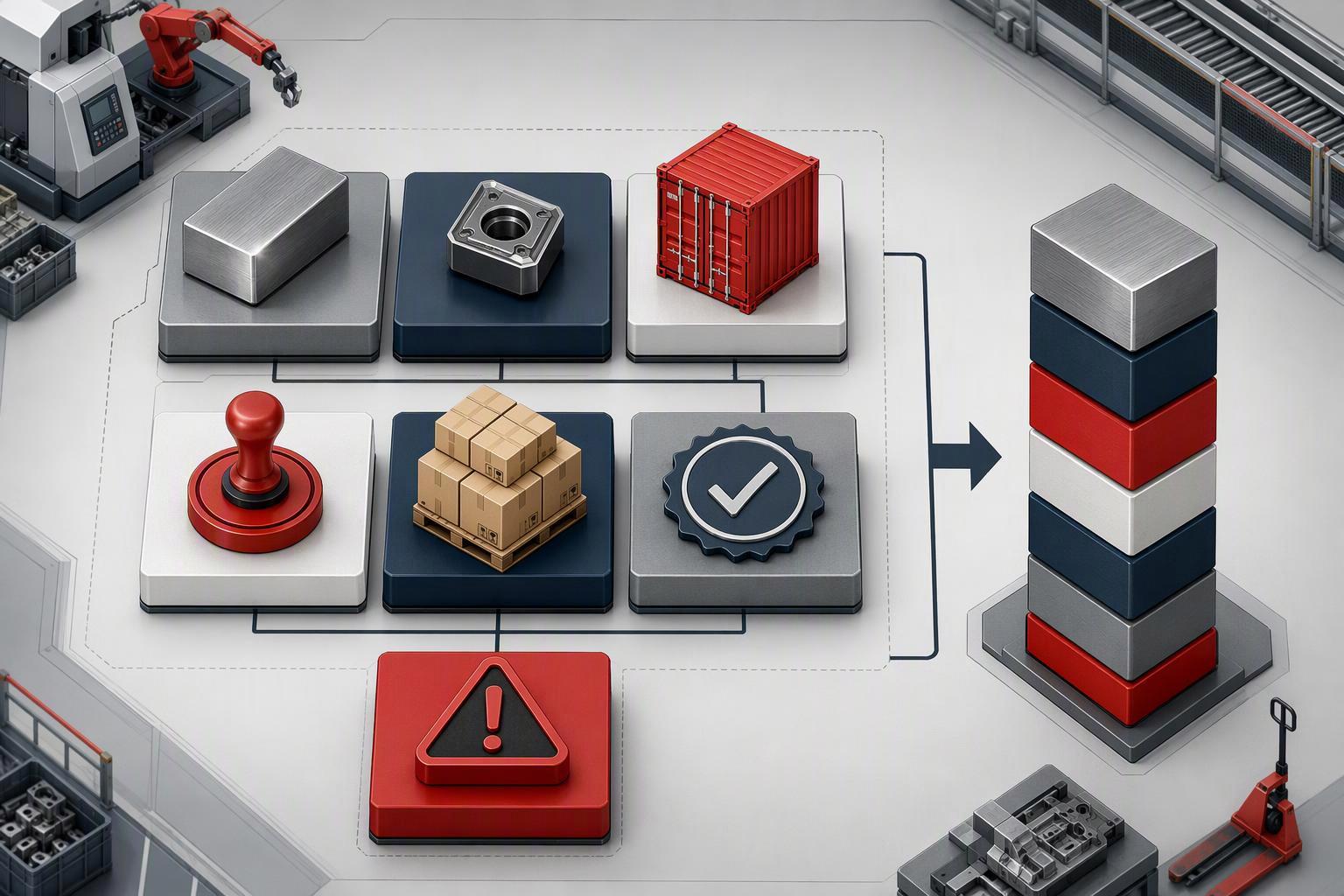
Variability is a cost line, not a footnote. A supplier quoting a 30-day lead time that ships in 45 forces either air freight or buffer stock, and both are cheaper to model up front than to absorb mid-program. Price the probability of a late shipment and a rejected lot into the comparison before awarding, and hold the supplier to the same Incoterm across every quote you score.
Supplier Scorecard
Comparing quotes from three capable suppliers is hard because the documents look alike. A scorecard fixes that by forcing every field to point at an artifact you can request and read. Build it in three blocks: capability and quality, capacity and performance, commercial and logistics. Score each field 1 to 5 against evidence, not against the sales conversation.
Capability and Quality Fields
Score certification scope, not the certificate’s existence. IATF 16949 is an autonomous QMS standard fully aligned to ISO 9001:2015 but not stand-alone: it is implemented as a supplement to and in conjunction with ISO 9001:2015, which must be purchased separately (AIAG’s IATF 16949:2016 standard page, published 2016-10-03). A supplier claiming IATF 16949 without a current ISO 9001 registration has a scope problem worth scoring down; the same page explains why IATF 16949 is purchased alongside ISO 9001.
Then score the measurement system behind the inspection reports. Under AIAG MSA guidance, the %GRR bands are 10, 10 to 30, and over 30, and AIAG cautions that using the GRR guidelines as threshold criteria alone is not acceptable practice for judging a measurement system (AIAG’s caution against threshold-only gage R&R judgement, undated). Ask for the study, the part, the appraiser count, and the tolerance it was run against.
Capacity and Performance Fields
Score installed turning capacity, the share of it you can realistically book, and the automation that keeps it running unattended. Request OEE, first-pass yield, and uptime as reported figures with the period they cover, plus the machine list with bar-feeder and lights-out capability stated per asset. A capacity number without a reporting period is not a field.
Commercial and Logistics Fields
Score landed cost, not unit price, and score tariff exposure as a live risk. The second four-year review of the Section 301 tariffs was formally initiated by USTR in May 2026, with continuation requests running 7 May to 5 July 2026 and a comment period through July 2026 on continuing certain exclusions (ST&R’s Section 301 tariff tracker, current as of the May to July 2026 review milestones). Add Incoterms, packaging and labeling spec, buffer-stock terms, and payment terms as scored fields.
Run this scorecard before shortlisting, and high-volume CNC turning supplier selection stops being a comparison of quotes and becomes a comparison of evidence.
Conclusion
Align engineering and procurement on one set of measurable criteria before quotes arrive, then hold every candidate to it. The scorecard is what makes that possible: capability and quality fields (tolerances, materials, certifications, PPAP and FAI readiness, SPC/Cpk targets, gage R&R) sit beside capacity and performance fields (machine mix, unattended hours, OEE, FPY, uptime) and commercial and logistics fields (Incoterms, packaging, VMI, total cost of ownership). Used together, they turn a stack of quotations into a comparison, and they give you a defensible reason for every shortlist decision.
Choosing the right OEM CNC turning manufacturer for high-volume production comes down to three things you can verify rather than infer: stable quality, scalable capacity, and predictable total cost over time. Ask each supplier for the artifacts behind their claims at three points. At quote: tolerance and finish capability, material and certification scope, and capacity data. At PPAP: the control plan, process capability studies, and gage R&R results. At ramp: OEE, first-pass yield, and on-time delivery records. Where a supplier cannot produce an artifact, treat the claim as unproven and score it accordingly.
Score every supplier on the same fields. Use the scorecard to compare quotes side by side, validate claims against the artifacts behind them, and select for stable quality, scalable capacity and predictable total cost over time.
FAQ
What tolerances can an OEM CNC turning manufacturer hold in high-volume production?
Industry turning tolerance bands typically run from ±0.001″ to ±0.005″, but what matters is the capability the shop can prove on your specific feature, at your volume. Ask for a documented process capability study (Cpk) on the critical dimensions rather than a verbal assurance.
What is a typical lead time for high-volume CNC turned parts?
For custom high-volume components, initial lead time commonly runs 6 to 10 weeks, depending on raw material availability, custom tooling, and PPAP submission level. Request the timeline in phases—prototype, first article, pilot run, and full production—instead of a single fixed number.
Do I need ISO 9001 or IATF 16949 for a high-volume turning program?
It depends on your end market. ISO 9001 is the general quality management baseline, while IATF 16949 is automotive-specific and is implemented alongside ISO 9001, not on its own. Match the certificate scope to your program, and confirm PPAP and FAI readiness before you award the work.